
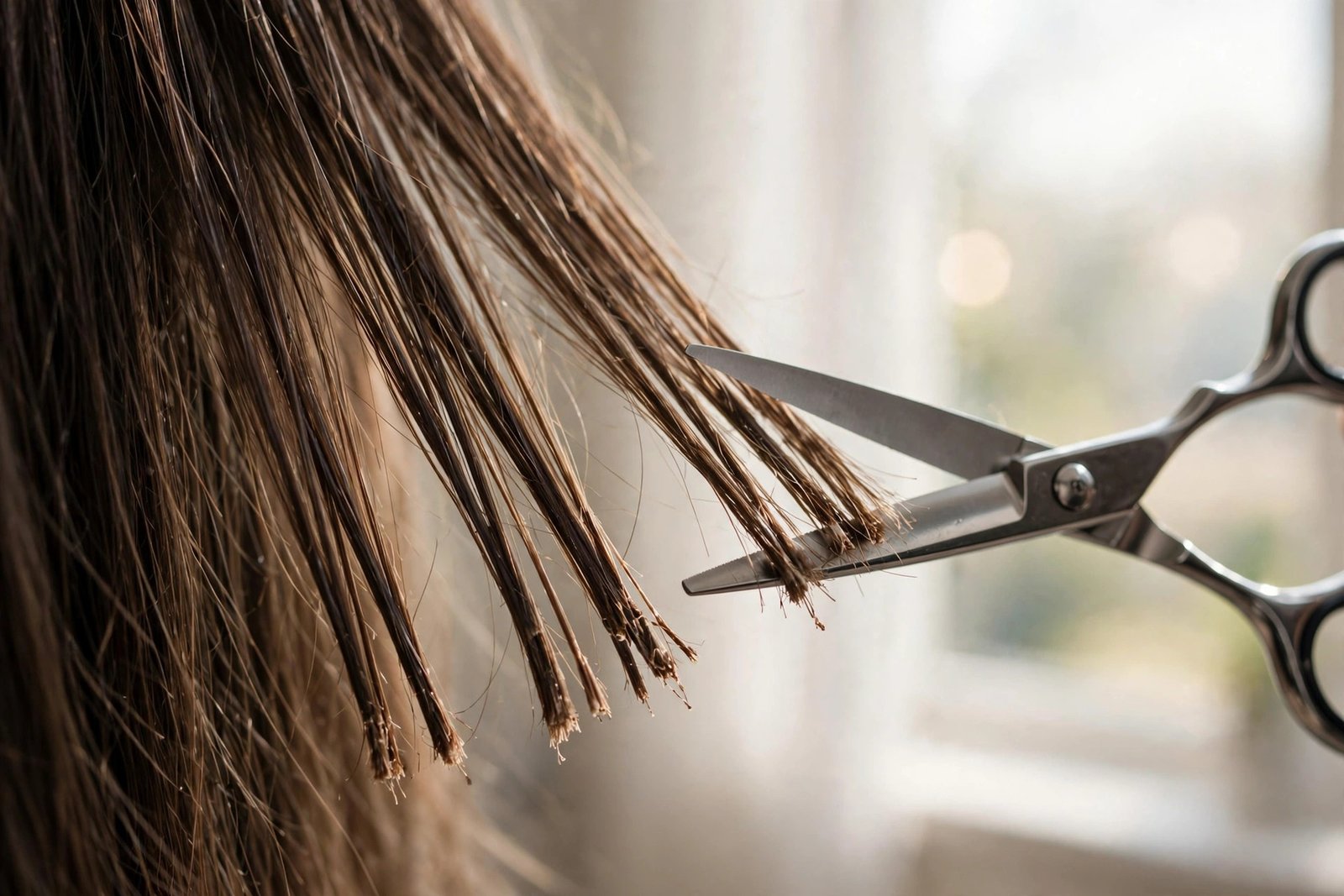
Split ends are the frayed tips that make even freshly washed hair look tired. They are, strictly speaking, irreversible: once the shaft splits, no product fuses it back together, whatever marketing claims. The only true cure is cutting them off — and you can do that safely at home, if you know what you are doing and when to stop.
This guide covers how to identify split ends, the right way to trim them yourself (including the popular “dusting” and “search and destroy” methods), the tools that matter, and the clear line between a safe at-home trim and a job for your stylist.
What Split Ends Actually Are
Each hair strand is protected by overlapping cuticle scales, like shingles on a roof. Heat styling, chemical processing, rough brushing, friction from cotton pillowcases, and even UV exposure wear those shingles down. Once the protective cuticle is compromised at the tip — the oldest, most weathered part of the strand — the inner cortex frays apart. The split then travels upward if left alone, which is why ignoring split ends eventually forces a bigger haircut than a timely trim would have.
Not all damage looks identical. The classic split is a Y-shape at the tip, but there are also tree splits (multiple branches along the shaft), feather splits (several splits stacked), and white dots — tiny pale nodules where the shaft is about to break. White dots are the early warning system: they signal structural weakness before a full split forms. The American Academy of Dermatology’s guidance on preventing hair damage emphasizes that gentle handling matters as much as products — most splits are mechanical damage, not mysterious bad luck.
Can You Fix Split Ends Without Cutting?
Honestly: no. “Split end repair” serums and creams work by temporarily gluing the frayed fibers together with silicones and polymers — the hair looks smoother until the next wash, but the structural damage remains. These products are useful camouflage between trims, not cures. The only permanent fix is removing the damaged portion above the highest point of the split.
This matters because it reframes the goal of at-home trimming. You are not performing a haircut; you are performing maintenance — removing damaged ends to stop splits from traveling. That distinction keeps expectations (and scissors) in check.
The Tools: Non-Negotiable
Before touching your hair, assemble the right equipment. This is the step people skip, and it is responsible for most at-home disasters:
- Hair-cutting shears, not household scissors. This is the single most important rule. Kitchen or craft scissors have thick, dull-ish blades that crush and fray the hair shaft as they cut — literally creating new split ends while removing old ones. Decent hair shears cost $15–$30 and are the cheapest insurance in this entire process.
- A fine-tooth comb for sectioning and smoothing.
- Clips to hold sections out of the way.
- Good lighting and a mirror setup that lets you see the back of your head (a handheld mirror plus a wall mirror).
Work on clean, fully dry, straightened-or-straight hair if possible — curls and waves hide length discrepancies, and wet hair stretches, causing you to cut more than intended. If your hair is very curly, trim in its natural dry state, curl by curl, to respect the shrinkage pattern.
Method 1: Dusting (the Safest At-Home Trim)
Dusting removes a whisper of length — literally an eighth of an inch or less — from the very tips all around. It is maintenance, not restyling, and it is the method stylists most readily endorse for at-home use:
- Part your hair down the middle and divide it into four sections (two front, two back), clipping three away.
- Take a one-inch subsection, comb it smooth, and hold it taut between your fingers.
- Slide your fingers down to the last half-inch of the strand.
- Snip straight across just the very tips — you should see only a faint dusting of hair fall. If you are seeing real lengths drop, you are cutting too much.
- Work through all sections, keeping the amounts consistent.
Dusting every 8–12 weeks keeps ends fresh between salon visits and is nearly impossible to mess up, because the amounts involved are too small to change your haircut’s shape. It pairs well with an overall healthy-hair routine — including drinking enough water daily, since chronic dehydration shows up in hair as brittleness, and protecting your rest with a consistent bedtime routine (silk or satin pillowcases reduce the overnight friction that frays ends).
Method 2: Search and Destroy (for the Meticulous)
“Search and destroy” is exactly what it sounds like: working through small sections of hair, visually identifying individual split ends, and snipping each one just above the split. It is tedious — a full head can take 30–60 minutes — but it removes damage with zero length loss, which makes it beloved by people growing their hair long.
- Work in bright, natural light; splits are nearly invisible in dim bathrooms.
- Twist small sections gently — splits and white dots pop out, making them easier to spot.
- Cut at least a quarter-inch above the visible split; cutting at the fork leaves weakened shaft that re-splits immediately.
- Set a timer if needed — perfectionism is how search-and-destroy sessions turn into accidental haircuts.
When to Stop and Book a Stylist
At-home trimming has firm boundaries. Book a professional if:
- Splits extend more than two inches up the shaft (dusting cannot reach them; you need reshaping).
- You want to change the shape, add layers, or cut bangs — maintenance trims preserve a cut; they do not create one.
- Your hair is severely damaged from bleach or chemical processing — it needs professional assessment, possibly including bond-building treatments.
- You have already had one at-home mishap. Two wrongs do not make a right; a stylist can fix asymmetry far more easily the sooner you go in.
A useful rule of thumb from professional stylists: if the job requires you to cut hair you cannot comfortably see and hold taut, it is not an at-home job. The back of your head counts.
Preventing the Next Round of Splits
Trimming treats the symptom; prevention addresses the cause:
- Heat discipline: always use a heat protectant, keep flat irons under 400°F (lower for fine hair), and give hair heat-free days. Thermal damage is the number one cause of splits in otherwise healthy hair.
- Gentle detangling: wide-tooth comb on wet hair, working from ends upward — never ripping top-down through tangles.
- Reduce friction: silk or satin pillowcases, loose braids or buns for sleep, and avoiding aggressive towel-drying (squeeze with a microfiber towel instead).
- Chemical spacing: do not bleach, perm, and relax in overlapping windows; each process compounds cuticle damage.
- Regular maintenance: a professional trim every 10–12 weeks (6–8 for short styles) catches damage before it travels. Beauty chemists at Paula’s Choice research library and trichologists alike converge on the same point: consistent small trims beat infrequent big chops for retaining length.
Frequently Asked Questions
How often should I trim split ends at home?
Light dusting every 8–12 weeks is plenty for most hair types. Search-and-destroy sessions can be done monthly if you enjoy the process. If you need trims more often than every 6 weeks, the real issue is damage prevention — address heat styling and handling first.
Can I use regular scissors in an emergency?
One snip will not ruin your hair, but regular scissors crush the shaft and create micro-frays that become new splits. If you trim at home more than once, proper shears are worth the small investment — they are the difference between maintenance and slow damage.
Do split-end repair products actually work?
They cosmetically smooth splits until the next wash by filling the fray with silicones — useful for making hair look better between trims, useless as a cure. No product re-fuses a split shaft; only cutting removes it.
Should I cut my hair wet or dry at home?
Dry, for at-home trims. Wet hair stretches up to 30% longer, so cuts made on wet hair end up shorter than intended once dry. Professionals sometimes cut wet because they account for this; at home, eliminate the variable.
Will trimming make my hair grow faster?
Trimming does not affect the follicle, so it does not speed growth. But removing splits stops breakage — and hair that is not breaking retains length, which looks and measures like faster growth. The effect is real even though the mechanism is often misstated.
The Bottom Line
Trimming split ends at home is safe, sensible maintenance — provided you use real shears, cut dry hair, remove only the damaged tips, and respect the line between dusting and actual haircutting. Done right, it is the cheapest, most effective thing you can do for your hair’s appearance: no product delivers the clean, light-reflecting finish of genuinely healthy ends. Done wrong — dull scissors, wet hair, ambitious restyling — it is an expensive lesson. When in doubt, dust lightly and let your stylist handle the rest.