
How Do I Build a Bedtime Routine for Better Sleep?
How do I build a bedtime routine for better sleep? If you lie in bed staring at the ceiling while your brain replays the day, the problem probably isn’t you — it’s the hour before bed. Sleep doesn’t have an on-switch, but it does have a runway. A good routine gives your brain and body consistent signals that it’s time to power down. I’ve fixed my own chronic tossing-and-turning with the routine below, and none of it requires supplements, gadgets, or perfect discipline.
Why Routines Work (The Science in 30 Seconds)
Your brain runs on cues. The same way your stomach growls at your usual lunchtime, your brain can learn to release melatonin and wind down in response to a consistent pre-sleep sequence. Sleep researchers call this stimulus control: bed = sleep, and the routine = the on-ramp. People with consistent bedtime routines fall asleep faster and report better sleep quality — not because of any single step, but because of the consistency itself.
Step 1: Set a Fixed Wake Time (Yes, Before Bedtime)
Counterintuitive, but the anchor of good sleep is when you get up, not when you go to bed. A fixed wake time — within 30 minutes, even on weekends — stabilizes your circadian rhythm, which then makes you naturally sleepy at the right bedtime. Sleeping in on weekends feels great and creates “social jet lag” that ruins Monday. Pick your wake time first; bedtime is just wake time minus 7.5–8.5 hours.
How to Build a Bedtime Routine for Better Sleep: The 60-Minute Wind-Down
Start 60 minutes before your target bedtime. The sequence:
- T-60: Screens off (or at least dimmed). This is the big one. If cold turkey feels impossible, start by spending less time on your phone before bed — even 30 phone-free minutes helps.
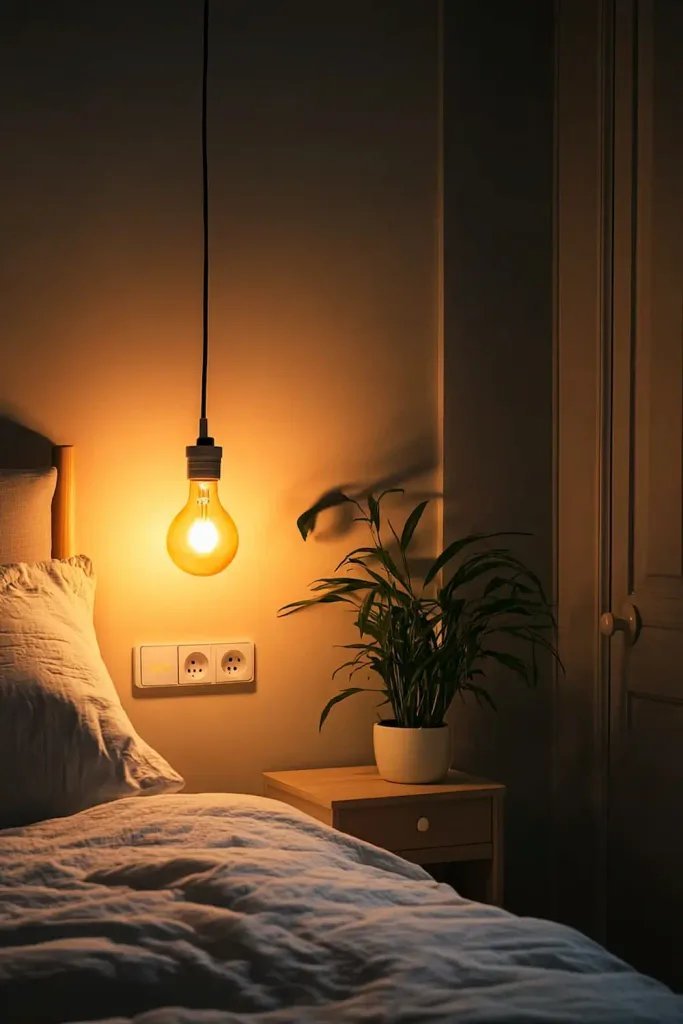
- T-45: Dim the lights. Bright overhead light suppresses melatonin. Switch to lamps or candles. Your bedroom should start feeling like evening, not an office.
- T-30: The body routine. Warm shower or bath (the subsequent drop in body temperature promotes drowsiness), brush teeth, skincare — the same order nightly so it becomes automatic.
- T-15: The mind routine. This is your choice: read a physical book, journal for five minutes, gentle stretching, meditation, or simply lying in bed doing slow breathing. Pick one calming activity and protect it.
- T-0: Bed is for sleep. Cool room (65–68°F is the research-backed sweet spot), dark, quiet. If you’re not asleep in 20 minutes, get up and do something boring in dim light until sleepy — don’t train your brain that bed is for worrying.
Optimize the Bedroom
- Dark: blackout curtains or a sleep mask. Even small light sources disrupt sleep quality.
- Cool: your core temperature needs to drop to initiate sleep. A cool room plus warm extremities (socks!) is the ideal combo.
- Quiet: earplugs, white noise machine, or a fan. Consistent background noise beats intermittent silence.
- Comfortable: a mattress and pillow that don’t cause pain. This is worth spending on — you use them 2,500+ hours a year.
- Phone-free: charge it outside the room. The alarm clock excuse died years ago.
Daytime Habits That Decide Your Night
Your bedtime routine starts at sunrise, honestly:
- Morning light. 10–15 minutes of daylight within an hour of waking sets your circadian clock. It’s the most underrated sleep habit there is.
- Caffeine curfew. Nothing with caffeine after noon (it has a 5–6 hour half-life; that 3 PM coffee is still 25% active at midnight).
- Exercise — but not late. Regular exercise improves sleep dramatically; intense workouts within 2–3 hours of bed can delay it.
- Limit naps. If you nap, keep it to 20 minutes before 3 PM.
- Watch the alcohol. It helps you fall asleep and then wrecks your second half of sleep. Net loss.
Pairing good days with good nights is the full system — our guide on starting a morning routine that sticks covers the other end of the cycle.
When to See a Doctor
If you’ve done all of this consistently for 3–4 weeks and still can’t sleep — or if you snore loudly, gasp awake, or feel exhausted despite full nights — talk to your doctor. Sleep apnea, restless leg syndrome, and chronic insomnia are medical issues, not willpower issues, and they’re highly treatable.
How Do I Build a Bedtime Routine for Better Sleep When My Partner’s Schedule Differs?
One of the most common sleep complaints isn’t about the routine — it’s about the person in the other half of the bed. Different bedtimes, different wake times, one snoring, one scrolling: mismatched sleep schedules are a top source of couple friction. But you don’t need identical schedules to both sleep well. You need a system that respects both.
First, decouple your wind-downs. You don’t have to do the routine together — you each need your own version timed to your own bedtime. The early sleeper starts their wind-down at 9:30; the night owl starts theirs at 11:30. Trying to synchronize incompatible chronotypes breeds resentment, not rest. Parallel routines, different times, same bedroom (with adjustments).
Manage the light and noise conflict. The night owl’s reading lamp is the early bird’s sleep destroyer. Solutions: the later sleeper uses a dim book light or reads in another room until sleepy; the earlier sleeper uses an eye mask and earplugs as standard equipment. A white noise machine benefits both — it masks the partner’s movements and the house’s sounds. These aren’t compromises; they’re just good sleep hygiene that happens to solve the couple problem.
Protect the shared bedtime window, even if it’s short. If one of you sleeps 10–6 and the other 12–8, there’s still overlap. Spend 15–20 minutes together in bed before the early sleeper drifts off — talk, read side by side, connect. Then the night owl gets up quietly (phone on silent, clothes laid out outside the bedroom) and returns later without the hallway light show. The relationship gets its wind-down; the sleep gets its protection.
Address snoring like the medical issue it can be. Occasional snoring: earplugs, white noise, the tennis-ball trick. Chronic loud snoring: that’s worth a doctor visit — it can indicate sleep apnea, which is treatable and serious. “Just deal with it” isn’t a plan; it’s a slow-burn resentment generator. And if schedules are truly incompatible, consider the Scandinavian sleep method (separate duvets) or even separate bedrooms a few nights a week. Couples who sleep apart by choice often report better sleep and better relationships — the stigma is outdated.
The principle: your sleep needs are individual, even in a shared bed. Design for both people’s biology, communicate about what works, and treat sleep as the non-negotiable health foundation it is. A couple that sleeps well is a couple that likes each other more. That’s not a metaphor — it’s sleep science.
The Bottom Line
Building a bedtime routine for better sleep means: fixed wake time, a 60-minute wind-down with dimming lights and no screens, a cool dark quiet room, and daytime habits that support the night. Start with any two changes tonight. Sleep is a skill, and like any skill, it responds to consistent practice — not perfection.
For evidence-based guidance, the Sleep Foundation’s sleep hygiene guide is the gold standard, and Wikipedia’s sleep hygiene overview summarizes the research compactly.