
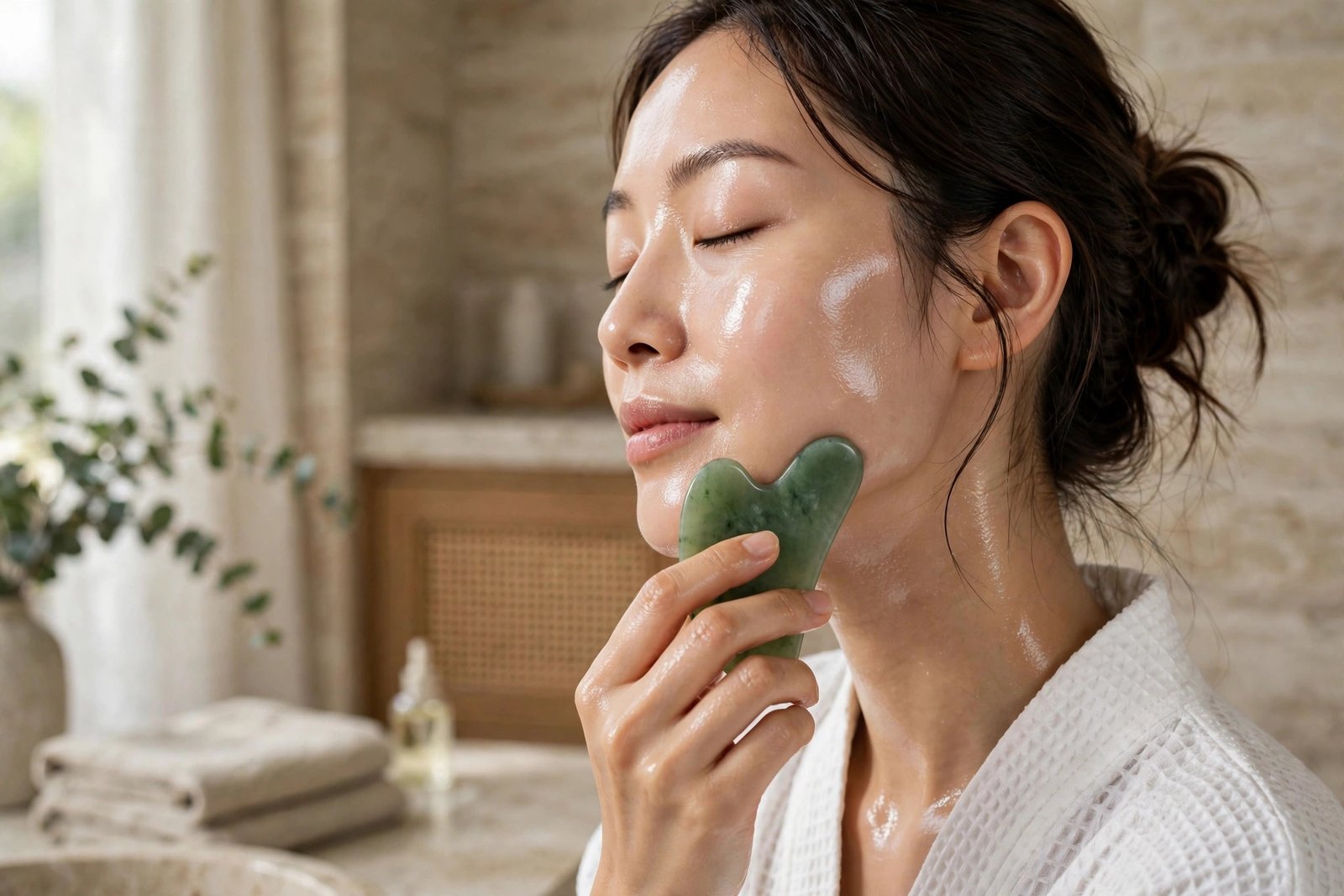
Gua sha has gone from a 2,000-year-old Chinese medicine practice to a staple of #SkinTok routines, with jade and rose quartz tools selling in the millions. Devotees credit it with sculpted cheekbones, drained puffiness, eased jaw tension, and a post-facial glow — all from stroking a shaped stone across the face for five minutes a day. Skeptics call it an expensive placebo with good lighting.
As with most viral wellness practices, the reality is more interesting than either extreme. Gua sha does have measurable physiological effects — just not all the ones claimed for it. Here is what the practice is, what research actually shows, how to do it without hurting yourself, and where the marketing outruns the evidence.
What Gua Sha Is (and Is Not)
Gua sha (pronounced “gwa sha”) translates roughly to “scraping sand” — in traditional Chinese medicine, practitioners scrape the skin with a smooth-edged tool to produce petechiae (tiny red spots called “sha”), believed to release stagnant energy and blood. The facial version popular today is a far gentler descendant: light stroking of the face and neck with a shaped stone, typically jade or rose quartz, usually over facial oil to prevent dragging.
Two things worth stating plainly. First, modern facial gua sha should never produce the bruising of traditional body gua sha — if you are getting red marks or broken capillaries on your face, your pressure is far too high. Second, the tool’s material is largely irrelevant to results. Jade, rose quartz, stainless steel, and even a chilled spoon all work through the same mechanism: a smooth, cool edge moving across skin. Claims about crystal “energies” are marketing, not physiology.
What the Research Actually Shows
Let us grade the claims honestly:
- Reducing puffiness — plausible, supported by mechanism. The lymphatic system, which drains excess fluid from tissues, sits just beneath the skin and responds to gentle mechanical pressure. Light stroking toward the lymph nodes plausibly accelerates fluid drainage — the same principle behind manual lymphatic drainage massage used in clinical settings. A 2023 review in dermatology literature found the mechanical rationale sound, though large facial-specific trials are still lacking.
- Relieving jaw and facial tension — genuinely supported. This is gua sha’s strongest claim. Massaging the masseter (jaw) muscles reduces clenching-related tension and pain — relevant for the huge number of people who grind their teeth. The evidence here overlaps with general massage research, which is solid.
- “Sculpting” cheekbones and jawlines — exaggerated. Gua sha cannot change bone structure or remove fat. What it can do is temporarily reduce fluid retention, which makes facial contours look more defined for a few hours. The before-and-after photos are real but temporary — the effect fades as fluid redistributes.
- Boosting circulation and glow — short-term, real. The stroking increases superficial blood flow, producing the immediate post-gua-sha flush. It is transient, like the glow after exercise.
- Anti-aging and wrinkle reduction — weak evidence. No quality research shows gua sha meaningfully reduces wrinkles long-term. Any smoothing effect is temporary fluid and circulation change, not structural remodeling.
- Traditional body gua sha for pain — modest clinical evidence. A well-known 2011 German randomized trial found a single gua sha treatment significantly reduced chronic neck pain versus a heat pack. But that is the vigorous, bruising body technique — not the gentle facial version.
The Cleveland Clinic’s dermatologists take a measured view, noting in their gua sha overview that while dramatic claims are overblown, the practice is low-risk and the massage benefits (tension relief, relaxation) are real. The National Library of Medicine hosts peer-reviewed gua sha research for readers who want to evaluate the primary studies themselves.
How to Do It Correctly (Technique Matters More Than the Tool)
Bad technique is why some people see no results or, worse, irritate their skin. The professional method:
- Always use slip. Apply facial oil or a rich serum first. Dry scraping drags the skin, causing micro-irritation and broken capillaries. This step is non-negotiable.
- Feather-light pressure. The tool’s weight plus a whisper of pressure is enough — think of the pressure you would use to spread butter on soft bread, not scrape a windshield. Your skin should never redden beyond a mild flush.
- Hold the tool nearly flat. A 15-degree angle to the skin (almost flat, not perpendicular) distributes pressure evenly. Digging with the edge causes the dragging injuries people blame on the practice.
- Stroke outward and downward toward lymph nodes. The standard sequence: neck (downward strokes toward the collarbone), jawline (chin to ear), cheeks (nose to ear), under-eyes (inner to outer corner, extremely light), brow (upward), forehead (center outward). Each stroke 3–5 times. The direction matters — you are encouraging fluid toward drainage points, not randomly pushing it around.
- Anchor the skin. Use your free hand to hold skin taut behind the stroke. This prevents pulling and is especially important around the eyes and mouth.
- Five to ten minutes is plenty. More is not better; overworking the face causes irritation. Most practitioners suggest 3–5 sessions per week rather than daily marathons.
Who Should Skip It (or Be Careful)
- Active breakouts, rosacea flares, or eczema: stroking over inflamed skin worsens inflammation. Wait for calm skin.
- Recent injectables: avoid gua sha for at least two weeks after Botox or fillers — pressure can displace product. Ask your injector for their specific guidance.
- Blood thinners or clotting disorders: even gentle pressure carries more bruising risk; consult your doctor.
- Broken skin, sunburn, or post-procedure skin: any compromised barrier means hands (and tools) off until healed. If you are recovering from sun damage, focus first on soothing care — see our guide to treating sunburn at home.
Fitting It Into a Real Routine
Gua sha works best as a small ritual inside an already-sound routine, not as a substitute for one. It pairs naturally with your evening skincare — do it after applying facial oil, before heavier moisturizer — and many users find the slow, deliberate strokes genuinely relaxing, a kind of moving meditation. If stress shows up on your face (clenched jaw, tension headaches, shallow breathing), the relaxation benefit alone may justify the five minutes — similar to how people use dedicated stress-reduction habits during the workday. Some practitioners combine it with their wind-down, alongside a calming bedtime routine, since the parasympathetic activation from slow facial massage genuinely aids the transition to sleep.
Keep the tool clean — wash with soap and water after each use, since oil residue breeds bacteria — and replace it if it chips. A chipped edge on a stone tool will scratch skin.
Frequently Asked Questions
Does gua sha actually slim your face?
Temporarily. It reduces fluid retention, which can make the face look more defined for several hours. It does not remove fat, change bone structure, or produce permanent slimming. Anyone promising lasting facial slimming from a stone tool is misrepresenting the mechanism.
How long until I see results from gua sha?
De-puffing effects are visible immediately after a session (and fade within hours). Tension relief in the jaw builds over 1–2 weeks of consistent use. There is no cumulative “transformation” timeline because the effects are maintenance, not remodeling.
Is jade better than rose quartz for gua sha?
No meaningful difference. Both are smooth, cool stones; the technique and consistency matter, while the material is aesthetic preference. Stainless steel tools stay cooler longer and are non-porous (easier to sanitize), which some dermatologists prefer.
Can gua sha cause wrinkles from pulling the skin?
With proper technique — adequate slip, light pressure, anchored skin — no. With aggressive dry scraping, yes, repeated dragging can irritate and potentially contribute to laxity over time. Technique is everything; the tool is innocent.
Should I do gua sha in the morning or at night?
Morning sessions target overnight puffiness (fluid pools while you sleep); evening sessions double as tension relief and wind-down ritual. Either works — choose based on which benefit you want most, or do a quick morning pass and a longer evening session.
The Bottom Line
Gua sha is neither miracle nor myth. It is a pleasant, low-risk facial massage technique with real short-term benefits — less puffiness for a few hours, genuine jaw-tension relief, improved circulation glow — and heavily exaggerated long-term claims. The sculpted-cheekbone photos are fluid dynamics, not transformation; the relaxation is real. If you enjoy the ritual and do it correctly, it earns its five minutes. If you are buying it expecting a non-surgical facelift, save your money. As with most of skincare, the unglamorous fundamentals — sunscreen, retinoids, sleep — will always matter more than the tool.