
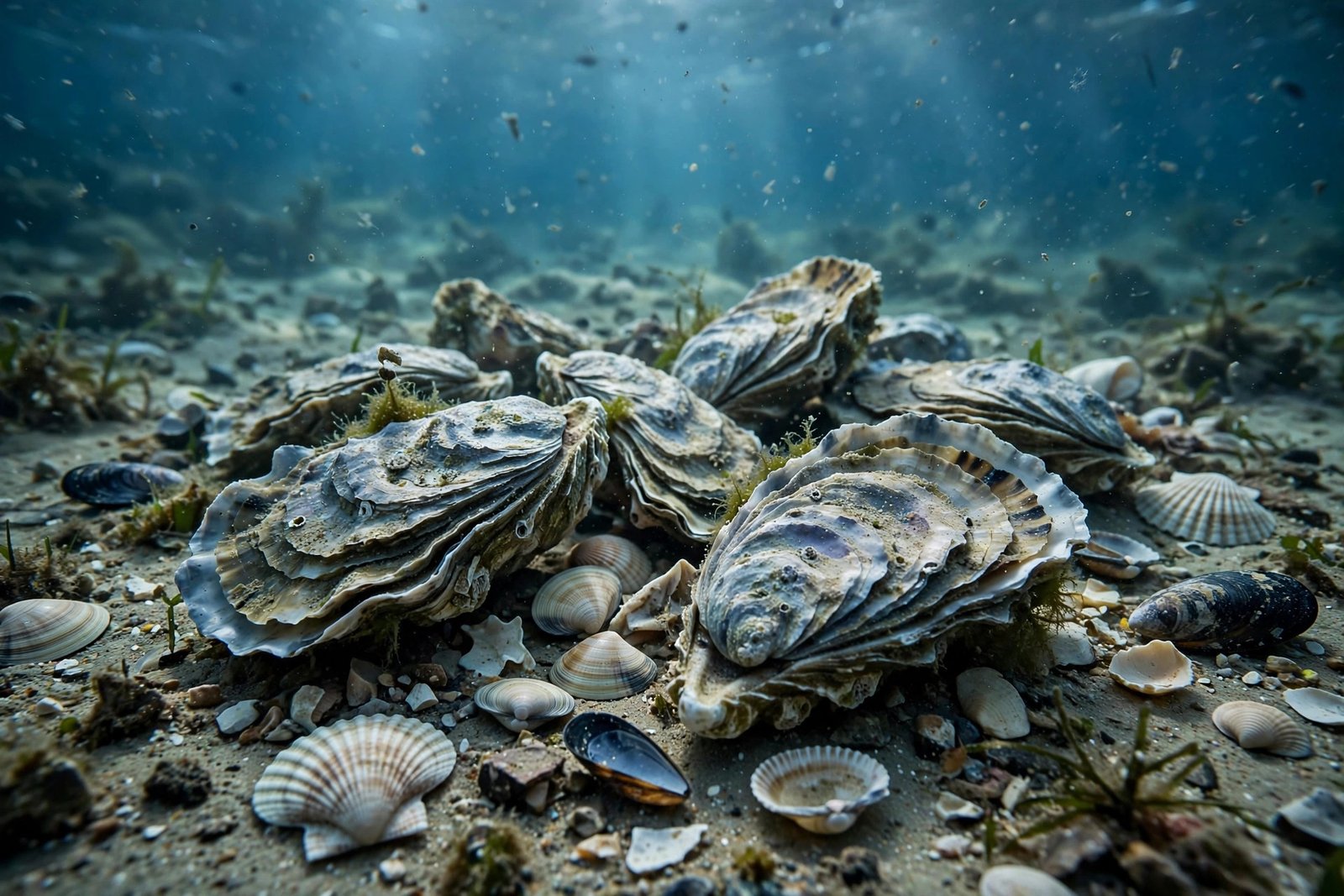
Between 2007 and 2009, oyster hatcheries along the U.S. Pacific Northwest suffered catastrophic die-offs. Billions of larval oysters — the seed of a $100-million-plus industry — dissolved in their tanks before growers understood why. The culprit was not disease or pollution in the conventional sense. It was the ocean itself, turning corrosive: seawater made more acidic by absorbed carbon dioxide was literally dissolving baby oysters’ shells faster than they could build them.
How does ocean acidification harm shellfish? The chemistry is straightforward and the consequences are already economic, not theoretical. Here is the mechanism dissolving shells from the inside out, the species at risk, the industry fighting back — and what it portends for the wider ocean.
The Chemistry: CO2 Becomes Acid
The ocean has absorbed roughly a quarter to a third of humanity’s carbon dioxide emissions — a planetary favor that slowed atmospheric warming while quietly altering seawater chemistry. When CO2 dissolves, it forms carbonic acid, which releases hydrogen ions, lowering pH. Surface ocean pH has already dropped by about 0.1 units since the Industrial Revolution — which sounds trivial until you remember pH is logarithmic: that is roughly a 30 percent increase in acidity.
The critical consequence for shellfish is not the pH number itself but what it does to carbonate ions. Shell-building animals construct their armor from calcium carbonate — in the form of aragonite or calcite — by combining calcium with carbonate ions from seawater. Extra hydrogen ions bind up carbonate ions, leaving fewer available for shell construction. NOAA’s ocean acidification research programs track this through aragonite saturation levels: when saturation drops too low, shells do not just grow slowly — they actively dissolve.
Why Larvae Are the Canary
Adult oysters and clams can often cope with moderately acidified water, at least for a time. Their larvae cannot. In the first days of life, a larval oyster must rapidly build its initial shell — the prodissoconch — from aragonite, the more soluble crystal form. Under corrosive conditions, the larvae expend enormous energy fighting dissolution, grow misshapen shells, or simply die. This is exactly what devastated Pacific Northwest hatcheries: intake water drawn from deep, naturally CO2-rich upwelled water — made worse by human-added CO2 — arrived during the precise window when larvae were most vulnerable.
The hatchery crisis became the textbook case because it was measurable in dollars and dead larvae. But wild populations face the same chemistry with no engineers adjusting their water. Mussels, clams, scallops, abalone, and sea urchins all build carbonate structures; pteropods — tiny swimming snails that form the base of many polar food webs — grow shells so delicate that researchers have documented pitting and dissolution in live-caught specimens from acidifying waters.
The Ripple Through Food Webs and Economies
Shellfish are ecosystem engineers. Oyster reefs filter water, stabilize shorelines, and shelter juvenile fish and crabs; their decline degrades entire coastal habitats. Economically, U.S. shellfish aquaculture is a multi-hundred-million-dollar industry supporting thousands of coastal jobs — jobs that depend on chemistry invisible to the naked eye.
The food-web risk extends beyond shellfish. Pteropods feed salmon, herring, and mackerel; krill and copepods show sensitivity too. Acidification does not act alone — it combines with warming, oxygen loss, and pollution in compounding stress. A crab larva fighting shell dissolution while its habitat warms and oxygen thins faces a stacked deck. For coastal communities whose tables and livelihoods depend on the sea, understanding these compounding pressures matters as much as knowing whether local water is safe — it is about whether the harvest itself survives.
How the Industry Is Adapting
Pacific Northwest hatcheries did not surrender — they engineered around the chemistry. Growers now monitor intake water chemistry in real time, timing larval production to avoid corrosive upwelling pulses. Some buffer hatchery water with sodium carbonate, chemically countering the acidity during the vulnerable larval window. Selective breeding programs are developing oyster strains more tolerant of low-saturation conditions.
These adaptations buy time, not victory. Buffering works in a tank; it cannot be scaled to an ocean. And tolerance has limits — breeding tougher oysters helps at the margins but cannot outrun chemistry indefinitely. The industry’s experience is best read as an early-warning system: what hatcheries needed engineers to survive, wild ecosystems must face unassisted.
Can Anything Reverse It?
Locally, yes, partially. Reducing nutrient runoff — which fuels algal blooms whose decay adds more CO2 to coastal waters — can ease acidification in estuaries. Restoring seagrass beds and kelp forests helps: photosynthesis draws down CO2 during daylight, creating local refuges of less-corrosive water. But the dominant driver is global atmospheric CO2, and only emissions reductions change the ocean’s long-term trajectory. The chemistry is unforgiving arithmetic: as long as the atmosphere keeps loading CO2, the ocean keeps absorbing it, and saturation states keep falling.
Monitoring an Invisible Threat
You cannot see acidification, which is why monitoring networks matter. NOAA’s Ocean Acidification Program maintains moorings and sensors along U.S. coasts that track pH, carbonate chemistry, and saturation states in real time — data that hatcheries now check like farmers check weather forecasts. The Global Ocean Acidification Observing Network coordinates hundreds of monitoring sites worldwide, building the baseline against which change is measured.
This monitoring has already changed practices. West Coast hatcheries that once lost entire larval cohorts now schedule production around upwelling forecasts and real-time chemistry readings, treating corrosive water events the way coastal towns treat storm warnings. For consumers, the takeaway is awareness: choosing sustainably farmed shellfish from operations that carefully monitor and adapt supports the growers investing in resilience. And for policymakers, the monitoring record provides the hard numbers that make acidification impossible to dismiss as theoretical — the chemistry is measured, logged, and worsening on a clear trend line.
Conclusion
Ocean acidification harms shellfish by depleting the carbonate ions they need to build shells, hitting larvae hardest during their first fragile days of shell formation. The Pacific Northwest oyster die-offs proved the damage is economic and current, not theoretical and future. Hatcheries can engineer around it temporarily; wild ecosystems cannot. The dissolving shells are a message written in chemistry — and it reads the same everywhere: cut carbon, or watch the ocean’s architects crumble.
Further reading: For more on this topic, see do you need a passport for a Bahamas cruise and Smithsonian Ocean Portal’s acidification explainers.
Frequently Asked Questions
What is ocean acidification in simple terms?
The ocean absorbs about a quarter of human CO2 emissions, forming carbonic acid that lowers seawater pH. Surface ocean acidity has increased roughly 30 percent since the Industrial Revolution, reducing the carbonate ions shellfish need to build shells.
Why are baby oysters more vulnerable than adults?
Larvae must rapidly build their first shells from aragonite, the most soluble form of calcium carbonate, during a narrow developmental window. Under corrosive conditions they cannot build shell faster than it dissolves, leading to deformity or death.
Which shellfish are most at risk?
Oysters, clams, mussels, scallops, and abalone all show sensitivity, especially as larvae. Pteropods — tiny planktonic snails eaten by salmon and other fish — are among the most vulnerable because their shells are extremely thin.
Can we fix ocean acidification locally?
Partially. Reducing nutrient runoff, restoring seagrass and kelp beds, and buffering hatchery water all help locally. But the main driver is global CO2 emissions — lasting reversal requires cutting carbon at the source.