
How Do I Hang Shelves on Drywall Without Studs?
You found the perfect spot for shelves. You ran the stud finder over it. Nothing. Just hollow drywall and disappointment. If you’re asking how do I hang shelves on drywall without studs, here’s the reassuring truth: modern drywall anchors are remarkably strong, and for most shelf loads you don’t need a stud at all — you just need the right anchor for the weight.
Know Your Wall First
Before buying anything, confirm what you’re dealing with. Knock on the wall — drywall sounds hollow; plaster sounds solid and dull. Push a pin in an inconspicuous spot: drywall gives easily, plaster resists. This matters because plaster and drywall need different approaches — plaster is brittle and needs pre-drilling to avoid cracking, while drywall works beautifully with the anchors below.
Also confirm there’s no stud by checking 16 inches left and right of your spot (standard stud spacing) and using a decent stud finder. Sometimes the stud is just slightly off from where you want the shelf — and if you can shift the bracket even a few inches to hit one, do it. A stud-mounted shelf holds dramatically more than any anchor.
The Anchors, Ranked by Strength
When you hang shelves on drywall without studs, the anchor is everything. Here’s what actually works, from strongest to weakest:
- Toggle bolts (best for heavy shelves): 50–100+ lbs per anchor in 1/2″ drywall. The wings spring open behind the wall and distribute load across a wide area. The downside: they need a larger hole (1/2″+), so they’re not great if you might move the shelf later. For bookshelves and heavy loads, these are the answer.
- Self-drilling threaded anchors (best all-around): 25–75 lbs per anchor depending on size. They screw directly into drywall with no pre-drilling, grip tightly, and remove cleanly-ish. For most floating shelves and bracket shelves, these are my default recommendation.
- Molly bolts (sleeve anchors): 25–50 lbs per anchor. They expand behind the wall as you tighten. Reliable but fussier to install than self-drilling anchors.
- Plastic expansion anchors: 10–25 lbs per anchor. Fine for small decorative shelves with light items. Not for books. Not for anything you care about.
- Adhesive strips: skip these for shelves. They’re great for picture frames; they’re a disaster waiting to happen for anything with real weight.
The golden rule: use at least two anchors per bracket, and rate for double your expected load. Books are shockingly heavy — a 3-foot shelf of hardcovers can weigh 40–60 lbs.
Step-by-Step: Hanging a Bracket Shelf
1. Mark your line. Use a level to draw a light pencil line where the shelf will sit. Measure twice — patching drywall holes is annoying.
2. Mark bracket holes. Hold the bracket on the line and mark each screw hole. For a standard shelf, use brackets every 24–32 inches maximum — more brackets beat stronger anchors.
3. Install anchors. For self-drilling anchors, just drive them in with a drill or screwdriver until flush. For toggle bolts, drill the pilot hole, fold the wings, push through, and tighten. Don’t overtighten — you’ll crush the drywall and weaken the hold.
4. Mount brackets. Drive screws into the anchors. Check level again before fully tightening.
5. Set the shelf and load gradually. Place the shelf, check level one final time, then load it up. Give it a gentle stress test before trusting it with the good china.
How Do I Hang Shelves On Drywall Without Studs?
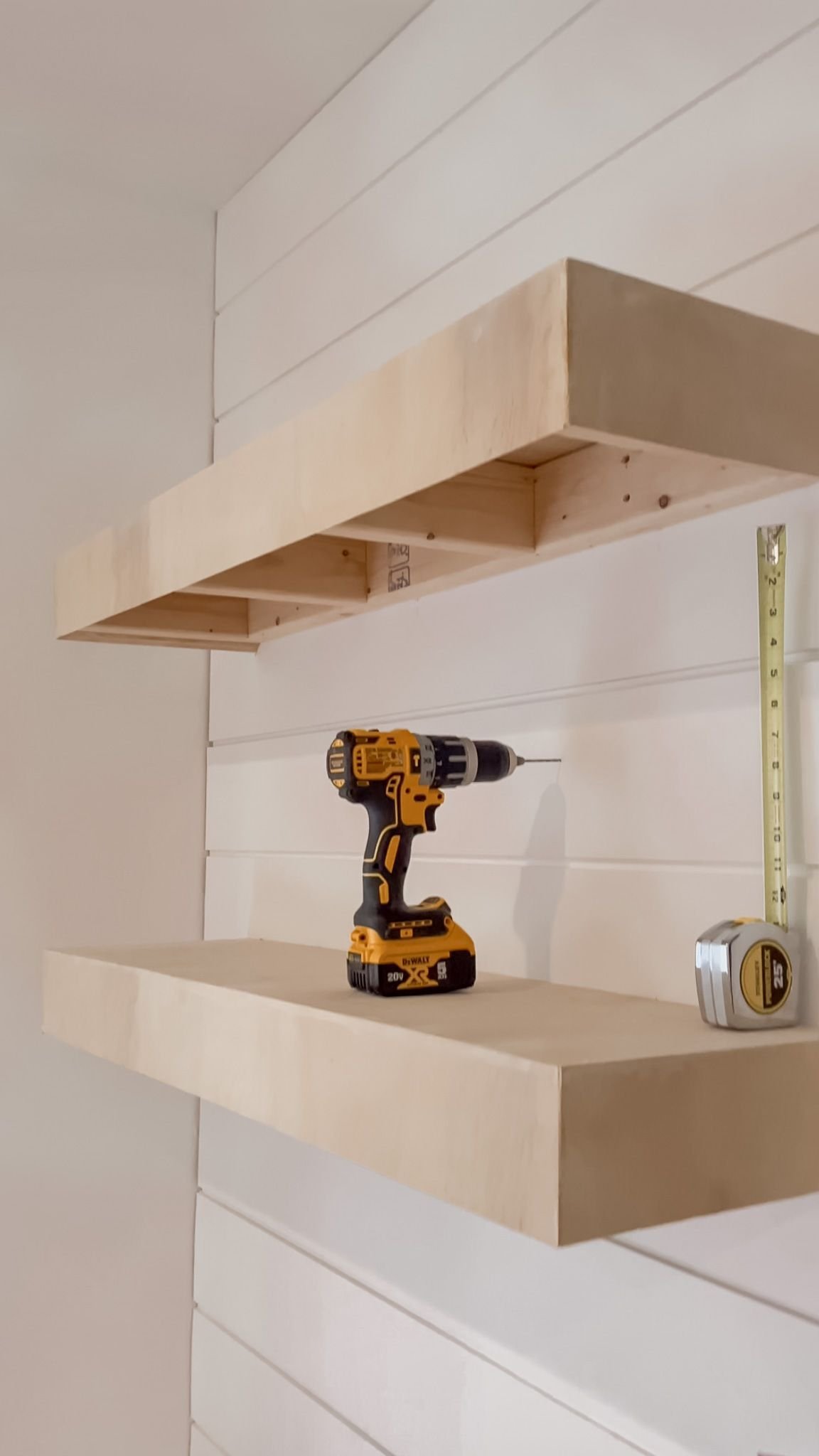
Floating shelves (no visible brackets) look fantastic but concentrate all the force on the mounting hardware — they’re actually harder on anchors than bracket shelves because of leverage. For floating shelves without studs:
- Use the heaviest-duty mounting system the shelf offers — many come with inadequate hardware; upgrade it.
- Toggle bolts are strongly preferred for floating shelves over ~20 lbs total load.
- Keep floating shelves shorter and lighter-loaded than bracket shelves. They’re for display, not for your encyclopedia collection.
- Consider a French cleat for heavier floating-style mounting — a beveled wood strip screwed to the wall (with multiple toggle bolts) that the shelf hangs on. Extremely strong, nearly invisible.
Common Mistakes That End in Disaster
- Using the anchors that came in the box. Shelf kit hardware is notoriously undersized. Buy quality anchors separately — it’s a $5 upgrade that prevents a $500 mess.
- Overloading. When in doubt, assume books weigh more than you think. They do.
- Anchors too close to the edge of the drywall or too close together — they need intact drywall around them to grip.
- Skipping the level. A shelf that’s off by even a little looks terrible and things slide. Check level at every step.
- Drilling into something unexpected. Use a stud finder with electrical detection, and never drill blindly near outlets or switches — wires run vertically from them.
The basics of drywall construction are worth a quick read if you’ve never worked with it — understanding what’s behind the wall makes every mounting decision smarter.
When You Really Should Find a Stud
Some loads demand studs, no exceptions: wall-mounted TVs (use a stud-mounted bracket), very heavy bookshelves, anything over ~100 lbs total, and shelves in earthquake-prone areas. If your shelf location truly has no stud options, consider repositioning the shelf rather than gambling. Drywall anchors are excellent — but they’re not magic.
Quick-Reference: Anchor Weight Limits
Bookmark this: toggle bolts hold 50–100+ lbs each in 1/2″ drywall — the choice for books and heavy loads. Self-drilling threaded anchors hold 25–75 lbs each — the everyday default. Molly bolts hold 25–50 lbs. Plastic expansion anchors hold 10–25 lbs — light decor only. Always use at least two anchors per bracket and mentally halve the rating for a safety margin. And remember: a 3-foot shelf of books can weigh 40–60 lbs, so “just a few books” usually means toggle bolts, not plastic anchors.
The Takeaway
How do you hang shelves on drywall without studs? Use toggle bolts for heavy loads or self-drilling threaded anchors for standard shelves, use more brackets than you think you need, rate everything for double the expected weight, and never trust the hardware that came in the box.
Done right, stud-free shelves are rock solid for years. Done wrong, they’re a YouTube fail video. Spend the extra five dollars on good anchors — it’s the cheapest insurance in home improvement. Mounting more things? Our drywall patching guide fixes the mistakes, and beginner home repair tools covers the toolkit.