
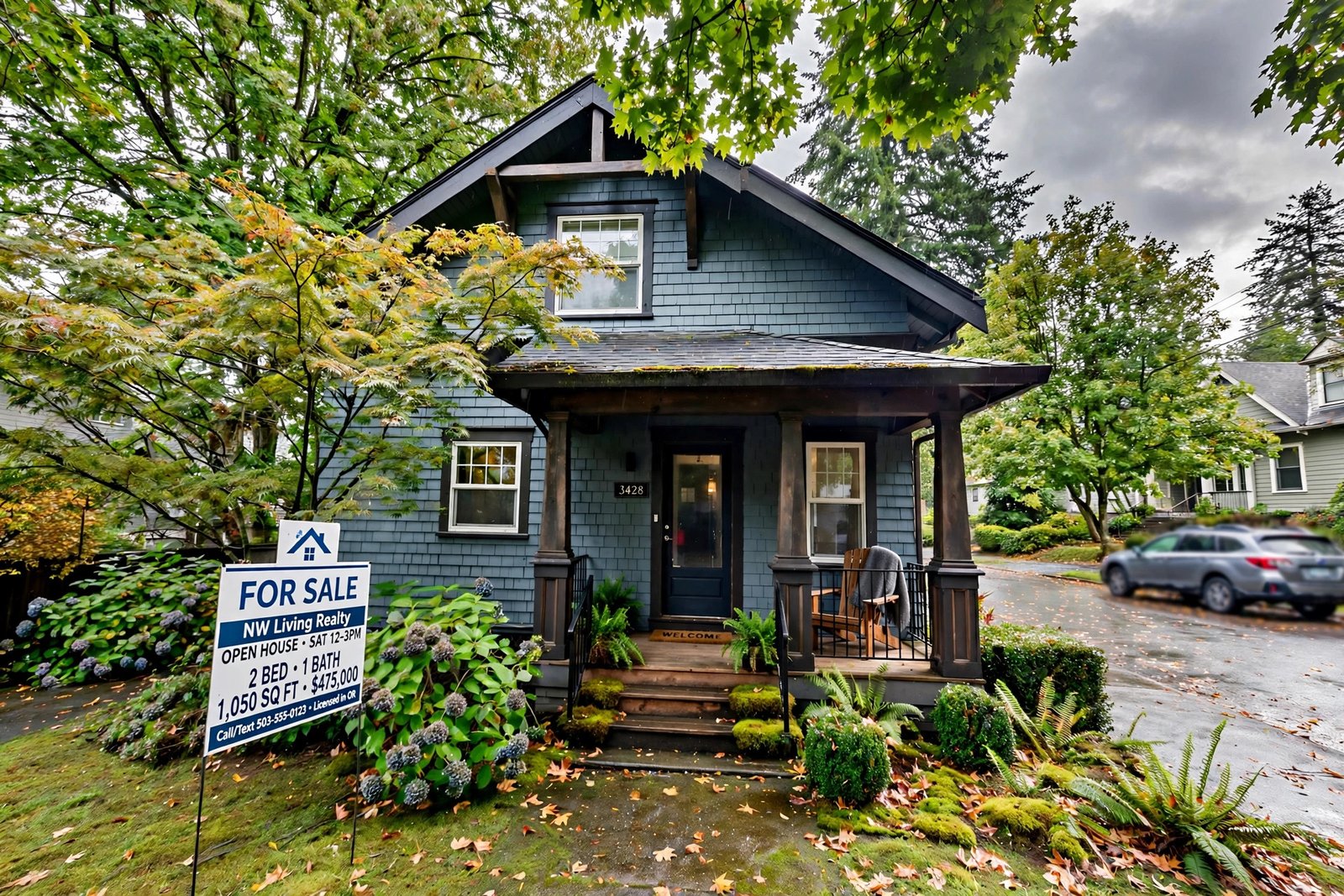
Portland’s starter homes occupy a strange middle ground in 2026: dramatically cheaper than Seattle or the Bay Area, yet far from the bargain they were a decade ago. If you’re a first-time buyer eyeing the Rose City, the question isn’t just “what does it cost” — it’s what your money actually buys, which neighborhoods still offer value, and whether the math works at today’s rates.
Here’s the full 2026 picture: current starter-home prices, the all-in monthly cost, the neighborhoods where first-timers are actually buying, and the programs that can get you in with less cash.
What a Starter Home Costs in Portland in 2026
Let’s define terms: a “starter home” in Portland typically means a 2–3 bedroom, 1–2 bath house or condo between 900 and 1,400 square feet — enough for a first-timer, a couple, or a small family, without the premium of fully renovated turnkey properties.
In 2026, that home runs roughly $475,000 to $575,000 in most Portland neighborhoods, with the metro-wide median for entry-level single-family homes hovering near $525,000. Condos and townhomes — the true entry point — start in the high $300,000s to mid-$400,000s. For context, that’s about 60% of Seattle’s starter-home cost and roughly half of the Bay Area’s, which is exactly why Portland keeps attracting priced-out coastal buyers.
Prices have stabilized after the 2022–2024 rollercoaster: modest 2–4% annual appreciation in 2025–2026, with well-priced starter homes still drawing multiple offers while overpriced listings sit. The market has bifurcated — move-in-ready homes under $550,000 sell fast; fixer-uppers and homes with “character” (read: problems) linger.
The Real Monthly Cost: Beyond the Listing Price
A $525,000 home with 10% down ($52,500) at a 6.5% rate means a loan of $472,500 and principal-and-interest of roughly $2,985 per month. Then add the rest: property taxes in the Portland metro run about 1%–1.2% of assessed value ($440–$525/month on this home), homeowner’s insurance $150–$250/month, and PMI around $180–$280/month until you hit 20% equity. All in, budget $3,800–$4,100 per month before utilities and maintenance.
That number shocks some first-timers, but compare it to renting: a comparable 2–3 bedroom rental in Portland runs $2,400–$3,000 in 2026. The ownership premium is real but narrowing, and unlike rent, the mortgage payment builds equity — especially valuable in a market with steady appreciation.
Use the CFPB’s mortgage resources to understand your loan options, and get pre-approved before touring — in Portland’s competitive starter segment, offers without pre-approval letters don’t get a second look.
The Down Payment Question: How Much Do You Really Need?
The old 20%-down rule is more myth than requirement in 2026. On a $525,000 Portland starter home, 20% means $105,000 in cash — a number that keeps many qualified buyers renting for years. The realistic paths: 10% down ($52,500) on a conventional loan with PMI you’ll drop at 20% equity, 5% down ($26,250) with slightly higher PMI, or 3.5% down ($18,375) via FHA.
Each step down in down payment costs you monthly — PMI on a 5%-down conventional loan runs roughly $250–$350/month — but it gets you building equity years sooner. In a market appreciating 2–4% annually, buying two years earlier with 5% down often beats waiting to save 20% while prices climb and rents eat your savings. Run both scenarios with your lender; the “right” answer depends on your savings rate, not a rule of thumb.
Where does the down payment come from? Beyond savings, first-timers commonly use gifts from family (allowed on conventional and FHA loans with a gift letter), Oregon’s down-payment assistance programs, and — increasingly — two-buyer partnerships with friends or siblings splitting costs. Each has trade-offs worth discussing with a lender before you start touring.
Where First-Time Buyers Are Actually Buying
East Portland: Cully, Powellhurst-Gilbert, Lents
The last genuinely affordable quadrant. Starter homes here run $425,000–$525,000, often with bigger lots than closer-in neighborhoods. Trade-offs: longer commutes, fewer walkable amenities, and flood-plain awareness in parts of Lents. For buyers prioritizing square footage per dollar, this is the value play.
Southeast: Montavilla, Brentwood-Darlington
The sweet spot for many first-timers — $500,000–$600,000 for charming older bungalows on quiet streets, with MAX light-rail access and a growing commercial scene on Glisan and Foster. Competition is stiffest here; expect to bid quickly on well-priced listings.
North Portland: St. Johns, Portsmouth
Still relatively affordable at $475,000–$575,000, with a small-town feel that surprises newcomers. The trade-off is distance from downtown job centers, though remote workers don’t care.
Condos and townhomes: the true entry point
If single-family prices stretch you thin, look at townhomes in Beaverton, Hillsboro, and Tigard ($380,000–$480,000) or condos in inner Southeast. Watch HOA fees closely — a $400/month HOA can erase the price advantage fast.
Programs That Lower the Bar
Oregon offers meaningful help for first-timers. Oregon Housing and Community Services (OHCS) runs down-payment assistance programs, and the federal HUD single-family programs back FHA loans requiring as little as 3.5% down. First-time buyer tax credits and mortgage credit certificates (MCCs) can effectively reduce your rate — worth asking your lender about specifically.
Employer-assisted housing is an underused lever in Portland’s market: major employers like Nike, Intel, and OHSU have offered down-payment help at various times. And don’t overlook the Federal Housing Finance Agency’s resources on conforming loan limits — Portland’s 2026 limit comfortably covers starter-home prices, keeping you in cheaper conventional-loan territory.
Making an Older Starter Home Work
Most Portland starter homes were built between 1920 and 1970, which means character — and projects. Budget 1–2% of the home’s value annually for maintenance, and get a thorough inspection: Portland’s wet winters punish bad roofs, aging foundations, and unsealed crawl spaces. Common first-year fixes include fixing squeaky floorboards in an old house and updating worn flooring — replacing carpet with laminate flooring is one of the highest-ROI updates for a starter home you’ll eventually resell.
The smart play: buy the worst house on a good block, fix the unsexy stuff first (roof, electrical, plumbing, drainage), and let sweat equity build the down payment for your next move-up home.
Conclusion
A Portland starter home in 2026 costs roughly $475,000–$575,000, translating to about $3,800–$4,100 per month all-in with 10% down. East and North Portland offer the best value, Southeast offers the best lifestyle-to-price ratio, and condos remain the lowest rung on the ladder. With stable prices, real assistance programs, and a meaningful discount to peer West Coast cities, Portland remains one of the more achievable homeownership markets in the region — provided you budget for the true monthly cost, not just the listing price.
Frequently Asked Questions
What is considered a starter home in Portland in 2026?
Typically a 2–3 bedroom, 1–2 bath home or condo between 900 and 1,400 square feet, priced roughly $475,000–$575,000 for single-family homes or high-$300,000s to mid-$400,000s for condos and townhomes.
How much income do I need to buy a $525,000 home in Portland?
With 10% down at 6.5%, your all-in monthly cost lands near $4,000. Lenders generally want housing costs under 28–31% of gross income, suggesting roughly $155,000–$170,000 in household income — though assistance programs and higher down payments lower that bar.
Is Portland’s housing market going up or down in 2026?
Stable with modest 2–4% annual appreciation. Well-priced starter homes still get multiple offers, while overpriced listings sit — it’s a bifurcated market, not a boom or bust.
What are the best neighborhoods for first-time buyers in Portland?
Cully, Powellhurst-Gilbert, and Lents offer the lowest prices; Montavilla and Brentwood-Darlington balance price with amenities and transit; St. Johns offers small-town feel at a discount.
Can I buy a home in Portland with 3.5% down?
Yes, via FHA loans backed by federal programs. You’ll pay mortgage insurance premiums, but it’s a legitimate path — especially combined with Oregon’s down-payment assistance programs.