
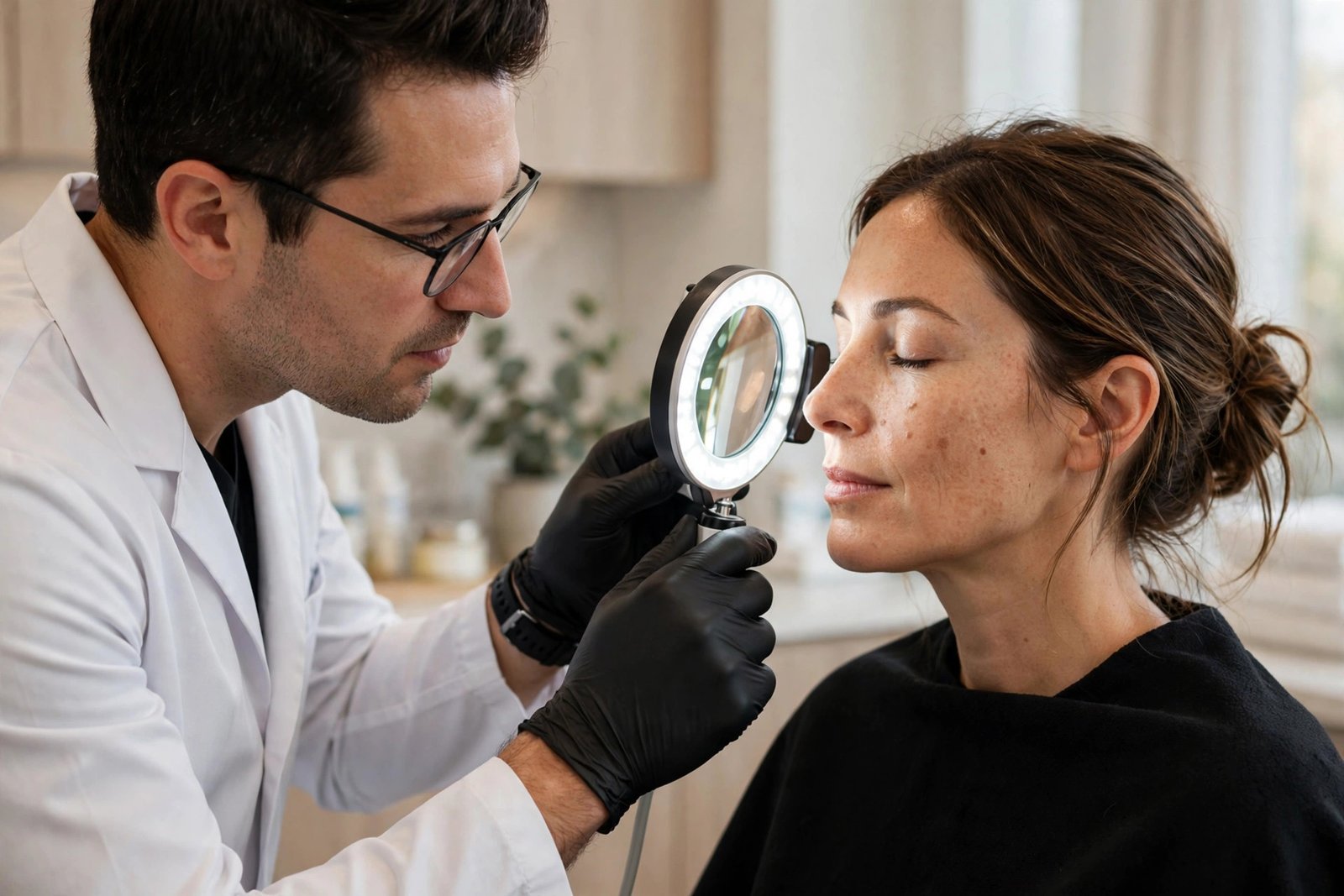
They show up quietly — a small brown freckle-like mark on your cheekbone, then another on your forehead, then a cluster along your temple. Sunspots, also called solar lentigines or liver spots (despite having nothing to do with your liver), are among the most common cosmetic skin complaints in adults over 30. They are flat, brown, and stubbornly persistent — and unlike a tan, they do not fade when summer ends.
The good news: sunspots are almost always harmless, and modern dermatology offers more ways to fade them than ever before, from prescription creams to in-office lasers. The honest news: no single product erases them overnight, and anything that promises to is lying. Here is what sunspots actually are, what genuinely works to fade them, and how to stop new ones from forming.
What Sunspots Are — and Why They Appear
Sunspots are areas where ultraviolet radiation has triggered an overproduction of melanin, the pigment that gives skin its color. Years of cumulative sun exposure — not just sunburns, but the daily incidental UV you absorb driving, walking, and sitting near windows — cause melanocytes (pigment-producing cells) to cluster and overproduce in patches. The result is flat, tan-to-dark-brown spots with well-defined edges, most commonly on the face, backs of hands, shoulders, and chest.
They are distinct from melasma (larger, symmetrical patches often triggered by hormones), freckles (genetic and present since childhood), and moles (raised, and worth monitoring). One critical distinction: while sunspots themselves are benign, any spot that changes in size, shape, or color — or that bleeds, itches, or does not heal — deserves prompt dermatological evaluation. The Skin Cancer Foundation emphasizes that early detection through regular skin checks is the single most important habit for catching melanoma, which can occasionally mimic a dark spot.
Fair-skinned people develop sunspots earlier and more visibly, but no skin tone is immune. In deeper skin tones, sun-induced hyperpigmentation tends to appear as darker patches rather than discrete spots, and it carries a higher risk of post-inflammatory hyperpigmentation from aggressive treatments — which is why treatment choice matters.
Prevention First: Stop Making New Ones
Every dermatologist will tell you the same unglamorous truth: fading existing sunspots while continuing to accumulate UV damage is like bailing out a boat without plugging the leak. Prevention is not optional; it is half the treatment.
Daily broad-spectrum sunscreen of SPF 30 or higher is the foundation — applied generously (about a shot glass for the full body, a nickel-sized dollop for the face) and reapplied every two hours outdoors. If you are still figuring out formulas, our guide to choosing the right sunscreen for sensitive skin walks through mineral versus chemical options. Beyond sunscreen: wide-brimmed hats, UV-blocking sunglasses, seeking shade between 10 a.m. and 4 p.m., and remembering that UVA rays penetrate clouds and window glass. Tanning beds, which the World Health Organization classifies as carcinogenic, are out entirely.
One underappreciated point: many people apply sunscreen only on “sunny days” while their spots were largely built during years of unprotected incidental exposure. Consistency matters more than any single product’s SPF number.
Over-the-Counter Ingredients With Real Evidence
Several non-prescription ingredients have published evidence for fading hyperpigmentation, though they work slowly — expect 8 to 12 weeks before judging results:
- Vitamin C (L-ascorbic acid): an antioxidant that inhibits tyrosinase, the enzyme driving melanin production. Look for concentrations of 10–20% in airtight, opaque packaging, since the ingredient oxidizes easily.
- Niacinamide (vitamin B3): interferes with the transfer of pigment from melanocytes to skin cells. Effective at 4–5% and exceptionally well tolerated, making it a good choice for sensitive skin.
- Azelaic acid: available over the counter at 10% (prescription at 15–20%), it selectively targets hyperactive melanocytes. Particularly useful for deeper skin tones because of its low irritation profile.
- Alpha arbutin and kojic acid: tyrosinase inhibitors derived from natural sources. Effective but can irritate; patch-test first.
- Retinoids: over-the-counter retinol accelerates cell turnover, gradually pushing pigmented cells to the surface where they shed. It also boosts the penetration of other brightening ingredients — which is why dermatologists often pair it with vitamin C (vitamin C in the morning, retinol at night).
The American Academy of Dermatology notes that fading dark spots requires patience and sun protection alongside treatment — without the latter, even effective ingredients fight a losing battle.
Prescription Options: When OTC Is Not Enough
If three months of consistent over-the-counter treatment has not moved the needle, a dermatologist has stronger tools:
- Hydroquinone (4%): the most potent topical lightener, available by prescription in the US. It is typically used in cycles of three months on, then a break, because prolonged continuous use carries a small risk of exogenous ochronosis (a paradoxical darkening). Despite periodic regulatory controversy, it remains the benchmark prescription treatment when used under supervision.
- Tretinoin (prescription retinoid): stronger and faster-acting than cosmetic retinol for pigment disorders.
- Triple-combination creams: formulations combining hydroquinone, tretinoin, and a mild corticosteroid — often considered the most effective topical approach for stubborn spots, used short-term under medical supervision.
- Tranexamic acid (oral or topical): originally a clotting medication, it has shown remarkable efficacy for melasma and some sun-induced pigmentation, but oral use requires medical screening for clotting risk.
In-Office Procedures: The Fastest Route
For spots that resist topicals, or for people who want faster results, dermatology offices offer procedures with strong track records:
- Intense pulsed light (IPL) / photofacial: broad-spectrum light targets melanin, causing spots to darken temporarily then flake off over 1–2 weeks. Best for fair to light-medium skin; typically 2–4 sessions.
- Q-switched and picosecond lasers: deliver ultra-short pulses that shatter pigment particles, which the body then clears. Picosecond lasers (like PicoSure) work across more skin tones with lower heat damage.
- Chemical peels: medium-depth peels with glycolic or trichloroacetic acid remove pigmented surface layers. Downtime ranges from days to over a week depending on depth.
- Cryotherapy: freezing individual spots with liquid nitrogen — quick and cheap, but carries a risk of lightening the surrounding skin, so it is best for isolated spots on lighter skin.
Costs vary widely by market, but expect roughly $300–$600 per IPL session and $400–$800 per laser session in most US cities, with multiple sessions usually needed. Anyone considering procedures should also know how to care for healing skin afterward — our article on treating a sunburn at home covers the soothing, barrier-first approach that applies equally to post-procedure skin.
What Does Not Work (Despite the Hype)
Lemon juice, apple cider vinegar, and baking soda pastes are internet staples with no evidence and real risks — highly acidic DIY treatments cause chemical burns and post-inflammatory hyperpigmentation, often worse than the original spot. “Miracle” creams from unverified sellers sometimes contain undisclosed steroids or mercury, which the FDA has repeatedly warned about. And no supplement, juice cleanse, or detox tea fades sunspots; pigmentation is a cellular process, not a toxin buildup.
Frequently Asked Questions
Can sunspots turn into skin cancer?
Sunspots themselves (solar lentigines) are benign and do not transform into melanoma. However, heavily sun-damaged skin is at higher risk of skin cancer overall, and a new or changing dark spot should always be evaluated — when in doubt, get it checked rather than assuming it is “just a sunspot.”
How long does it take to fade sunspots?
With consistent topical treatment and strict sun protection, expect visible improvement in 8–12 weeks and significant fading in 4–6 months. In-office procedures work faster — often 2–4 weeks per session — but still require sun protection to prevent recurrence.
Will sunspots come back after treatment?
They can, if UV exposure continues. Treated spots often return within a year or two without diligent sunscreen use. Think of fading treatments as resetting the clock and sun protection as keeping it reset.
Are sunspots different on dark skin?
The underlying mechanism is the same, but treatment must be gentler — aggressive lasers and peels carry higher risks of post-inflammatory hyperpigmentation in deeper skin tones. Niacinamide, azelaic acid, and vitamin C are safer starting points, and any in-office procedure should be performed by a dermatologist experienced with skin of color.
Should I see a dermatologist or can I treat sunspots myself?
Mild, long-stable spots can be approached with over-the-counter brighteners first. See a dermatologist if spots are new, changing, numerous, or resistant to three months of consistent treatment — or immediately for any spot with irregular borders, multiple colors, or rapid change.
The Bottom Line
Sunspots are a receipt for years of ultraviolet exposure — annoying, but fixable. The formula that actually works is unglamorous: relentless sun protection to stop new damage, a proven brightening ingredient (or combination) used consistently for months, and professional help when drugstore options plateau. Skip the lemon juice, be patient with the timeline, and get any suspicious spot checked promptly. Your skin keeps score for decades; the good news is that it also responds to sustained, sensible care.