
How Can I Spend Less Time on My Phone Before Bed?
How can I spend less time on my phone before bed? You tell yourself “just five more minutes” — and suddenly it’s 1 AM and you’re watching a stranger renovate a van. Here’s what you’re up against: the last hour of the day is when your willpower is at its lowest and your phone is at its most tempting. Willpower-based plans fail here more than anywhere else.
The fix isn’t discipline. It’s redesigning your bedroom and your evening so the phone simply isn’t an option. Here’s what actually works.
Why the Phone Wins Every Night
Three things conspire against you at bedtime. First, decision fatigue: after a full day of choices, your brain defaults to the easiest stimulation available. Second, the “one more” loop: feeds are engineered to never end, and a tired brain can’t find the stopping point. Third, revenge bedtime procrastination — when your day felt out of your control, your brain steals back freedom at night, even at the cost of sleep.
Understanding this matters because it tells you the solution: you can’t out-decide a depleted brain. You have to remove the decision entirely.
Get the Phone Out of the Bedroom
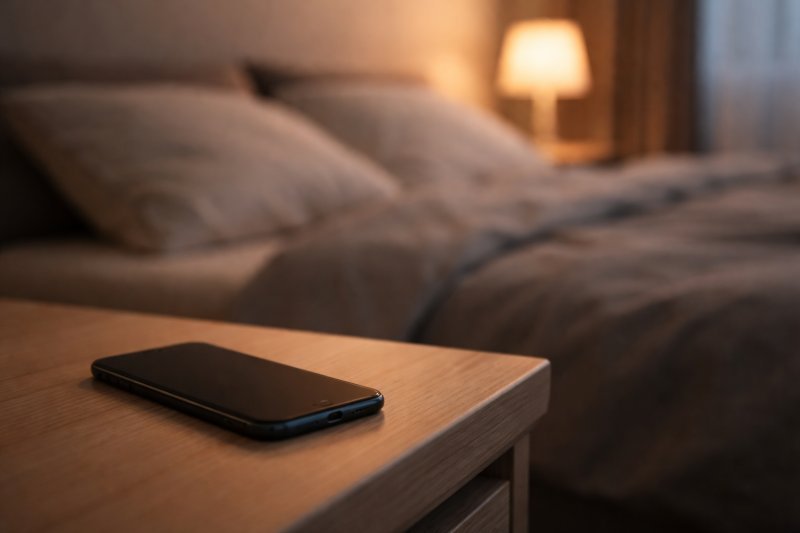
This is the single highest-impact change, and I won’t soften it: charge your phone outside the bedroom. Every other tip is a distant second. Here’s how to handle the objections:
- “It’s my alarm.” A basic alarm clock costs $12–$15. Or use a smart speaker. This excuse has expired.
- “What if there’s an emergency?” Keep the phone charging in the hallway with the ringer on for calls only. You’ll hear a real emergency; you won’t hear Instagram.
- “I read on my phone.” Get a dedicated e-reader, or read a physical book. An e-ink screen doesn’t have a feed attached.
- “I’ll just do it tomorrow.” Do it tonight. The first night is the hardest; by night three it feels normal.
If the phone isn’t in the room, the midnight scroll is physically impossible. Environment beats willpower every single time.
How to Spend Less Time on Your Phone Before Bed: Build a Wind-Down Hour
Your brain needs a runway to land, not a cliff. The last 30–60 minutes before bed should be deliberately boring — in the best way:
- Set a “phone bedtime.” Pick a time (say, 10 PM) when the phone goes on the charger outside the bedroom. An alarm or automation can remind you.
- Dim the lights. Bright light tells your brain it’s daytime. Dim lamps or candles signal wind-down.
- Do something analog. Read, stretch, journal, take a warm shower, talk to your partner. Boring is the point.
- Keep it consistent. The same sequence nightly trains your brain to get sleepy on cue — the core idea behind building a bedtime routine for better sleep.
Handle the “But I’m Not Tired” Trap
Lying awake without the phone feels unbearable at first because your brain is used to stimulation-to-sleep. It recalibrates within a week. In the meantime:
- If you’re not sleepy after 20 minutes, get up and do something dull in dim light (fold laundry, read a boring book) until drowsy. Don’t get back in bed to “try harder.”
- Keep a notepad by the bed for the thoughts that used to go into the phone — tomorrow’s tasks, random ideas. Writing them down tells your brain it can let go.
- Try the 4-7-8 breathing pattern or progressive muscle relaxation. Unsexy, effective.
Fix the Daytime Habits That Feed the Night Scroll
Nighttime phone use is often a symptom of daytime overload. If your days leave you no personal time, your brain will steal it at night. Protecting some genuine downtime during the day — even 20 minutes — reduces revenge procrastination dramatically. Our guide on reducing screen time without feeling bored covers the full daytime playbook.
How Can I Spend Less Time on My Phone Before Bed When My Partner Won’t?
Here’s a scenario the standard advice ignores: you charge your phone outside the bedroom, but your partner is scrolling in bed next to you, screen glowing, laughing at videos. Their habit becomes your temptation — and their light and noise wreck your sleep even if you resist the phone. Solving this requires partnership, not just personal discipline.
Start with the shared goal, not the complaint. “Your phone keeps me awake” sounds like an attack. “I want us both to sleep better — can we try something for a week?” frames it as teamwork. Share the sleep science briefly: the light, the mental stimulation, the fragmented sleep. Most partners aren’t pro-phone-in-bed; they’ve just never examined the habit. Make it an experiment, not an accusation.
Negotiate a “phones down” time you both agree on. It doesn’t have to be extreme — even 30 phone-free minutes before sleep makes a measurable difference. Some couples do a full hour; others start with 20 minutes and expand. The key is that it’s mutual. One person scrolling while the other lies there resentful helps nobody.
Create a charging station together — outside the bedroom, with both phones. Make it a ritual: phones go on the charger, you both get ready for bed. Buy two cheap alarm clocks so the “but my alarm” excuse dies for both of you. The shared ritual removes the willpower asymmetry where one person’s discipline is constantly tested by the other’s glow.
Replace the scroll with something shared. The reason couples scroll in bed is often that they don’t know what else to do — they’re tired, they’re together, the phone is easy. Alternatives: read side by side (even different books — parallel reading is genuinely cozy), talk about the day (the old-fashioned way), do a crossword together, listen to a podcast or audiobook chapter. The goal isn’t forced conversation; it’s shared wind-down instead of parallel scrolling.
If your partner truly won’t budge, protect yourself unilaterally: eye mask, earplugs, and your phone still outside the room. You can’t control their habit, but you can control your light exposure, noise, and temptation. And sometimes, watching you sleep noticeably better for two weeks does more persuading than any argument. Lead by rested example.
The Bottom Line
Spending less time on your phone before bed comes down to one big move — charge it outside the bedroom — plus a boring wind-down routine to fill the gap. You’ll fall asleep faster, sleep deeper, and wake up without the 6 AM doomscroll. Try it for one week. The first night is weird. By night seven, you’ll wonder why you ever slept next to a slot machine.
On the science of screens and sleep, the Sleep Foundation’s guide to blue light and sleep is excellent, and Wikipedia’s sleep hygiene overview covers the full set of evidence-based habits.