
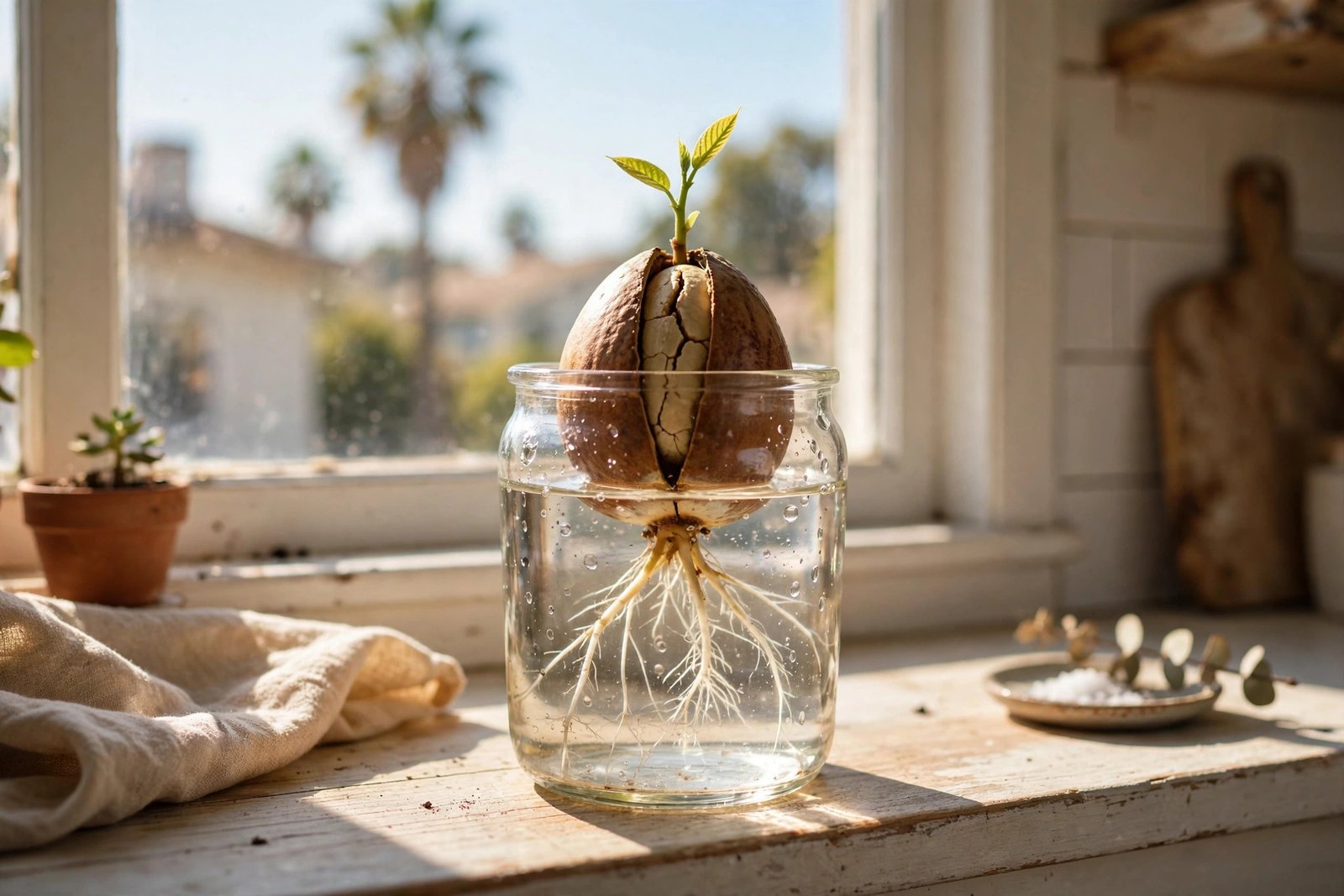
There's something deeply satisfying about sprouting an avocado pit on your kitchen windowsill and watching it become a real tree. In California, where the climate is already on your side, growing avocados from seed is less a science experiment and more a genuine gardening project — but the gap between a cute windowsill sprout and a tree that actually produces fruit is bigger than most guides admit. Let's close that gap.
This guide walks you through the whole journey: picking the right pit, sprouting it reliably, transplanting it into California soil, and caring for it year after year. You'll also learn the one honest truth seed-grown avocado growers need to hear — most seedling trees produce unpredictable fruit — and the practical workaround that commercial growers use.
Why California Is Uniquely Suited for Seed-Grown Avocados
Avocados are native to the warm, humid highlands of south-central Mexico, and much of coastal and Southern California offers a near-perfect match: mild winters, warm summers, and long growing seasons. The USDA zones where avocados thrive outdoors — roughly zones 9b through 11 — cover San Diego, Orange County, much of Los Angeles, parts of the Bay Area, and the Central Valley's warmer pockets. If you live in one of these zones, a seedling avocado can live outdoors year-round once established.
That said, microclimates matter more than the zone map: a sheltered courtyard can run five degrees warmer than an exposed hilltop nearby, and five degrees decides whether a young tree shrugs off a winter night or loses its leaves. Young trees are the most frost-sensitive stage; even mature trees suffer below about 30°F. Know your site's cold-air drainage and wind exposure, not just your zone.
Choosing the Right Pit (Not All Avocados Are Equal)
Start with a Hass avocado from the grocery store — it's the variety most Californians eat, and its pits germinate reliably. Rinse the pit gently to remove all flesh (leftover flesh invites mold), and avoid pits that are cracked, shriveled, or dried out. Fresh pits sprout; pits that have sat in a bowl for weeks are far less reliable. The top of the pit is the slightly pointed end; the bottom is the flatter, broader end, and this orientation matters when you plant it.
Here's the honest part: a Hass pit grows into a genetic wildcard, not a Hass tree — the fruit may be excellent or nearly inedible, and you'll wait 5 to 13 years to find out. If you want reliable fruit, grow the seedling as rootstock and graft a known variety onto it later. A simple cleft or whip graft has a high success rate on vigorous seedlings and transforms a fun experiment into a genuinely productive tree.
For official guidance, see UC Agriculture's avocado resources.
Sprouting the Pit: Water Method vs. Soil Method
The classic water method — suspending the pit over a glass with toothpicks, flat end down, with the bottom third submerged — works because you can watch the process. Keep the water fresh (change it every few days to prevent stagnation), place the glass in bright indirect light at 65–75°F, and wait. The pit typically cracks in 2–8 weeks, sends a taproot down first, then a shoot up. It's slow, and about a quarter of pits simply never wake up — that's normal, not failure.
The soil method skips the theatrics and often produces stronger seedlings: soak the pit overnight, plant it flat-end down in a 6-inch pot of well-draining mix with the top third exposed, water thoroughly, and keep it warm and barely moist. Soil-grown seedlings develop sturdier roots since they never transition from water to earth. Either way, when the stem hits 6 inches, pinch it back to 3 — it forces thicker, bushier regrowth instead of tall spindliness.
Transplanting Outdoors: Timing and Technique
Move your seedling outdoors only after all frost danger has passed — typically late March to May in Southern California, later in the Bay Area. Choose a spot with full sun (at least 6 hours), excellent drainage, and wind protection; a south-facing wall is ideal. Avocados despise wet feet: dig the hole no deeper than the root ball and twice as wide, and if your soil is heavy clay, plant on a slight mound or in a raised bed rather than digging deeper.
Watering reality check: young avocados need deep, regular watering — 2–3 times weekly in summer, less in winter — and they're famously salt-sensitive. In areas with hard municipal water, a periodic deep flush leaches salts below the root zone and prevents the leaf-tip burn plaguing many Southern California trees. Mulch with 3–4 inches of coarse wood chips, kept away from the trunk, to hold moisture for the shallow feeder roots.
Year-by-Year Care: Feeding, Pruning, and Patience
Feed with a balanced citrus/avocado fertilizer containing zinc, starting the first full spring outdoors at label rates for young trees, split across spring and summer. Yellow leaves with green veins signal iron or zinc deficiency, common in alkaline soils — a foliar spray corrects it fast.
Prune lightly and purposefully. Young trees need little more than removing crossing branches and shaping for structure; heavy pruning delays fruiting. Once the tree reaches 8–10 feet, you can head it back to keep fruit within picking reach — commercial California groves are routinely kept at 12–15 feet for exactly this reason. And about that long wait: a seedling typically fruits in 5–13 years, while a grafted tree can fruit in 3–4. If fruit is the goal, grafting at 1–2 years old is the single highest-leverage thing you can do.
Learn more from California Avocado Commission.
The Grafting Option: Getting Fruit You Can Count On
Grafting a seedling means attaching a bud or scion from a proven variety — Hass, Fuerte, Reed, or Pinkerton all do well in California — onto your seedling's trunk. The seedling provides vigorous, locally adapted roots; the graft provides guaranteed fruit quality. Nurseries and UC Cooperative Extension offices in avocado-growing counties occasionally hold grafting workshops, and scion wood is often available through local California Rare Fruit Growers chapters.
Graft when the trunk is pencil-thick, usually the second spring. A cleft graft sealed with grafting tape, kept shaded for a few weeks, takes in most attempts — and within 3–4 years you can harvest fruit worth eating. Even ungrafted, the seedling is a handsome evergreen; not every garden project needs to end in a harvest.
If this was helpful, keep reading: our guide to keeping cut avocados from browning and keeping houseplants alive while you travel.
Growing avocados from seed in California is one of those rare projects that is both genuinely easy to start and genuinely rewarding to finish — as long as you know what you're signing up for. Sprout the pit, get it into good soil with good drainage, water deeply, feed it zinc, and be patient. And if you want fruit worth the wait, graft a proven variety onto your seedling and turn a fun experiment into a tree that feeds you. Either way, you'll have grown something real from something you were about to throw away, which is a pretty good deal.
Frequently Asked Questions
How long does it take to grow an avocado from seed to fruit in California?
A seedling-grown avocado typically takes 5 to 13 years to fruit in California, depending on variety genetics and growing conditions. Grafting a known variety onto the seedling cuts that to roughly 3–4 years after the graft takes.
Can avocado trees survive winter in Northern California?
In sheltered Bay Area microclimates (zones 9b–10a), yes, with protection during cold snaps. Young trees should be covered or moved indoors when frost threatens; mature trees handle brief dips to about 30°F. Exposed inland valleys are much riskier.
Why is my avocado seedling tall and leggy?
Leggy growth almost always means insufficient light. Move the seedling to brighter light (a south-facing window or outdoors in shade, then full sun gradually), and pinch the stem back to 3 inches when it reaches 6 inches to encourage bushier regrowth.
Do I need two avocado trees to get fruit?
No. Avocado trees are self-fertile; a single tree can produce fruit. Having both A-type and B-type flowering varieties nearby can improve pollination and yields, but one healthy tree fruits on its own.