
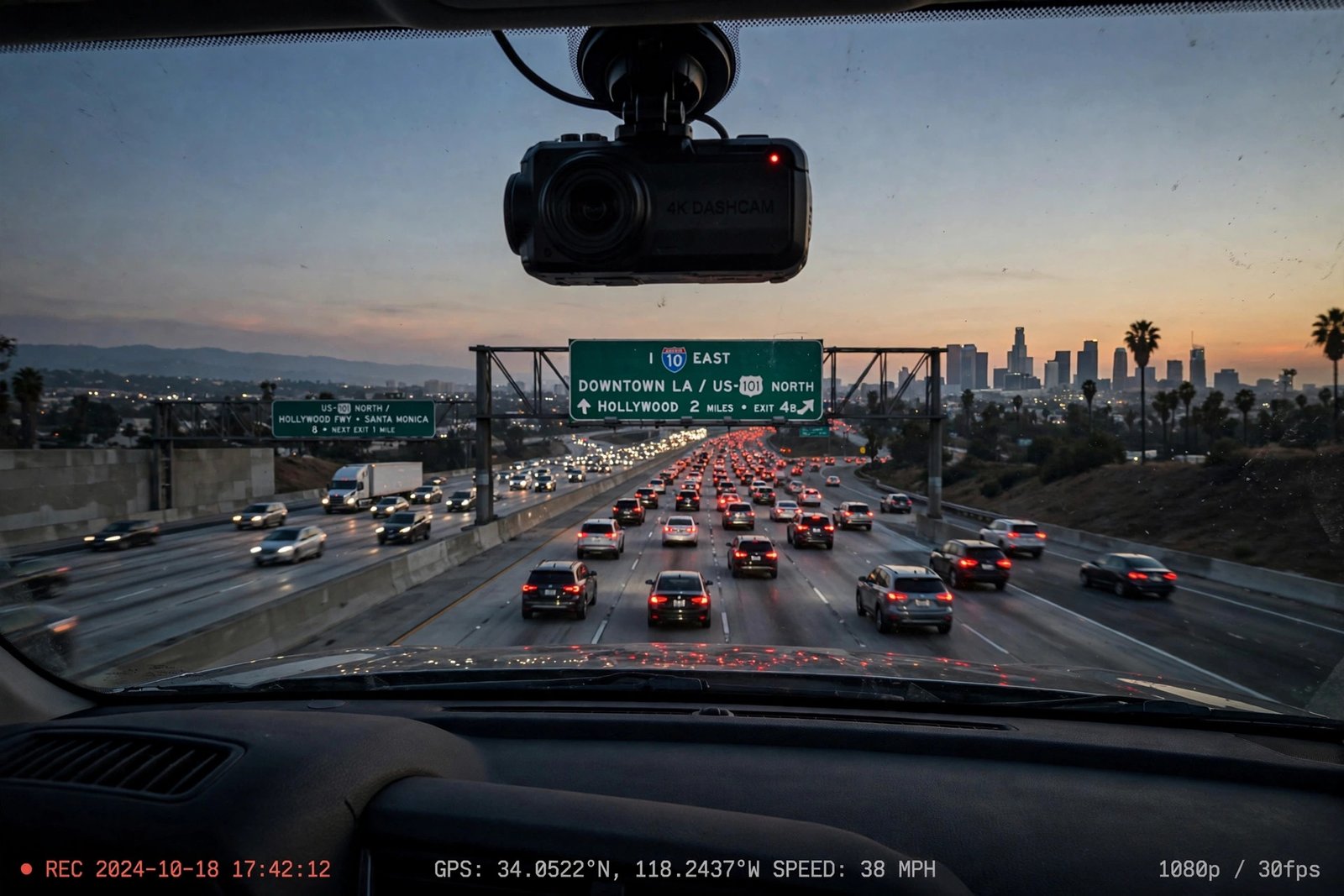
Los Angeles traffic is a contact sport. Between the 405 at rush hour, delivery drivers on deadlines, and the city’s infamous hit-and-run rate, LA drivers face more fender-benders, disputed liability, and insurance headaches than almost anywhere in America. A dash cam — a small camera recording your drive — has gone from enthusiast gadget to genuine financial protection. But is it worth getting one in Los Angeles specifically?
Short answer: yes, more here than almost anywhere. Here’s why, what to buy, the California legal rules, and how to get the most from it.
Why LA Makes the Strongest Case in America
Hit-and-runs: Los Angeles has one of the nation’s highest hit-and-run rates — thousands annually, with a large share never solved. A dash cam with parking mode (recording while parked) is often the only way to identify the driver who sideswiped you on a crowded street and vanished. Disputed liability: in multi-car freeway incidents, fault is genuinely ambiguous — dash cam footage ends arguments instantly, with your insurer and theirs.
Insurance fraud: staged accidents (“swoop and squat” rear-end setups) target congested urban areas, and LA is prime territory. Footage showing the car ahead brake-checking you is the difference between a denied claim and an exposed fraud. Rideshare and delivery driving: if you drive for Uber, Lyft, or deliveries in LA, a dual-facing cam (road + cabin) protects against false passenger complaints — many drivers consider it mandatory equipment. Parking incidents: door dings, lot scrapes, and break-in attempts in LA’s dense parking landscape are all captured by parking-mode recording.
California Legal Rules: What You Must Know
Dash cams are legal in California, but with specific constraints. Windshield placement: California Vehicle Code restricts windshield obstructions — dash cams must be mounted in a 7-inch square in the lower corner of the passenger side or a 5-inch square in the lower corner of the driver side, outside the airbag deployment zone. Dashboard mounting (not on the glass) avoids this entirely and is the simplest compliant option. The California Legislative Information portal hosts the current vehicle code if you want the exact text, and the NHTSA’s vehicle safety resources cover the broader road-safety context dash cams serve.
Audio recording: California is a two-party consent state for audio — recording conversations where participants have a reasonable expectation of privacy without consent can violate wiretapping law. The practical guidance: either disable audio recording, post a visible notice (“audio recording in progress”) which courts have treated as implied consent in vehicles, or limit audio to situations without private conversation. Video-only recording of public roadways has no such issue. Privacy: footage of public roads is fair game; be thoughtful about sharing footage identifying private individuals online.
What to Buy in 2026: The Tiers
Budget ($60–$100): single-channel 1080p or 1440p front cameras from established brands (Viofo, 70mai). Perfectly adequate for liability protection — the footage just needs to show what happened, not win cinematography awards. Mid-range ($150–$250): dual-channel (front + rear) 2K/4K with parking mode, GPS, and Wi-Fi app transfer. The sweet spot for most LA drivers — rear coverage matters enormously for rear-end disputes. Premium ($250–$400): 4K front + 2K rear, cloud connectivity, advanced parking surveillance with impact and motion detection. Worth it for expensive vehicles, rideshare drivers, and street parkers.
Key features that actually matter: parking mode (hardwire kit required — budget $30–$50 plus installation), supercapacitor instead of battery (California heat kills dash cam batteries; capacitors survive), loop recording with a high-endurance microSD card (standard cards die fast under constant rewriting), and GPS (speed and location data strengthen insurance claims). 4K is nice; reliability is everything — a camera that overheats and shuts off in August is worse than none.
Installation and Daily Use
Basic installation is a 20-minute DIY job: mount, route the cable along the headliner and A-pillar (tuck, don’t dangle — airbag zones matter), plug into the 12V outlet. Hardwiring for parking mode is more involved — fuse-tap kits with voltage cutoffs (so the cam doesn’t drain your battery) — and many owners sensibly pay a car audio shop $100–$150 for professional installation. Given what belongs in a car emergency kit, consider the dash cam part of the same philosophy: preparation that pays for itself the one time it matters.
Daily habits: format the SD card monthly (prevents file corruption), check that it’s actually recording weekly (a dead cam you trusted is worse than no cam), and after any incident, lock and preserve the footage immediately — download it before loop recording overwrites it, and back it up to your phone or cloud. For road-trippers, the cam doubles as a trip recorder — making long car rides more enjoyable is even better when the scenic stretches are captured.
The ROI Math
A $150 dual-channel setup versus the scenarios it resolves: a single disputed-liability accident where footage saves your deductible ($500–$1,000) and prevents a rate hike ($300–$600/year for 3–5 years) pays for the camera 10–20x over. A hit-and-run identified via parking mode can be the difference between a covered claim and an out-of-pocket loss. For LA’s driving environment specifically — high incident rates, high fraud, high hit-and-runs — the expected value is overwhelmingly positive. It’s the cheapest insurance policy you’ll ever buy.
Dash Cams and Rideshare/Delivery Driving
If you drive for Uber, Lyft, or delivery platforms in LA, a dash cam graduates from smart to essential. Dual-facing models (road + cabin) protect against false passenger complaints — the leading cause of driver deactivations — and document delivery completions. Most platforms permit dash cams, but California’s two-party consent rule for audio means you should either disable audio or post clear notice; many rideshare drivers use visible “video recording in progress” stickers that satisfy practical consent requirements.
Tax angle: a dash cam used for gig driving is a deductible business expense — keep the receipt. And footage has secondary value: delivery drivers use it to dispute false “damaged item” claims, while rideshare drivers facing traffic citations on the job can submit footage as evidence. If your car is your workplace, the camera is your security system — budget for the premium tier with cloud backup, because losing footage of an incident that affects your livelihood is the nightmare scenario.
Conclusion
Getting a dash cam in Los Angeles is worth it — arguably more here than anywhere in America, given the hit-and-run rate, disputed freeway incidents, and insurance fraud. Buy a dual-channel model with parking mode and a supercapacitor ($150–$250), mount it legally, hardwire for parking surveillance, and maintain the SD card. One saved deductible pays for a decade of cameras. In LA traffic, the question isn’t whether you need a witness — it’s whether you’ll have one when it counts.
Frequently Asked Questions
Are dash cams legal in California?
Yes, with placement restrictions — windshield-mounted cams must sit within small zones in the lower corners, outside airbag deployment areas. Dashboard mounting avoids the issue. Audio recording falls under California’s two-party consent law.
What is parking mode on a dash cam?
Recording while the car is parked, triggered by impacts or motion. It requires a hardwire kit with voltage cutoff and is the key feature for hit-and-run and break-in protection.
How much should I spend on a dash cam?
$150–$250 for a dual-channel (front + rear) model with parking mode, GPS, and supercapacitor — the sweet spot for LA drivers. Budget $60–$100 works for basic front-only liability protection.
Can dash cam footage lower my insurance?
Some insurers offer small discounts, but the real value is claims protection — footage proving you weren’t at fault saves deductibles and prevents rate hikes worth far more than any discount.
Do I need front and rear cameras?
Strongly recommended in LA — rear-end collisions are the most common freeway incident type, and rear footage is decisive in the disputes they generate.