
California homeowners face a question no one in Ohio ever asks: should I pay thousands per year for insurance against the ground itself moving? Standard homeowner’s insurance explicitly excludes earthquake damage — a fact many Californians discover only after the shaking stops. With the USGS estimating significant odds of a major quake in the coming decades, earthquake insurance isn’t paranoia. But at $800–$5,000+ per year with deductibles of 10–25%, it’s also not an obvious buy.
Here’s the honest 2026 analysis: what earthquake insurance costs, what it actually covers, who needs it most, and the alternatives worth considering.
What California Earthquake Insurance Covers (and Doesn’t)
Most California earthquake policies — the majority sold through the California Earthquake Authority (CEA), a publicly managed nonprofit — cover three things: dwelling damage (structural repairs to your home), personal property (often capped at lower limits unless you buy up), and loss of use (temporary living expenses while your home is repaired). Critically, earthquake insurance covers the catastrophic scenario homeowner’s insurance ignores: your foundation cracks, your chimney collapses through the roof, your home shifts off its foundation.
What it doesn’t cover: fire damage following an earthquake (that’s covered by your standard homeowner’s policy — and post-quake fire is historically a huge damage source), land damage (your lot sliding away is generally excluded), vehicles (that’s auto insurance), and pre-existing damage. Read the exclusions as carefully as the coverage — the California Earthquake Authority’s policy details are the authoritative source for CEA policies.
What It Costs in 2026
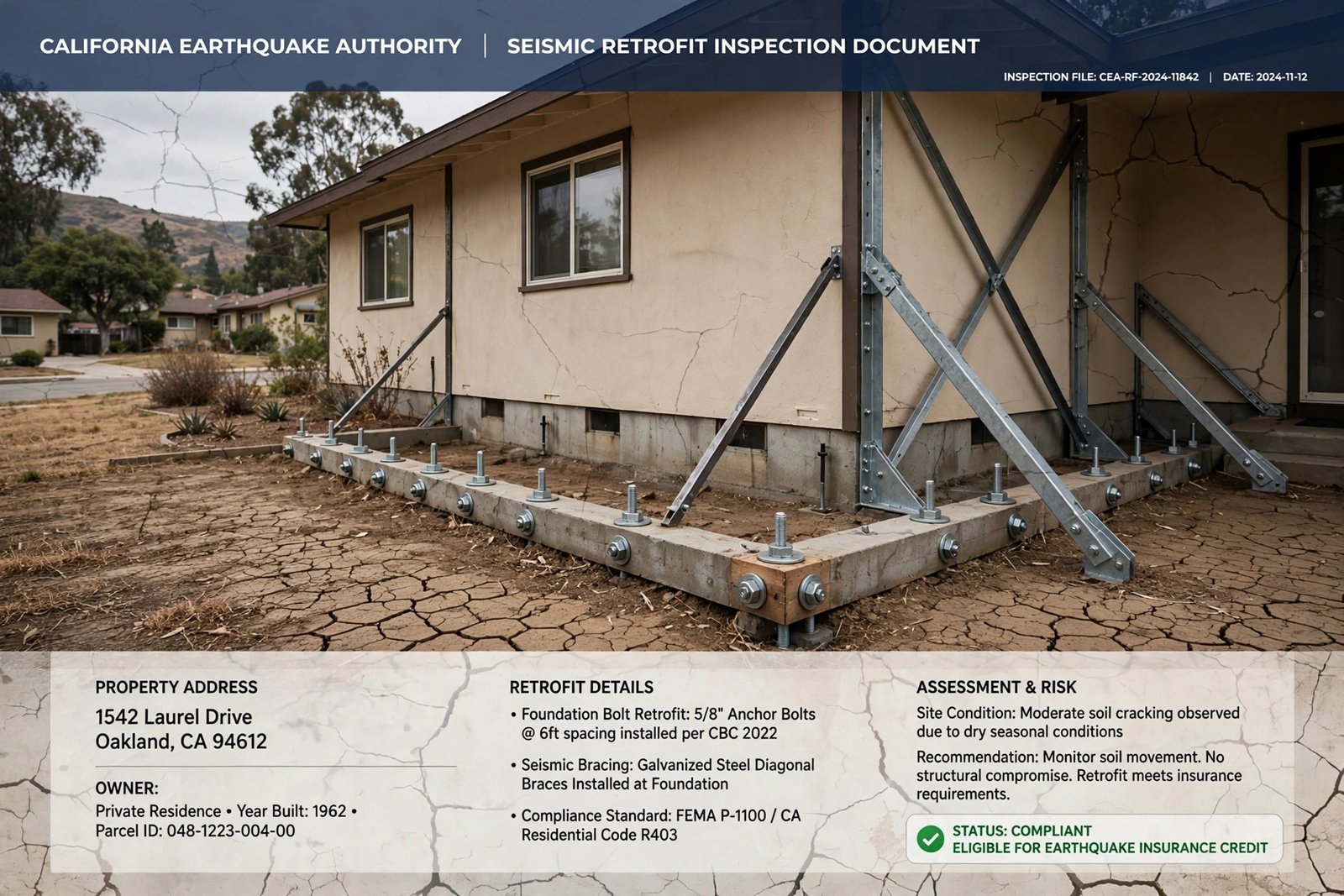
Premiums vary enormously by location, home age, construction type, and coverage choices. Rough 2026 ranges: $800–$2,000/year for newer wood-frame homes in lower-risk zones with basic coverage; $2,000–$5,000+/year for older homes, masonry construction, or high-risk zones near major faults (parts of the Bay Area, LA basin, and San Diego County). Retrofitted homes (bolted foundations, braced cripple walls) earn meaningful discounts — California’s Earthquake Brace + Bolt program has offered grants up to $3,000 for qualifying retrofits, which both reduce damage risk and lower premiums.
The deductible is the real sticker shock: typically 10–25% of the coverage limit (not of the damage). On a $600,000 dwelling limit with a 15% deductible, you pay the first $90,000 of damage yourself. This structure means earthquake insurance is catastrophic coverage, not maintenance — it protects against the $200,000+ rebuild scenario, not the cracked-drywall scenario. The USGS earthquake hazard resources can help you assess your specific location’s risk level.
Who Should Buy It: A Decision Framework
Strong candidates
You own an older home (pre-1980, especially pre-1940) that hasn’t been retrofitted, you live near a major fault (San Andreas, Hayward, San Jacinto), you have significant equity (a quake that destroys a paid-off home destroys your net worth), or you couldn’t financially survive rebuilding. If a total loss would ruin you, the premium is cheap.
Reasonable to skip
You rent (your landlord’s problem structurally; consider renter’s earthquake coverage for belongings if you own valuables), your home is newly built to modern seismic codes on stable ground (damage risk is dramatically lower), or the premium plus massive deductible exceeds your realistic risk tolerance math. Also: if you have a mortgage, check your lender’s requirements — most don’t mandate earthquake insurance, but some portfolio lenders do.
The middle path
CEA offers flexible coverage options — you can insure just the dwelling (skipping personal property coverage you don’t need) and choose higher deductibles to cut premiums. Some homeowners pair a high-deductible CEA policy with a dedicated emergency fund for the deductible amount. And everyone should retrofit: bolting and bracing costs $3,000–$7,000 but can cut expected damage by more than half — the highest-ROI earthquake spending available.
How to Shop for a Policy
Start with the CEA — most California homeowner’s insurers offer CEA policies as an add-on, so your current agent can quote it. But compare: a handful of private insurers (GeoVera, Palomar, and others) sell standalone earthquake coverage, sometimes with lower deductibles or broader terms. Get at least two quotes.
When comparing, look past the premium: check the deductible structure (percentage of dwelling limit vs. flat amount), loss-of-use limits, personal property sublimits, and any masonry or older-home surcharges. Ask specifically about discounts for retrofits — and get the retrofit done before the quote if possible, since it changes your risk tier. Finally, review the policy annually: as you pay down your mortgage and build equity, the amount of net worth at risk grows, which may justify increasing coverage even as the premium rises.
Alternatives and Complements
Earthquake insurance isn’t the only protection. Retrofitting (above) reduces the damage that insurance would cover. Emergency preparedness — keeping an emergency kit in your car and home, securing water heaters and bookcases, knowing how to shut off gas — reduces the human cost no policy covers. Financial preparedness: an emergency fund covering 6 months of expenses plus your potential deductible means a quake is a crisis, not a catastrophe. Review Ready.gov’s earthquake preparedness guidance for the household checklist.
One more consideration: loss-of-use coverage is underrated. After a major quake, contractors are booked for months and rents spike — the additional living expenses coverage (often $25,000–$100,000) may be the part of the policy you actually use. When comparing quotes, don’t just compare dwelling premiums; compare the loss-of-use limits.
A final practical note: if you decide to buy, do it before earthquake season anxiety spikes — insurers can impose moratoriums on new policies immediately after a significant quake, exactly when demand surges. The best time to buy earthquake insurance is when the ground has been quiet and you can think clearly about deductibles. Like all insurance, it is a product you want to have arranged long before you need it.
Conclusion
Earthquake insurance in California is worth it if you own an older or unretrofitted home near a major fault, carry significant equity, or couldn’t absorb a catastrophic loss — the high deductibles make it disaster protection, not repair coverage. It’s reasonable to skip for new construction on stable ground or if the premium math doesn’t work for your situation. Either way, retrofit your home, prepare your household, and make the decision deliberately — the worst option is discovering your homeowner’s policy excludes earthquakes after the ground moves. For more detail on a related topic, see our article on is travel insurance actually worth buying for domestic trips.
Frequently Asked Questions
Does homeowner’s insurance cover earthquakes in California?
No — standard California homeowner’s policies explicitly exclude earthquake damage. You need a separate earthquake policy, most commonly through the California Earthquake Authority.
How much is earthquake insurance in California?
Roughly $800–$2,000/year for newer homes in lower-risk areas, $2,000–$5,000+/year for older homes or high-risk zones near major faults. Deductibles are typically 10–25% of the coverage limit.
What is the deductible on California earthquake insurance?
Usually 10–25% of the dwelling coverage limit — e.g., a 15% deductible on a $600,000 limit means you pay the first $90,000 of damage. It’s designed for catastrophic losses, not minor repairs.
Does retrofitting lower earthquake insurance premiums?
Yes — bolted foundations and braced cripple walls earn meaningful discounts, and California’s Brace + Bolt program has offered grants up to $3,000 for qualifying retrofits.
Is earthquake insurance required with a mortgage in California?
Generally no — most lenders don’t require it. But check your specific loan terms, as some portfolio lenders do mandate coverage.