
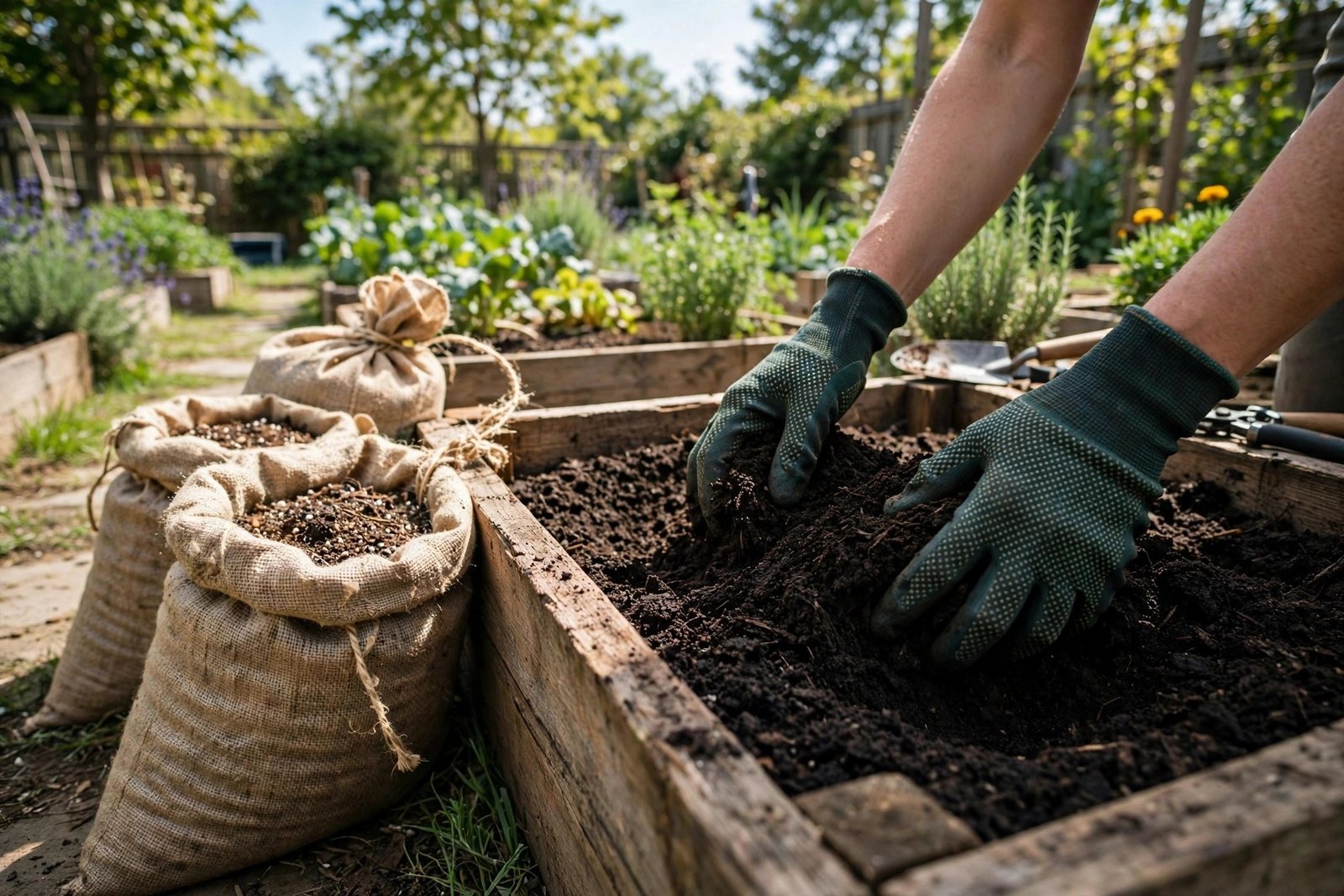
Raised beds are only as good as what fills them. The right soil mix grows explosive vegetables with minimal fuss; the wrong one — dense, soggy, or nutrient-dead — turns a beautiful cedar bed into a disappointment. With bagged options running $8–$15 per cubic foot and a 4×8 bed needing 16+ cubic feet, getting the mix right the first time saves serious money.
This guide covers the best soil mix for raised beds: the proven ratios, bagged versus DIY economics, amendments for different crops, and the mistakes that ruin good beds.
The Classic Recipe: What Actually Works
The most proven raised bed mix — popularized by Mel Bartholomew’s Square Foot Gardening and validated by decades of gardeners — is equal parts compost, peat moss (or coco coir), and coarse vermiculite. This “Mel’s Mix” drains beautifully, holds moisture, and starts weed-free and nutrient-rich. It works brilliantly, with two caveats: vermiculite is expensive, and the mix needs regular compost replenishment as it settles.
The practical alternative most experienced gardeners use: 60% high-quality topsoil or garden soil, 30% compost, 10% aeration (perlite, pumice, or coarse bark). This is cheaper at scale, heavier (good for stability), and performs excellently for vegetables. The non-negotiable in every recipe: compost — it provides nutrients, biology, and structure. Multiple compost sources (mushroom, worm castings, leaf mold) beat a single source every time. And start composting at home — homemade compost is the best amendment there is, and it is free.
Why not just use garden soil?
Native soil alone compacts in the confined raised-bed environment, drains poorly, and often harbors weed seeds and soil-borne diseases. Amended heavily (50%+ compost and aeration), it works — but unamended dug soil is the most common cause of disappointing first-year raised beds. The USDA’s Natural Resources Conservation Service offers free soil surveys showing exactly what your native soil contains, so you know what you are amending.
Bagged vs. Bulk vs. DIY: The Economics
Bagged raised-bed mix ($8–$15 per 1.5 cu ft bag): convenient, consistent, weed-free — and brutally expensive at scale. A 4x8x1-foot bed needs ~32 cubic feet: roughly $170–$320 in bags. Worth it for one or two small beds; painful for a garden full of them.
Bulk delivery (landscape supply yards): $35–$75 per cubic yard delivered (27 cubic feet) — dramatically cheaper, and many yards sell “raised bed mix” or “garden blend.” Quality varies: inspect before ordering (it should smell earthy, not sour; feel crumbly, not muddy). DIY mixing from bulk components is cheapest of all and gives full control. The smart play for multiple beds: bulk delivery of a base mix, amended with your own compost. One caution: bulk “topsoil” alone is not bed-ready — it still needs the compost and aeration fractions.
How much soil do you actually need?
Length × width × depth (in feet) = cubic feet; divide by 27 for cubic yards. A 4×8 bed at 12 inches deep needs 32 cubic feet (~1.2 cubic yards). Pro tip: fill the bottom third of deep beds with logs, branches, and leaves (hugelkultur-style) — it decomposes into rich soil, improves drainage, and cuts your soil bill by a third.
Amendments for Vegetables vs. Flowers
Vegetables are heavy feeders: enrich the base mix with extra compost (an inch top-dressed each season), worm castings at planting, and organic granular fertilizer monthly during growth. Tomatoes and peppers appreciate added calcium (crushed eggshells or gypsum) to prevent blossom end rot. Leafy greens want nitrogen-rich amendments (blood meal, fresh compost).
Flowers are less demanding: the base mix plus annual compost top-dressing suffices for most annuals and perennials. Root crops (carrots, parsnips) need the loosest, sandiest mix — extra perlite and zero fresh manure (which forks roots). Acid-lovers (blueberries in beds) need sulfur-amended acidic mix, a specialty case worth doing properly. Match the amendment to the crop and everything performs better — the same principle behind pairing beds with low-maintenance landscaping ideas for beginners for the surrounding yard.
Filling, Settling, and First-Year Care
Fill beds a few inches above the rim — all mixes settle 10–20% in the first season as particles nest together. Water thoroughly after filling to trigger settling, then top up before planting. Do not compact deliberately; let water and time do the work.
Year-one feeding: even rich mixes deplete as plants feast — side-dress heavy feeders mid-season and top-dress all beds with compost each spring thereafter. Mulch the surface (straw for vegetables, bark for perennials) to retain moisture and suppress weeds. Test every 2–3 years: a $20 soil test prevents the slow nutrient drift that degrades beds over time. The EPA’s home composting guide helps you produce the amendment your beds will always need more of.
The mistakes that ruin good beds
Using pure compost as fill (too rich, shrinks dramatically, nutrient imbalances); using potting mix alone (too light, dries fast, expensive); forgetting drainage (beds on concrete need drainage gaps); and never replenishing (a bed is a living system that consumes organic matter — feed it yearly or watch yields decline).
The second-year refresh
After the first season, every bed needs the same simple ritual: pull spent plants, top-dress with 2 inches of fresh compost, check the level (top up settled spots with mix), refresh mulch, and re-test pH if plants underperformed. This one-hour annual service keeps beds productive indefinitely — gardeners who do it harvest like year one forever, while those who skip it wonder why year three disappoints. Soil is not a one-time purchase; it is a relationship.
Conclusion
The best soil mix for raised beds is simple: roughly equal parts compost, moisture-retentive base (peat/coir or good topsoil), and aeration — enriched for heavy feeders, topped up yearly. Buy bagged for small projects, bulk for big ones, hugelkultur the deep bottoms, and make your own compost forever. Get the soil right and the raised bed practically gardens itself.
Frequently Asked Questions
Can I use only compost to fill raised beds?
No — pure compost shrinks excessively, can have nutrient imbalances and high salts, and lacks the mineral structure plants need. Use compost as roughly one-third of the mix, blended with a base (topsoil or peat/coir) and aeration material.
How deep should raised bed soil be?
12 inches minimum for most vegetables; 18–24 inches ideal for root crops and deep-rooted plants. Shallower beds (6–8 inches) work for herbs, lettuce, and flowers. Deeper is almost always better if budget allows.
Is bagged raised bed soil worth the price?
For one or two small beds, yes — the convenience and consistency justify it. For larger gardens, bulk delivery from a landscape yard costs a fraction per cubic foot. Inspect bulk mixes before ordering; quality varies significantly.
How often should I replace raised bed soil?
Never fully replace it — instead, top-dress with 1–2 inches of compost each season and amend based on periodic soil tests. Well-maintained bed soil improves with age as biology builds. Only replace if contaminated or completely depleted.
What is the cheapest way to fill a raised bed?
Hugelkultur-style: fill the bottom third to half with logs, branches, leaves, and grass clippings, then top with your soil mix. This cuts soil costs by up to half while creating a self-composting, moisture-retentive base that feeds plants for years.