
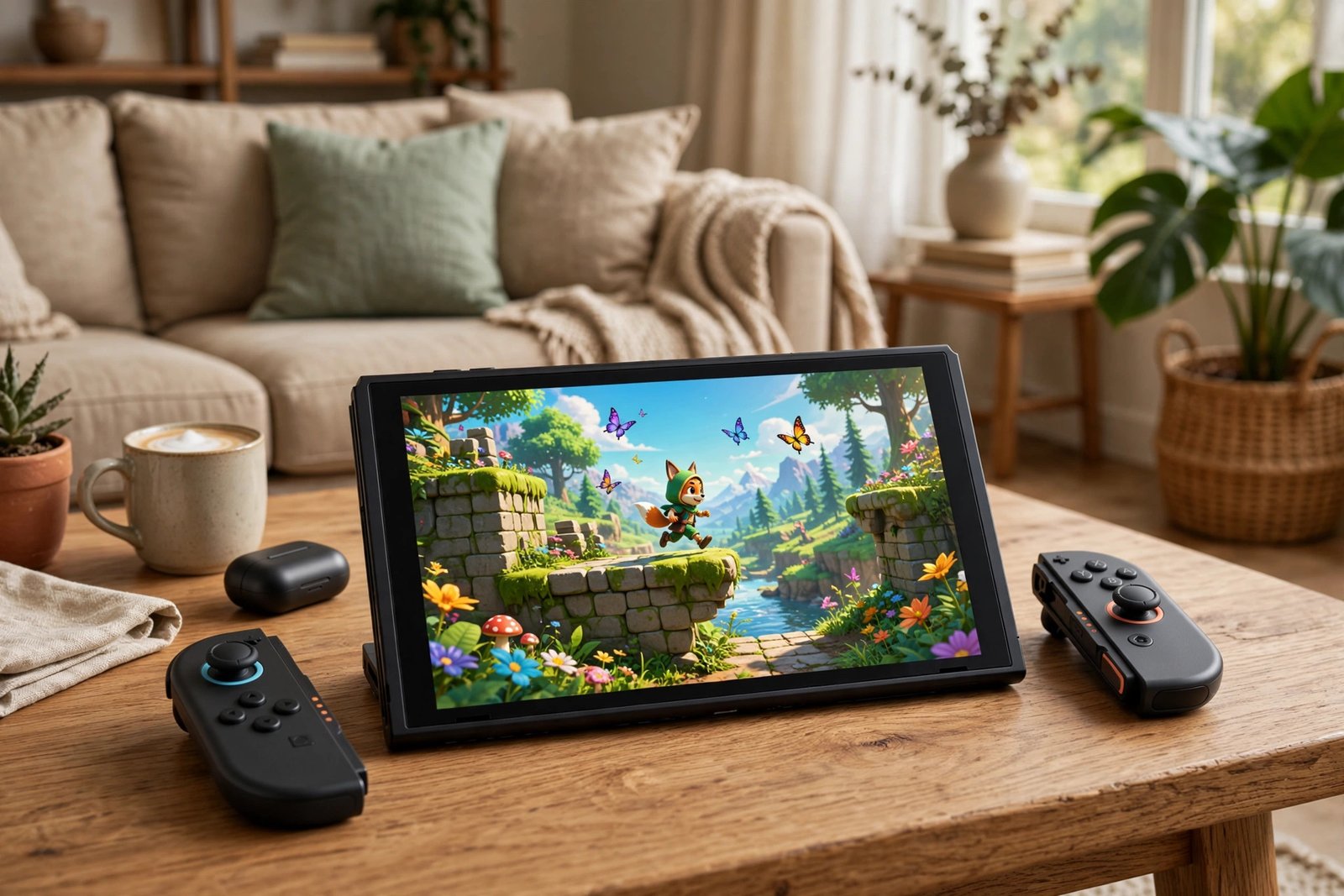
Nintendo’s Switch 2 arrived with the weight of impossible expectations: follow up the best-selling console of its generation (over 140 million units) without breaking what made it magical. Early adopters always face the same question — is it worth buying at launch, or wiser to wait for the price drop, the hardware revision, and the bigger game library? With the Switch 2, the answer depends on what kind of Nintendo player you are.
Here is the honest launch assessment: what the hardware delivers, the games situation, the price math, and who should buy now versus wait.
What the Switch 2 Actually Is
The Switch 2 is an evolution, not a revolution — and that is its strength. The core proposition is unchanged (hybrid handheld/docked play) with meaningful upgrades across the board:
- Performance: a substantial leap over the original — modern NVIDIA-based hardware with DLSS support, enabling higher resolutions and frame rates both handheld and docked. Games that struggled on the original Switch run cleanly; new titles target visual standards the old hardware could not touch.
- Display: larger, higher-quality screen with improved color and (on premium models) high refresh rate support — the handheld experience is transformed.
- Backward compatibility: the killer feature — your existing Switch library carries forward, with many titles receiving performance enhancements. Your 140-million-strong software ecosystem is not obsolete.
- Joy-Con refinements: redesigned controllers addressing the original’s drift issues (magnetic attachment, improved sticks) — though long-term drift resistance remains to be proven.
- Docked output: proper 4K output support with upscaling, finally bringing Nintendo’s docked experience into the modern era.
The Launch Library Question
Console launches live or die on games, and the Switch 2’s situation follows the classic pattern: strong first-party anchors, thin third-party depth initially, and a backward-compatible library that softens the wait.
- What is there at launch: Nintendo’s flagship launch titles (the new 3D Mario / Zelda-adjacent experiences that define generations), enhanced versions of Switch classics, and a solid indie showing.
- What is missing: the deep third-party AAA ports take 12–18 months to materialize historically, and the truly system-selling exclusives arrive in waves, not all at once.
- The backward-compat cushion: this is what makes the Switch 2 launch different — hundreds of existing Switch games, many running better than ever, mean there is no software drought even before the exclusives arrive.
If you own a large Switch library, the launch value proposition is dramatically better than for a newcomer — you are upgrading hundreds of games on day one, not buying into an empty platform.
The Price Math
Launch pricing sits at the premium Nintendo tier — and Nintendo hardware historically holds value (discounts are rare and shallow). The financial analysis:
- Buy at launch if: you will play it immediately and heavily — cost-per-hour of entertainment makes launch pricing trivial for engaged players. A $450 console played 300 hours in year one costs $1.50/hour.
- Wait if: your backlog is deep, you are price-sensitive, or you want the inevitable hardware revision (Nintendo reliably releases improved models 2–3 years in — better battery, refined design).
- The hidden costs: factor in the extras — additional controllers, a microSD Express card for expanded storage, the online subscription. Launch-day total cost of ownership runs meaningfully above the sticker price.
- Resale reality: Nintendo consoles retain value exceptionally well; buying at launch and selling later costs less than the sticker suggests. The used market is your safety net.
The purchase-decision logic mirrors other tech buys — our analysis of console versus PC gaming value covers the framework, and the buy-outright-versus-finance math applies to any big tech purchase.
Who Should Buy at Launch
- Day-one Nintendo fans with deep Switch libraries — the backward-compat upgrade alone justifies it, and you will play the launch exclusives regardless.
- Households sharing one Switch — the original becomes the kids’/travel unit, the 2 becomes the main. The multi-Switch household is Nintendo’s secret best use case.
- Players who skipped the original Switch — you are buying into the entire Nintendo library at its best-ever performance. The value is enormous.
- Content creators and enthusiasts who benefit from covering the launch window.
Who Should Wait
- Casual players with a working Switch and a backlog — the upgrade can wait for the first price drop or bundle.
- Budget-conscious buyers — Nintendo’s rare sales and eventual bundles reward patience; the experience in 18 months will be better and cheaper.
- Drift skeptics — if you want proof the new sticks solved the problem, a year of real-world data beats launch promises.
- Anyone on the fence — fence-sitting is itself the answer. The console will be there in a year, better and cheaper, with more games.
Nintendo’s official Switch 2 pages detail the hardware, while The Verge and IGN offer the independent launch reviews worth reading before deciding.
Accessories Worth Buying at Launch
Beyond the console itself, a few purchases earn their keep immediately. A microSD Express card (note: Express, not standard microSD — the Switch 2 uses the faster standard) for expanded storage, since modern game sizes devour internal memory. A second set of controllers if your household plays multiplayer — Joy-Con pairs or a Pro-style controller depending on preference. A screen protector and carrying case if the handheld leaves the house, which it will. And the Nintendo Switch Online subscription if you play online or want cloud saves. Skip the rest until you know what you actually need — launch-window accessory FOMO is real and mostly unnecessary.
Frequently Asked Questions
Is the Switch 2 backward compatible with Switch games?
Yes — physical and digital Switch games work on Switch 2, with many receiving free performance enhancement updates. This is the single biggest reason the launch library concern is muted compared to previous generations.
How much better is Switch 2 performance than the original?
Substantially — multiple generations of GPU architecture newer, with DLSS upscaling enabling resolutions and frame rates the original could not approach. The gap is most visible in demanding third-party ports and Nintendo’s own flagship titles.
Should I sell my original Switch?
Probably not immediately — keep it as a secondary/travel unit or for local multiplayer (two Switches enable the best Mario Kart sessions). Sell only if the cash matters more than the convenience; Nintendo handhelds hold value well whenever you decide.
Does the Switch 2 fix Joy-Con drift?
The redesigned controllers use new stick mechanisms specifically addressing drift, and early reports are positive — but drift is a long-term wear issue, so definitive proof requires a year+ of real-world use. The magnetic attachment is an unambiguous improvement regardless.
When will the Switch 2 get a price drop?
Nintendo rarely cuts prices quickly — expect 2–3 years for the first meaningful drop, likely coinciding with a hardware revision (the “OLED model” pattern). Bundles with games are the earlier value opportunity, typically within the first year.
The Bottom Line
The Switch 2 is worth buying at launch for engaged Nintendo players — especially those with deep Switch libraries getting an instant performance upgrade across hundreds of games — and for newcomers buying into the ecosystem at its best. Casual players with working hardware and backlogs should wait for bundles, revisions, and proof on drift. It is the rare console launch where backward compatibility makes “early adopter” a low-risk proposition: the library is already there, and it has never run better.