
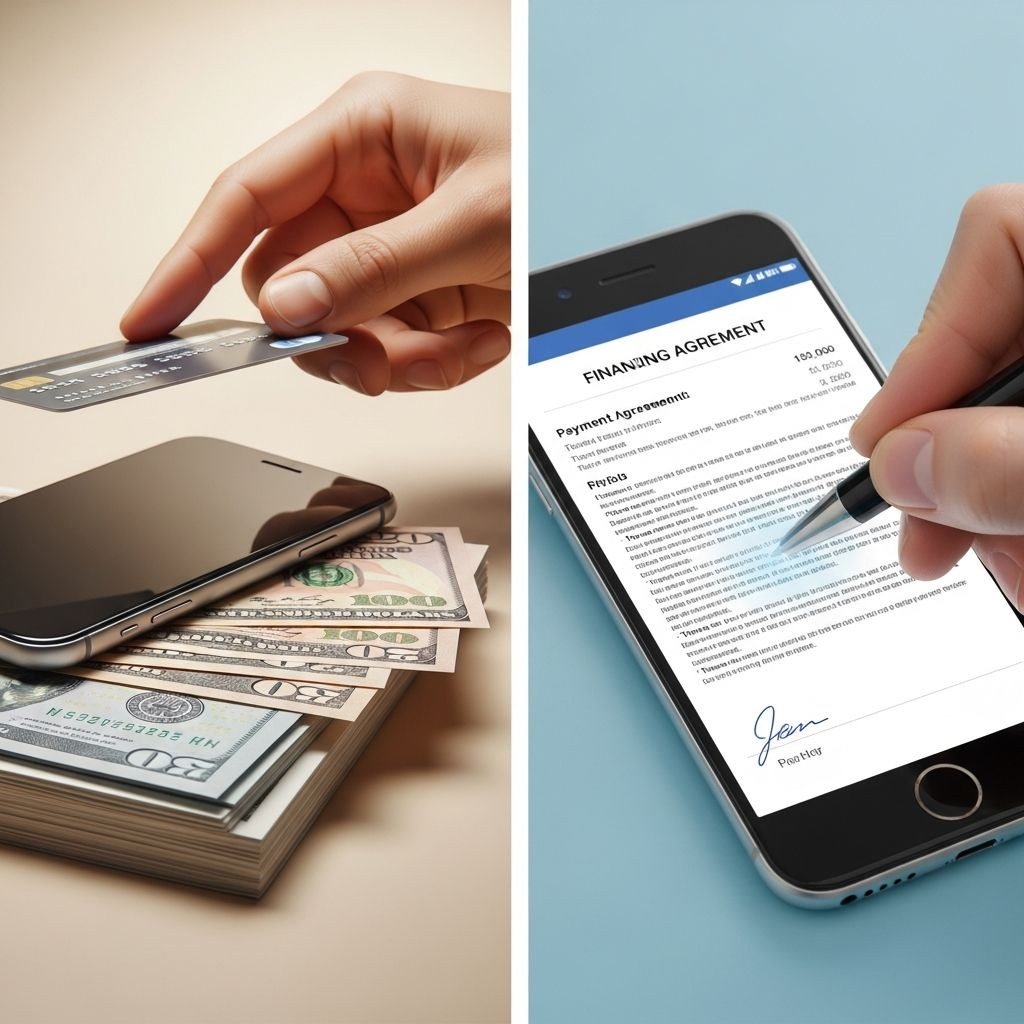
Is It Better to Buy a Phone Outright or Finance It Monthly?

Is it better to buy a phone outright or finance it monthly? The carrier store will happily sign you up for $33/month for 36 months — and present it as obviously smart. Sometimes it is. Often, it’s the most expensive way to buy a phone once you read the actual math.
I’ve bought phones both ways, and the right answer depends on three numbers most people never calculate. Let’s do the math together.
Is It Better to Buy a Phone Outright or Finance It Monthly? Do the Total-Cost Math
Start with the only number that matters: total cost of ownership over the phone’s life. A $1,000 phone financed at 0% APR for 24 months costs $1,000 — identical to buying outright. The financing itself is often interest-free, which makes monthly payments look like free money. And sometimes they nearly are.
But compare the financed price to the phone’s actual street price. Carriers sometimes inflate the financed price above retail, or bundle it with a plan that’s $15/month more than the equivalent SIM-only plan — that’s $360 over two years, making your ‘$0 down’ phone cost $360 in plan premiums. Always compare: (financed phone + required plan) vs. (outright phone + cheap SIM-only plan). The second combo wins more often than carriers admit.
The Real Cost: Carrier Lock-In
Financing’s hidden price is lock-in. Carrier installment plans typically require you to stay on that carrier (often on a premium plan tier) until the phone is paid off — 24 to 36 months. Want to switch to a cheaper carrier six months in? You’ll owe the remaining balance immediately, which wipes out the savings.
Outright ownership means freedom: switch carriers for a better deal anytime, sell the phone whenever you want, and negotiate as a free agent. Over three years, the ability to jump to a $25/month MVNO plan versus being stuck on a $70/month carrier plan is worth over $1,500 — dwarfing any phone discount. Flexibility has a dollar value; price it in. The FTC’s consumer resources at the Federal Trade Commission's consumer advice are worth a skim before signing any long contract.
The decision framework:
- Compare total cost: (financed phone + required plan) vs. (outright + SIM-only plan).
- Manufacturer 0% financing = usually fine. Carrier financing = check for plan premiums and lock-in.
- Never let a 36-month term trick you into a phone you couldn’t afford in 24.
- Best value play: last year’s flagship outright + cheap MVNO plan, kept 3+ years.
- Protect it: case + screen protector beats any insurance plan on value.
When Financing Actually Wins
Financing isn’t always a trap. Genuine wins: 0% APR installment plans with no plan-price penalty (common from Apple and Samsung directly, and increasingly from carriers), trade-in deals that genuinely beat the phone’s resale value (do the eBay math first — carriers sometimes overpay for trade-ins as a retention play), and cash-flow reality — if $1,000 upfront breaks the budget but $42/month doesn’t, financed is better than a credit card at 24% APR.
The key distinction: financing from the manufacturer (Apple, Samsung) usually has no strings — it’s just installment payments. Financing from a carrier usually has plan and lock-in strings. Same monthly payment, very different deal. Read which one you’re signing.
The Smart Buyer’s Playbook
My recommended sequence: buy last year’s flagship outright (20–30% cheaper, 95% of the experience), pair it with a cheap MVNO plan ($15–$30/month), and keep the phone for 3+ years. Total three-year cost: ~$700 phone + ~$900 service = $1,600. Compare the carrier path: $1,000 phone + $70/month × 36 = $3,520. The difference — nearly $2,000 — is the most expensive ‘convenience’ in consumer tech.
If you must finance, do it through the manufacturer at 0% with no plan strings, keep the term at 24 months max (36-month terms exist to make expensive phones feel cheap), and never finance accessories or insurance into the installment — that’s pure margin. And protect the investment: a case and a screen protector cost $40 and prevent the most common $200+ repair (see How much does it cost to replace a cracked phone screen at a repair shop for what that repair costs without protection).
The Bottom Line
Is It Better to Buy a Phone Outright or Finance It Monthly? The Fine Print
The fine print that matters most: early termination and payoff terms. Some carrier installment plans charge the remaining balance immediately if you leave — expected — but others also claw back promotional credits (‘free phone’ deals often require 24–36 months of bill credits; leave early and you owe the full retail price retroactively). That ‘$0 phone’ can become a $800 bill if you switch carriers at month 14. Read the promotion terms, not just the installment terms.
Also: check whether the financed phone is carrier-locked and when that lock lifts. Carrier policy varies — some release the lock after payoff, some after 60 days of service, some make you ask. An unlocked phone has meaningful resale value; a locked one doesn’t, which affects the total-cost math. And keep the box and accessories if you might resell — complete-in-box phones fetch 10–15% more on the used market. The financing decision doesn’t end at purchase; the exit terms shape the real cost.
Run the numbers on keeping your current phone one more year versus upgrading — it’s almost always the best financial move in the phone world. A battery replacement ($69–$99) and a factory reset can make a two-year-old phone feel new, and that extra year of ownership amortizes the purchase price dramatically. The financed-$33/month-for-36-months treadmill exists to keep you upgrading; stepping off it for even one cycle saves hundreds. The cheapest phone is the one you already own, made fresh again.
Buying outright with a cheap SIM-only plan beats carrier financing for most people — the plan savings dwarf any phone discount, and freedom to switch is worth real money. Manufacturer 0% financing without plan strings is the exception that works. Do the total-cost math, watch for lock-in, and remember the cheapest phone plan is the one you’re free to leave.
Read the promotion terms, understand the payoff-on-exit math, confirm the unlocking policy, and compare against outright-plus-cheap-plan honestly. Most of the time, outright wins — but an eyes-open financed deal with no strings can be fine. The enemy isn’t financing; it’s financing you didn’t fully understand.