
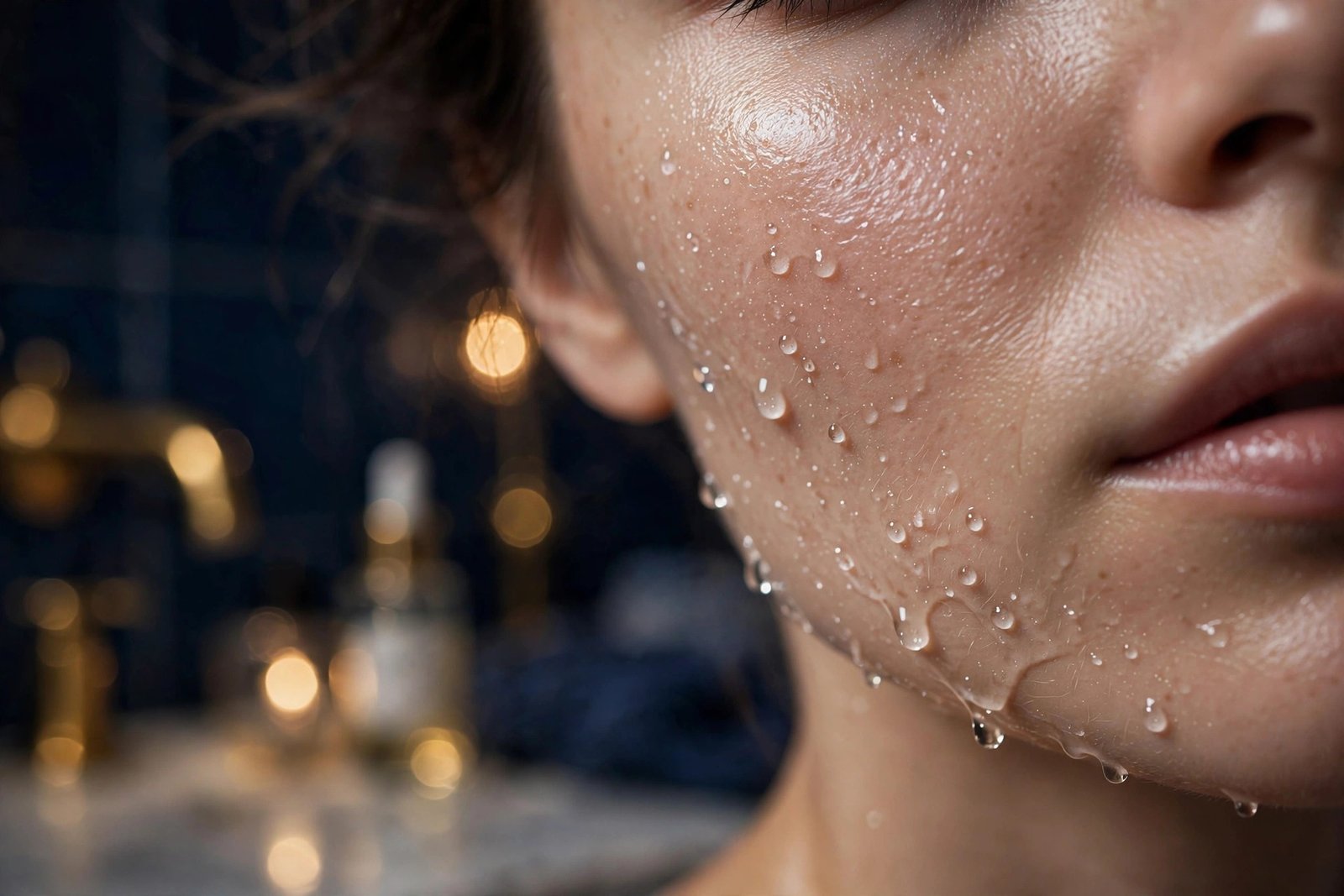
If your bathroom shelf looks like a chemistry lab, you are exactly the person skin cycling was invented for. The trend, introduced by dermatologist Dr. Whitney Bowe in 2022, is not a product but a scheduling philosophy: a four-night rotation that gives your skin active ingredients on some nights and deliberate rest on others — the glow of a multi-step routine without the redness and barrier damage of using everything at once.
But does the schedule actually matter, or is it just a new way to sell the same bottles? This guide breaks down what skin cycling really is, the biology behind it, and who should skip it.
What Skin Cycling Actually Means
Skin cycling is a four-night repeating cycle for your evening skincare routine:
- Night 1 — Exfoliation night: a chemical exfoliant (an AHA, BHA, or PHA) to dissolve dead skin cells and clear pores.
- Night 2 — Retinoid night: a retinol or prescription retinoid to accelerate cell turnover and target fine lines, dark spots, and acne.
- Nights 3 and 4 — Recovery nights: no actives at all. Just hydrating, barrier-supporting products like hyaluronic acid, ceramides, niacinamide, and a rich moisturizer.
Then the cycle repeats. Your morning routine stays constant throughout: gentle cleanser, antioxidant serum (vitamin C is the classic choice), moisturizer, and — non-negotiable — sunscreen. Dermatologists are emphatic that exfoliation and retinoids make skin more sun-sensitive, so choosing the right sunscreen for sensitive skin becomes even more important once you start cycling.
The core insight is restraint: most people damage their skin not with the wrong products but by using the right ones too often. Recovery nights let the barrier rebuild before the next round of actives.
The Biology: Why Your Skin Likes a Schedule
Your skin is not a passive surface; it is a living organ with its own repair rhythm. The outermost layer, the stratum corneum, is often described as a brick wall: skin cells are the bricks, and lipids (ceramides, cholesterol, fatty acids) are the mortar holding them together. This barrier keeps moisture in and irritants out.
Chemical exfoliants and retinoids deliberately disturb that wall. Alpha-hydroxy acids like glycolic and lactic acid loosen the bonds between dead cells so they shed faster. Retinoids bind to receptors in skin cells and speed up turnover — the process by which new cells travel from the basal layer to the surface, a journey that takes roughly 28 days in young adults and slows to 40–60 days with age, according to the American Academy of Dermatology. That acceleration is why retinoids remain, after decades of research, the gold-standard topical for photoaging.
Nightly bombardment never lets the mortar re-set: water loss rises, sensitivity spikes, and your face stings when you apply moisturizer. Recovery nights reverse this — ceramides and niacinamide support barrier repair, and two consecutive nights of them let the stratum corneum consolidate, like rest days after strength training.
How to Build Your Own Skin Cycling Routine
You do not need a special kit. You need four categories of product, most of which you may already own. Here is a practical framework, with options for beginners and experienced users.
Night 1: Exfoliation
After cleansing, apply a leave-on chemical exfoliant — dermatologists broadly prefer acids over harsh physical scrubs. Beginners should start with a PHA or low-strength lactic acid; experienced users might use glycolic acid, or salicylic acid if acne-prone. One thin layer, then moisturizer. Brief tingling is normal; burning or lingering redness means the product is too strong.
Night 2: Retinoid
Apply a pea-sized amount of retinol to dry skin — damp skin increases penetration and irritation. The “sandwich method” (moisturizer, retinol, moisturizer) buffers beginners well. Start at 0.25–0.3% and increase only after several uneventful cycles. If a dermatologist prescribed tretinoin, follow their schedule rather than forcing it into this framework.
Nights 3 and 4: Recovery
This is the part people skip, and it is the entire point. Layer a hyaluronic acid serum on damp skin, a niacinamide serum, then a ceramide-rich moisturizer — facial oil as a final step in dry climates. No acids, no retinoids: let the barrier do its quiet work.
Every Morning
Gentle cleanse, antioxidant serum, moisturizer, and broad-spectrum SPF 30 or higher. Morning sunscreen is the load-bearing wall of the whole routine — skip it and you create more pigmentation than the routine removes. It also helps to protect the investment with a consistent bedtime routine that supports skin repair, since deep sleep drives overnight regeneration.
Who Should Try It — and Who Should Sit This One Out
Good candidates: people with normal, combination, or mildly oily skin who want to simplify an overcomplicated routine; anyone who has experienced irritation from using actives nightly; beginners intimidated by multi-step regimens. The structure is genuinely clarifying — it answers the “what do I use tonight?” question permanently.
Proceed with caution: if you have rosacea, eczema, or very sensitive skin, the exfoliation and retinoid nights may still be too much — consider a longer cycle (one active night followed by three recovery nights) or skip retinoids entirely. If you are pregnant or trying to conceive, retinoids are contraindicated; consult your doctor. Anyone with active, inflamed acne or a diagnosed skin condition should get a dermatologist’s input before reorganizing their routine around a social media framework.
On the evidence: no published trials test “skin cycling” as a named protocol, but each component has strong evidence, and spacing irritants is standard dermatological advice. The American Academy of Dermatology’s guidance on using retinoids safely aligns with the cycle’s principles: start slow, moisturize, and protect from sun.
Common Mistakes That Ruin Skin Cycling
The most frequent errors: stacking actives on recovery nights (adding “just a little” vitamin C defeats the purpose), going too strong too fast (1% retinol plus 10% glycolic acid on day one), and ignoring your skin’s feedback — the four-night cycle is a template, not a law. Extend recovery nights if skin is still sensitive; as the Cleveland Clinic’s dermatologists note, understanding what each skincare ingredient does matters more than rigid scheduling.
What Results to Expect, and When
Set expectations on a biological timeline. Improved texture from exfoliation can appear within two to three weeks; retinoid benefits — softened fine lines, faded dark spots — typically need 8 to 12 weeks, because that is how long cell turnover takes to visibly remodel the surface. Temporary purging usually resolves within a month; persistent worsening beyond six weeks warrants a dermatologist visit.
Consistent retinoid use over months is what remodels collagen — see the peer-reviewed evidence on retinoids in photoaging via the National Library of Medicine. Skin cycling does not make retinoids work faster; it makes them tolerable enough that you keep using them, which is where most routines fail.
Frequently Asked Questions
Can beginners try skin cycling?
Yes — it is arguably the best framework for beginners because it prevents the classic mistake of using everything every night. Start with the gentlest actives, patch-test first, and consider a longer cycle (one exfoliation night, one retinoid night, three to four recovery nights) until your skin adapts.
Do I need to buy special “skin cycling” products?
No. The term describes a schedule, not a product line — several brands have simply repackaged existing exfoliants and retinoids with cycling labels. Any well-formulated AHA/BHA, retinol, and barrier moisturizer works. Spend on the retinoid and the sunscreen; those do the heavy lifting.
Can I skin cycle if I have acne?
Possibly, with adjustments. Salicylic acid on exfoliation night suits acne-prone skin better than glycolic acid, and recovery nights can calm inflammation. But moderate-to-severe acne deserves a dermatologist first — cycling is a cosmetic framework, not a treatment plan, and delaying effective treatment risks scarring.
What if my skin gets irritated anyway?
Pause the actives and do recovery nights until your skin feels normal again — usually three to five days. Then restart with lower strengths or a longer cycle. Persistent stinging, peeling that does not resolve, or new rashes mean something in the routine does not agree with you; remove products one at a time to identify the culprit.
Is skin cycling just a marketing trend?
The name is marketing; the principle is dermatology. Alternating actives with barrier recovery is standard clinical advice that predates the trend by decades. What the trend contributed was a memorable, easy-to-follow structure — and for many people, that structure is the difference between a routine they abandon and one they maintain.
The Bottom Line
Skin cycling earns its popularity honestly: it takes legitimate science — exfoliants resurface, retinoids remodel, barriers need rest — and packages it into a schedule simple enough to follow for years. It will not transform skin overnight, and it is no substitute for professional treatment of real skin conditions. But if your current routine is a nightly pile-on of actives, the four-night cycle is one of the most sensible resets in modern skincare. Start gentle, never skip morning sunscreen, and let biology do its slow work.