
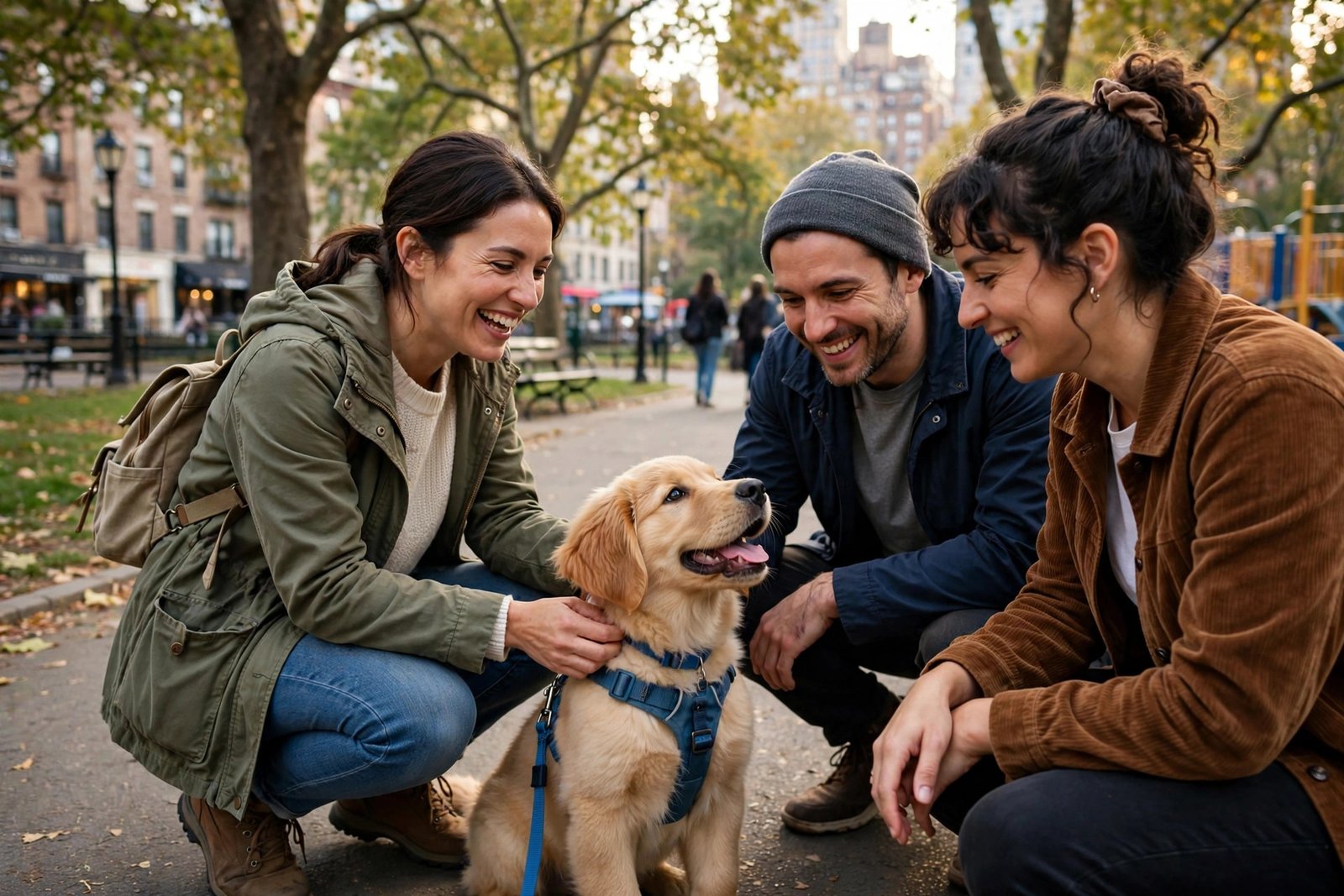
City puppies face a paradox: they need socialization more than suburban puppies (sirens, crowds, elevators, skateboards), yet the city is full of socialization hazards (unvaccinated dogs at the park, overwhelming stimuli, disease risks before vaccines are complete). The critical socialization window — roughly 3 to 14 weeks, with 8–12 weeks being prime time — doesn’t pause while you figure it out.
This guide explains how to socialize a puppy in the city safely: what the science says, how to expose without overexposing, navigating the vaccination dilemma, and the urban-specific exposures your puppy needs.
The Science: Why 3–14 Weeks Shapes Everything
Puppy brains have a developmental window when novel experiences get filed as “normal” rather than “threatening.” Positive exposures during 3–14 weeks — people of all ages and appearances, other vaccinated dogs, traffic sounds, elevators, umbrellas, wheelchairs — build a confident adult dog. Miss the window, and the same stimuli get filed as scary, producing the fearful, reactive adult dogs that fill city shelters.
The American Veterinary Society of Animal Behavior (AVSAB) takes a clear position: the risk of behavior problems from under-socialization exceeds the disease risk of careful early socialization. Translation: don’t lock your puppy indoors until 16 weeks “to be safe” — you’ll trade a small disease risk for a near-certain behavior problem. Socialize early, socialize smart, and socialize positively. Every interaction should end with the puppy thinking “that was fine” or “that was fun” — never “that was terrifying.” The AKC’s socialization guidance at AKC puppy socialization aligns with this science.
The Vaccination Dilemma: Safe vs. Sorry
Puppies aren’t fully vaccinated until ~16 weeks (the DHPP series), and parvovirus and distemper are real urban risks. The safe-socialization framework: carry your puppy in public (they experience the world from your arms — sounds, sights, people — with zero ground contact), host visitors at home (controlled, known dogs only), attend puppy kindergarten classes that require age-appropriate vaccination and sanitize floors (the AVSAB explicitly endorses these), and arrange playdates with healthy, vaccinated adult dogs you know.
Avoid until fully vaccinated: dog parks (uncontrolled, unknown vaccination status), pet-store floors, heavily trafficked dog-relief areas, and nose-to-nose greetings with strange dogs. The rule: socialize the puppy to the world, not necessarily to every dog in it — human, sound, surface, and handling exposures matter as much as dog-dog play. Your vet knows local disease prevalence; in high-parvo areas, be more conservative on ground contact while still maximizing carried exposures.
The Urban Exposure Checklist
City puppies need deliberate exposure to: sounds (traffic, sirens, construction, buses, skateboards — pair with treats), people (all ages, ethnicities, uniforms, hats, sunglasses, wheelchairs, strollers — the city’s diversity is a socialization asset), surfaces (concrete, grates, wet pavement, elevator floors, subway platforms), handling (paws, ears, mouth, collar grabs — vet and groomer prep), and experiences (elevators, car rides, outdoor cafes, crowded sidewalks).
Do it in micro-doses: 5–10 minute sessions, watch for stress signals (lip licking, yawning, tucked tail, avoidance), and retreat before overwhelm — flooding a puppy creates phobias. Treat generously; you’re building positive associations, not testing courage. A puppy who watches a bus go by while eating chicken builds a “buses are fine” file. Keep a checklist (100+ exposures is the enthusiast target) and track progress — what gets measured gets done. City living means meeting people constantly — see making new friends as an adult in a new city; your puppy’s social calendar can piggyback on yours.
Puppy Classes and Structured Socialization
Puppy kindergarten (for pups 8–16 weeks) is the highest-value investment in your dog’s life: supervised play with matched puppies, exposure to novel stimuli, and professional guidance on your specific puppy’s temperament. Choose force-free, positive-reinforcement classes — avoid any trainer using dominance theory, alpha rolls, or punishment-based methods, which the science has discredited and which damage the trust you’re building.
What good classes include: off-leash play with size/temperament matching, handling exercises, sound desensitization, and owner education (you’re really the student). Red flags: no vaccination requirements, overcrowded playgroups, trainers who can’t explain their methods, or any use of fear or pain. Cost: $150–$300 for a 4–6 week course — the cheapest behavior insurance you’ll ever buy. Many city shelters and training clubs offer them; book early, as puppy classes fill fast.
People, Dogs, and Hosting: The Social Strategy
Invite the world to meet your puppy: friends of all descriptions, kids (supervised — teach children to let the puppy approach, not chase), delivery people (pair the doorbell with treats to prevent alarm barking), and neighbors. Each positive human interaction builds the “strangers are safe” file that prevents fear-biting later.
For dog-dog socialization, quality beats quantity: a few well-matched playmates (similar size, play style, and energy) teach more than chaotic dog-park mobs. Host puppy playdates at home — controlled environment, known dogs, easy exits. Hosting friends at home doubles as puppy socialization when guests are briefed on the rules (let the puppy come to you, treats for calm, no looming). Avoid: dog parks before 16 weeks and full vaccination, forced interactions with scary dogs (“he’ll get over it” is how trauma works), and overwhelming events (street festivals, fireworks) during the fear periods (8–10 weeks and again ~6–14 months).
Mistakes That Create Problems
The big ones: waiting until vaccinations are complete to start (missing the prime window), flooding (too much too fast — the puppy “shuts down,” which looks like calm but is learned helplessness), punishing fear (comforting a scared puppy doesn’t “reward” fear — it builds trust), skipping handling practice (the dog who can’t tolerate paw-touching becomes the dog who bites at the vet), and inconsistency between household members (everyone uses the same rules and cues).
How to socialize a puppy in the city safely: start at 8 weeks, carry before vaccines are complete, attend puppy kindergarten, expose systematically to urban stimuli in micro-doses, host controlled playdates, and keep every experience positive. The city is the best socialization classroom on earth — use it deliberately. And remember that socialization doesn’t end at 14 weeks: the juvenile period through 6 months is when you proof those early lessons against the real world’s increasing distractions, so keep the exposures coming, keep them positive, and keep treats in every pocket.
The ASPCA and the American Veterinary Medical Association both publish detailed, vet-reviewed pet care guides.
Frequently Asked Questions
How do I socialize my puppy in the city safely?
Start at 8 weeks: carry your puppy in public before vaccinations are complete, attend puppy kindergarten (which requires age-appropriate vaccines), arrange playdates with known healthy dogs, and expose systematically to urban sounds, people, and surfaces in short positive sessions.
When should I start socializing my puppy?
Immediately — the critical window is 3–14 weeks, prime at 8–12. Don’t wait until 16 weeks for full vaccination; the AVSAB states under-socialization risk exceeds careful early-socialization disease risk.
Can my puppy go to the dog park before full vaccination?
No — wait until ~16 weeks and complete DHPP vaccination. Dog parks have uncontrolled, unknown-vaccination-status dogs. Use puppy classes and known-dog playdates instead.
How do I socialize a puppy to city sounds?
Micro-dose exposures: let the puppy hear traffic, sirens, and construction from a comfortable distance while eating high-value treats. Keep sessions to 5–10 minutes, watch for stress signals, and retreat before overwhelm.
What is the 3-14 week socialization window?
The developmental period when puppies file novel experiences as “normal” vs. “threatening.” Positive exposures to people, dogs, sounds, surfaces, and handling during this window build confident adults; missing it risks lifelong fear and reactivity.