
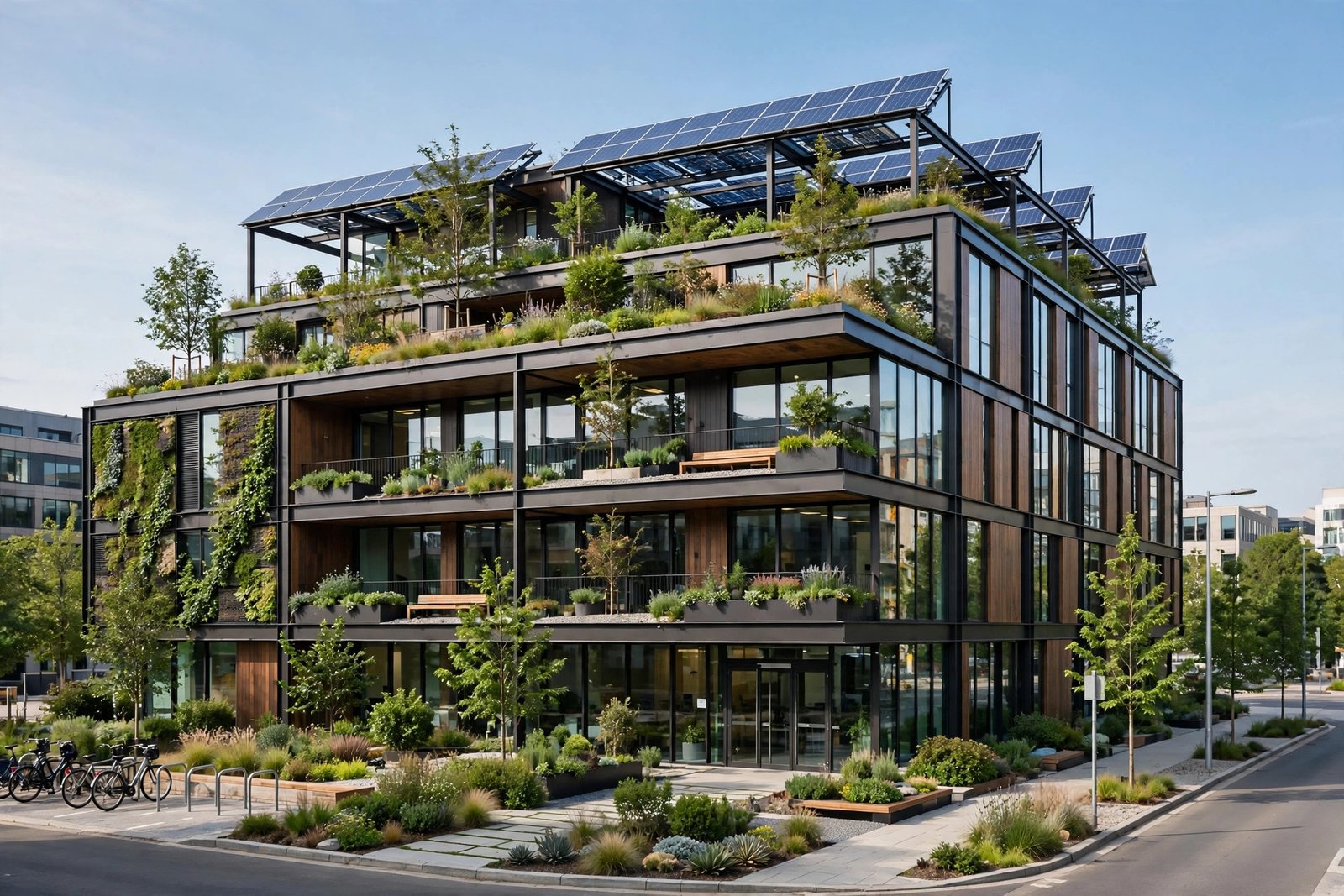
Sustainability used to be a marketing slogan — a green leaf on the packaging and a vague promise. Then energy prices spiked, customers started checking, employees started choosing employers by values, and regulations started biting. Today, the businesses thriving are often the ones that treat sustainability as operational strategy: cutting waste cuts costs, efficient buildings cut bills, and credible environmental commitments attract the talent and customers everyone competes for. The question shifted from “why bother” to “where do we start.”
How to make your business more sustainable? Through a systematic approach: measure your footprint, cut energy and waste (where the savings live), green the supply chain, engage employees, and certify credibly. Here is the practical roadmap for businesses of any size.
Step 1: Measure Before You Manage
You cannot improve what you do not measure. Start with a baseline: energy bills (electricity, gas, fuel) over 12 months, waste volumes and disposal costs, water usage, and business travel mileage. Free tools like the EPA’s Energy Star Portfolio Manager benchmark buildings against peers; carbon calculators estimate your footprint from utility data.
The audit usually reveals surprises — the “vampire loads” of equipment left on overnight, the waste stream that is 40 percent recyclable cardboard, the delivery routes that could be consolidated. Quantify in dollars as well as carbon: sustainability initiatives live or die on ROI, and the baseline is what proves the savings later. For small businesses, even a simple spreadsheet of monthly utilities and waste costs is a sufficient start. The EPA’s green business resources offer sector-specific starting points.
Energy: The Biggest Lever
Energy is typically the largest environmental footprint and the fastest payback. The hierarchy: reduce first (LED lighting, smart thermostats, equipment schedules, building envelope fixes), then produce (rooftop solar, where viable, increasingly with attractive paybacks), then purchase green power (renewable energy tariffs or credits for the remainder).
LED retrofits routinely pay back in 1–3 years through energy savings alone. HVAC optimization — the biggest energy user in most commercial buildings — rewards attention disproportionately. For larger operations, an ASHRAE-level energy audit identifies the specific measures with the best returns. And do not overlook behavior: the company that actually turns things off, enabled by clear policies and smart controls, saves 10–20 percent with near-zero investment. Energy efficiency is the rare initiative that is pure win: lower footprint, lower bills, better workplace.
Waste: From Cost Center to Resource
Waste is purchased material you paid to throw away — reframing it this way unlocks action. Conduct a waste audit: what leaves in the dumpster, and what is it worth? Typical wins: cardboard and paper recycling (often revenue-positive), food waste composting or donation, packaging reduction with suppliers, and going paperless where digital workflows suffice. Manufacturing businesses find the biggest gains in process efficiency — scrap reduction, material substitution, circular design.
Set a zero-waste-to-landfill goal as a north star; even partial progress transforms operations. And examine the supply chain: the packaging your suppliers use, the take-back programs available, the vendors whose practices align with yours. Procurement is sustainability policy expressed in purchase orders.
Green the Supply Chain
For most businesses, the supply chain dwarfs direct operations in environmental impact — Scope 3 emissions typically exceed Scopes 1 and 2 combined. Start with visibility: survey key suppliers on their environmental practices, prioritize local sourcing where it reduces transport emissions, and consolidate shipments. Then set expectations: supplier codes of conduct with environmental standards, preference for certified vendors, and collaboration on packaging reduction.
This is also risk management: supply chains dependent on volatile regions or environmentally destructive practices are fragile. Diversified, transparent, responsible sourcing is resilience. Small businesses have leverage here too — every purchasing decision is a vote, and suppliers notice when customers ask hard questions. The cumulative effect of thousands of businesses asking is what transforms industries.
Engage Employees: Culture Eats Strategy
The best sustainability plan dies without employee buy-in — and thrives with it. Form a green team with real authority and budget, not a symbolic committee. Tie sustainability to roles: facilities manages energy, procurement manages suppliers, everyone manages waste. Celebrate wins visibly and quantify them (“we saved $18,000 and 40 tons of CO2 this year”).
Extend to commuting and remote work: transit subsidies, EV charging, bike facilities, and remote-work options cut Scope 3 commuting emissions while improving satisfaction. And listen upward: frontline employees see waste that management misses — the suggestion box for efficiency ideas often outperforms consultants. A workforce that owns sustainability sustains it; a mandate from above merely complies with it.
Certify Credibly: Prove It
Claims without verification are greenwashing — and customers increasingly punish it. Credible certifications: B Corp (rigorous whole-company assessment via B Lab), LEED or Energy Star for buildings, Climate Neutral certification, and industry-specific labels (FSC for wood/paper, Fair Trade for commodities). Choose certifications your customers recognize and respect.
Report transparently: publish an annual sustainability summary with real numbers — energy, waste, progress against goals — including the misses. Honest reporting of shortfalls builds more trust than glossy claims of perfection. And align marketing with reality strictly: every environmental claim should be verifiable, because the regulators and the internet both check.
Water, Travel, and the Rest of the Footprint
Beyond energy and waste, address the remaining footprint. Water: fix leaks (a dripping tap wastes thousands of gallons yearly), install low-flow fixtures, landscape with natives that need no irrigation. Business travel: default to video for internal meetings, consolidate trips, choose direct flights (takeoff and landing burn the most fuel), and consider a travel carbon budget per team.
Digital footprint counts too: cloud providers with renewable-powered data centers, device lifecycle management (repair before replace, certified e-waste recycling), and efficient software practices. None of these individually transforms a footprint, but together they signal — to employees, customers, and yourself — that sustainability is comprehensive, not performative. The businesses that sweat these details are the ones whose claims survive scrutiny.
Set Targets and Report Progress
What gets measured gets managed — and what gets reported gets believed. Set specific, time-bound targets: 20 percent energy reduction in two years, 50 percent waste diversion in eighteen months, carbon neutrality by a defined date. Track monthly on a simple dashboard visible to the team. Celebrate milestones publicly; investigate misses honestly.
Annual reporting — even an informal summary shared with staff and customers — creates accountability that vague commitments never do. Include the numbers, the wins, and the shortfalls. Transparency about the journey builds more credibility than claims of arrival, and the discipline of reporting keeps sustainability on the agenda when daily urgencies compete for attention.
Conclusion
Making your business more sustainable means measuring your footprint, attacking energy and waste for the fastest returns, greening the supply chain where the biggest impacts hide, engaging employees as owners of the effort, and certifying achievements credibly. It is operational excellence with a longer time horizon — and the businesses that master it will own the future.
Further reading: For more on this topic, see starting a business while working full-time and traveling more sustainably without spending extra.
Frequently Asked Questions
Where should a small business start with sustainability?
Measure energy and waste baselines, then attack the fastest paybacks: LED lighting, smart thermostats, recycling, and packaging reduction. These typically pay for themselves within 1–3 years.
What is B Corp certification?
A rigorous third-party certification assessing a company’s social and environmental performance, accountability, and transparency. It is among the most credible whole-company sustainability credentials.
How does sustainability save businesses money?
Energy efficiency cuts utility bills, waste reduction cuts disposal costs and material purchases, and efficient operations generally cost less to run. Most core measures pay back in 1–3 years.
What are Scope 1, 2, and 3 emissions?
Scope 1: direct emissions (company vehicles, on-site fuel). Scope 2: purchased electricity/heat. Scope 3: supply chain and product lifecycle — typically the largest share and the hardest to address.