
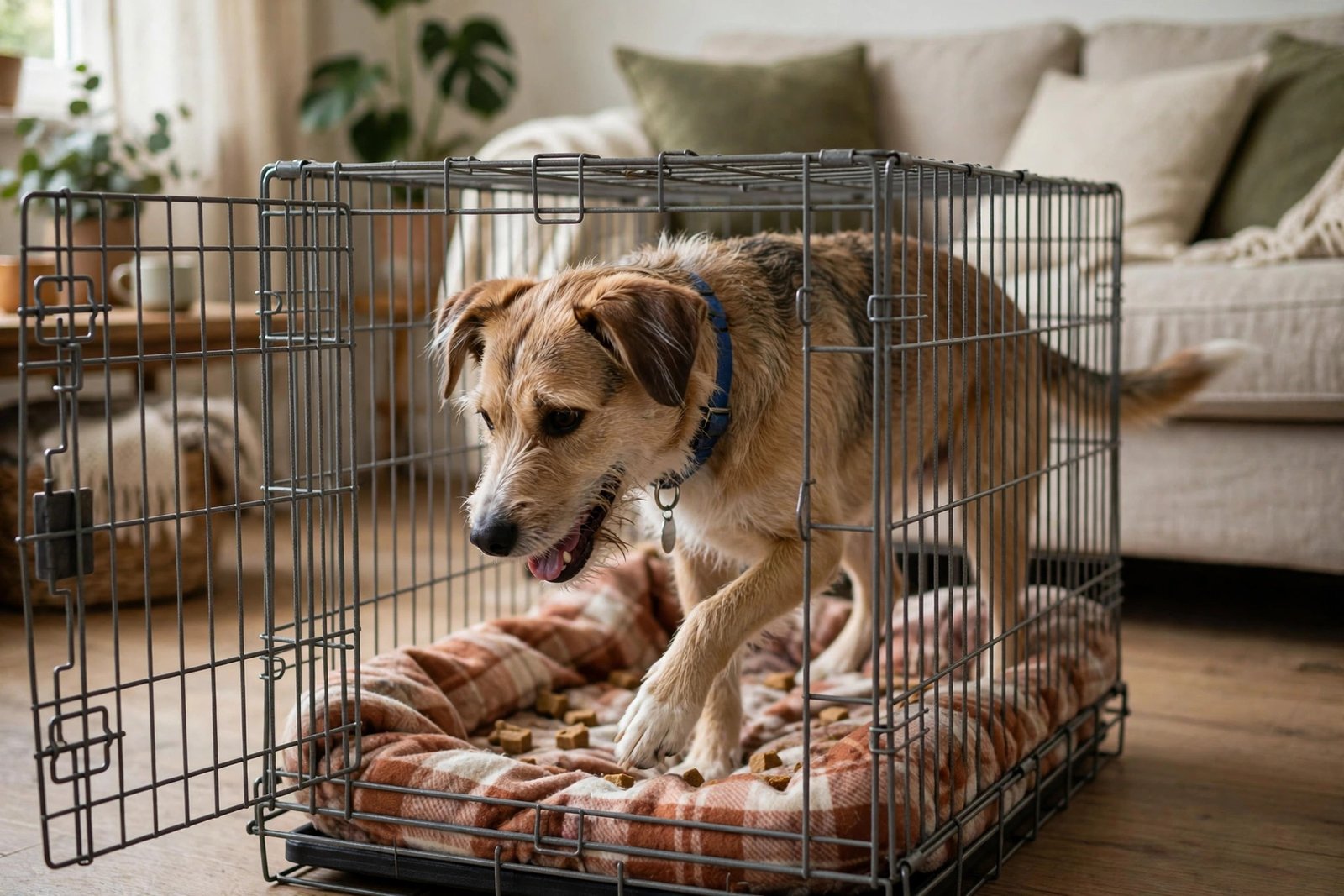
You just adopted a rescue dog. They’re wonderful — and they’re also stressed, confused, possibly never house-trained, and chewing your baseboards at 2 a.m. A crate can be the fastest path to a calm, house-trained, secure dog — but rescue dogs come with unknown histories, and “just crate them” without the right introduction can backfire into panic, injury, and a dog who fears the crate forever.
This guide explains how to crate train a rescue dog quickly — and correctly: choosing the crate, the introduction protocol that builds love (not fear), realistic timelines, rescue-specific challenges, and troubleshooting.
Why the Crate Works (When Done Right)
Dogs are den animals — a properly introduced crate becomes a bedroom, not a jail. For rescues specifically, the crate provides: a safe retreat in an overwhelming new home, house-training leverage (dogs avoid soiling their den), protection from bad decisions when unsupervised (chewing, trash-raiding, escape attempts), and a portable “home base” for vet visits and travel.
The non-negotiable rules: the crate is never punishment (one angry “go to your crate!” can poison it for months), time inside is limited (the rule of thumb: one hour per month of age for puppies, max 4–6 hours for adults during the day — rescues adjusting to a new home need the shorter end), and the introduction must be positive from the first second. A rescue dog’s first crate experience sets the tone — make it treats and comfort, never force. For the broader settling-in picture, the 3-3-3 rule applies: 3 days to decompress, 3 weeks to learn routines, 3 months to feel home — crate training rides alongside it. Structure helps everyone decompress — see building a bedtime routine for the human version of the same principle.
Choosing the Right Crate
Size: big enough to stand, turn around, and lie down comfortably — no bigger. Oversized crates defeat house-training (the dog sleeps in one corner, soils in the other); use the divider panel that comes with most wire crates. Type: wire crates (best ventilation, visibility, and they fold flat; cover with a blanket for den coziness), plastic airline crates (den-like, good for anxious dogs, required for air travel), or soft-sided (only for already crate-trained dogs — a panicked rescue shreds fabric).
Setup: place the crate in a social area (living room, not isolated garage — isolation breeds anxiety), make it inviting (soft bedding, a worn t-shirt smelling like you, a safe chew), and keep the door open initially — the crate should be furniture that dispenses treats, not a trap. For heavy chewers or escape artists, invest in a sturdier crate upfront; a dog who learns they can break out will try forever. Small-space living just means smarter placement — see making a small apartment feel bigger for fitting big-dog gear into tight quarters.
The Introduction Protocol: Days 1–3
Day 1: door open, treats scattered inside, meals fed in the crate — no door closing at all. Let the dog explore on their terms; every voluntary entry earns praise and treats. Some rescues walk right in (previous crate experience); others won’t go near it (bad associations) — both are workable, just different timelines.
Day 2: start brief door-closed sessions — treat inside, close the door for 5–10 seconds while you’re sitting beside the crate, open before any fussing. Repeat 10–15 times through the day, gradually extending. Feed all meals inside with the door closed. Day 3: extend to 15–30 minutes with you nearby, then briefly out of sight. The principle: always open the door before the dog panics — you’re building a history of “the door always opens,” which is what creates calm. If the dog has unknown history and shows crate panic (drooling, bending bars, self-injury), stop and consult a force-free trainer — some rescues need desensitization protocols spanning weeks, and pushing through panic causes harm. The ASPCA’s crate guidance at ASPCA dog behavior resources covers the fundamentals.
The Training Schedule: Days 4–14
Once the dog enters happily and settles for 30 minutes: build duration systematically — 1 hour while you’re home, then practice departures (leave for 5 minutes, return calmly — no emotional hellos/goodbyes, which spike anxiety). Add a cue (“kennel up” or “bed”) paired with a high-value treat that only appears at crate time (a stuffed Kong is the classic).
Nighttime: crate in your bedroom initially — proximity reduces anxiety dramatically for new rescues. Move it gradually once the dog is settled (a week or two). Daytime: maximum 4 hours for new rescues (build to 6 only once fully comfortable), with a midday break for dogs alone all day — a dog walker or neighbor visit isn’t optional for full-time workers, it’s welfare. House-training synergy: crate → outside immediately on release (puppies and untrained rescues) — the crate’s den instinct does half the training for you.
Rescue-Specific Challenges
Unknown history: assume nothing — the dog flinching at raised hands, panicking at the crate door sound, or freezing at thresholds is communicating past experience. Go slower than you think necessary; you can always speed up, but you can’t undo a flooding incident. Separation anxiety: common in rescues (abandonment history) — the crate helps mild cases but worsens severe ones if the dog panics inside; video your dog when alone (a $30 camera answers everything) and get professional help for true separation anxiety rather than hoping the crate fixes it.
House-training from scratch: many rescues were never trained — treat them like puppies regardless of age (frequent outs, massive praise, zero punishment for accidents). Resource guarding in the crate: feed in the crate but don’t reach in to take things; trade up (offer better treats for drops) rather than confronting. Regression: week 2–3 often brings testing as the dog feels safer — normal, not failure. Stay consistent.
Troubleshooting: When It’s Not Working
Whining/barking: wait for a pause before opening (opening mid-bark trains barking), ensure needs are met first (pottied? exercised? not too hot?), and never let them “cry it out” for hours — that’s not training, it’s flooding. Escaping: upgrade the crate (not punishment), and address the underlying panic — escape attempts mean the introduction went too fast. Refusing to enter: back up to Day 1 protocol — treats, meals, no pressure — and check for aversive associations (was the door slammed? was the dog forced?).
How to crate train a rescue dog quickly: the fastest path is the patient one — positive introduction over 3 days, systematic duration-building over 2 weeks, realistic expectations for rescue baggage, and professional help at the first sign of true panic. Rushing creates months of problems; patience creates a dog who loves their crate within a fortnight.
For breed-specific guidance see the American Kennel Club; for veterinary research summaries, Cornell University’s College of Veterinary Medicine.
Frequently Asked Questions
How do you crate train a rescue dog quickly?
Days 1–3: treats and meals in the open crate, no forced closing. Days 4–7: brief closed-door sessions building to 30+ minutes. Week 2: practice departures, add a cue, crate at night in your bedroom. Most rescues settle within 2 weeks with consistent positive training.
Should you crate a rescue dog at night?
Yes — in your bedroom initially. Proximity reduces new-home anxiety dramatically. Move the crate to its permanent spot after 1–2 weeks once the dog is settled and sleeping through.
What size crate for a rescue dog?
Big enough to stand, turn, and lie down — no bigger (use divider panels). Oversized crates undermine house-training. Wire crates with a blanket cover suit most rescues; plastic crates suit anxious dogs.
What if my rescue dog panics in the crate?
Stop and slow down — panic (drooling, bar-bending, self-injury) means the introduction went too fast. Return to Day 1 protocol, consult a force-free trainer, and video the dog when alone to distinguish crate issues from separation anxiety.
How long can a rescue dog stay in a crate?
New rescues: max 4 hours daytime initially, building to 6 once comfortable. Puppies: one hour per month of age. The crate is never an all-day solution — arrange midday breaks for full-time workers.