
Introduction: Why Brew Your Own Stout?
Stout is one of the most satisfying beers to brew at home. It is dark, smooth, and full of roasted flavor — coffee, chocolate, and caramel in a glass. Homemade stout also costs less per bottle than buying it.
Best of all, stout is forgiving for beginners. Its bold flavor hides small mistakes that would stand out in a light beer. Before you begin, you may also enjoy our homebrewing basics guide, which covers the core process every beginner should know.
What You Need to Brew a Stout
This recipe makes about 5 gallons (roughly 50 twelve-ounce bottles) — the standard homebrew batch size.
Ingredients
- Liquid malt extract (6.6 lbs / 3 kg) — a dark or amber extract. This gives the beer its body, alcohol, and much of its flavor.
- Specialty grains — about 1 lb roasted barley, 8 oz chocolate malt, and 8 oz crystal malt. These create the dark color and roasted, coffee-like taste.
- Hops (1 to 2 oz) — a mild variety such as East Kent Goldings. Hops add balance so the beer is not too sweet.
- Ale yeast (1 packet) — a clean ale yeast such as Safale US-05 or S-04. It works at room temperature, which is easy for beginners.
- Priming sugar (4 to 5 oz) — corn sugar or table sugar, added at bottling time to create carbonation.
- Water (5+ gallons) — clean tap water is usually fine. If it smells strongly of chlorine, filter it or let it sit uncovered overnight.
Equipment
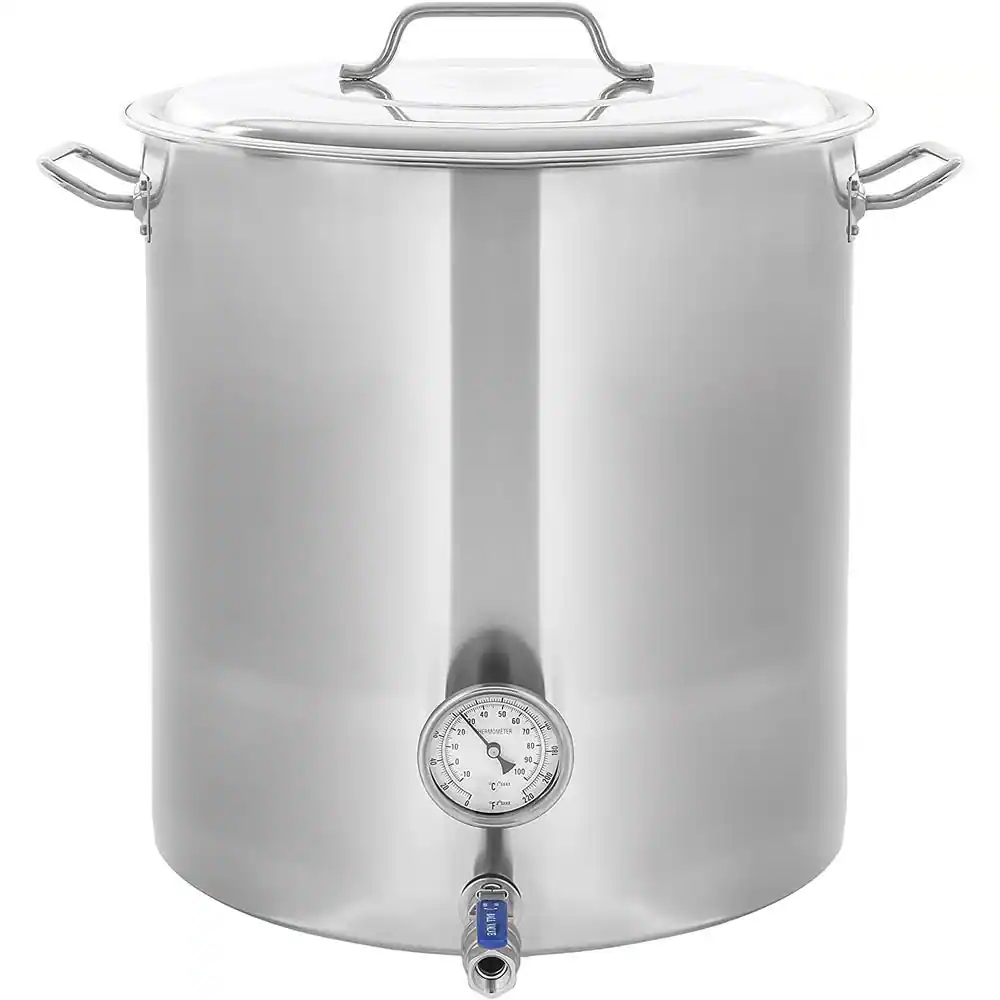
- Large brew kettle (at least 5 gallons / 20 liters)
- Fermenter bucket or carboy with airlock
- Siphon tube (racking cane)
- Bottles, caps, and a capper
- No-rinse sanitizer
- Thermometer and a long spoon
- Muslin bag or large strainer for the grains
You can buy all of this as a starter kit. If you want ideas for first recipes to try, browse our beginner beer recipe collection.
How to Brew a Stout at Home: Step by Step
Step 1: Sanitize Everything
Anything that touches your beer after boiling must be sanitized. Soak your fermenter, airlock, siphon, spoon, and thermometer in no-rinse sanitizer. Dirty equipment — not bad recipes — causes most failed batches.
Step 2: Steep the Specialty Grains
Heat about 2.5 gallons of water to 150–160°F (65–70°C). Put the specialty grains in a muslin bag and steep for 30 minutes. This is like making a big cup of tea — the hot water pulls color and roasted flavor from the grains. Remove the bag and let it drip; do not squeeze it hard, or you may release bitter tannins.
Step 3: Add the Malt Extract and Bring to a Boil
Bring the liquid to a boil, turn off the heat, and stir in the liquid malt extract until fully dissolved. (Turning off the heat first stops the thick extract from scorching on the bottom.) Then bring it back to a rolling boil.
Step 4: Add the Hops
Once boiling, add your bittering hops and set a timer for 60 minutes. If your recipe includes aroma hops, add them during the last 10 minutes. The boil sterilizes the liquid and pulls bitterness from the hops.
Step 5: Cool the Wort Quickly
The sugary liquid you have made is called “wort” (pronounced like “wert”). Cool it to about 70°F (21°C) before adding yeast, because hot liquid will kill the yeast. Place the kettle in a sink of ice water and stir gently. This usually takes 20–30 minutes.
Step 6: Transfer and Pitch the Yeast
Pour the cooled wort into your sanitized fermenter and top up with clean water to 5 gallons. Sprinkle the yeast on top and seal with the airlock. Store somewhere dark at 65–70°F (18–21°C). Bubbles in the airlock within 24–48 hours mean fermentation has started. Leave it for 1 to 2 weeks.
Step 7: Bottle and Condition
After 2 weeks, fermentation is usually finished. Boil the priming sugar in a cup of water, cool it, and add it to a sanitized bottling bucket. Siphon the beer onto the sugar, then fill and cap your bottles. Store them at room temperature for 2 to 3 weeks so the yeast eats the sugar and creates carbonation. Then chill a bottle and enjoy.
Tips for a Better Stout
- Control the temperature. Fermenting above 75°F (24°C) creates harsh flavors. A cool closet is often enough.
- Do not rush. Stout tastes better after a few weeks of bottle conditioning.
- Take notes. Write down your recipe and dates. If a batch tastes amazing, you will want to repeat it exactly.
- Keep bottles out of light. Light can make beer taste “skunky.” Store bottles in a dark place.
Common Mistakes (and How to Fix Them)
- Mistake: Skipping sanitation. This causes sour or off flavors. Fix: sanitize everything that touches the beer after the boil, every time.
- Mistake: Fermenting too warm. This creates harsh flavors. Fix: keep the fermenter around 65–70°F (18–21°C).
- Mistake: Bottling too early. This can cause over-carbonated or even exploding bottles. Fix: wait a full 2 weeks until airlock activity stops.
- Mistake: Drinking it too soon. A stout tasted after one week in the bottle seems flat and harsh. Fix: give it at least 3 weeks of conditioning.
- Mistake: Splashing the beer when transferring. Air exposure after fermentation causes stale, cardboard-like flavors. Fix: siphon gently.
For more detail on the bottling stage, see our guide to bottling homebrew.
FAQs About Brewing Stout at Home
How long does it take to brew a stout?
About 4 to 6 weeks from brew day to drinking: roughly 3–4 hours of brewing, 1–2 weeks of fermenting, and 2–3 weeks of bottle conditioning.
How much does it cost?
A starter kit costs around $50–$100, and each 5-gallon batch of ingredients runs roughly $25–$45 — well under $1 per bottle.
What alcohol percentage will my stout be?
About 4.5–5.5% ABV, similar to a classic Irish dry stout.
Can I use tap water?
Yes, if it is safe to drink. Strong chlorine is the only common problem, and a simple carbon filter removes it.
Do I need a special stout kit?
No. A standard starter kit plus stout ingredients is enough. Ready-made stout ingredient kits are a convenient option for your first batch.
How long does homemade stout last?
Bottled stout keeps for 6–12 months in a cool, dark place and improves over the first 2–3 months.
Is homebrewing legal?
In the US, homebrewing is legal in all 50 states for personal use, with yearly limits (see the American Homebrewers Association for details). In the UK, you may brew for personal consumption without a license. Always check your local laws first.
Final Thoughts
Brewing a stout at home is easier than most people expect. Sanitize well, follow the steps, and give the beer time — that is all it takes. Your first batch may not be perfect, but it will be enjoyable, and each batch after that will be better.
If you want to learn more about the history and styles of this beer, read the stout article on Wikipedia or the beginner resources at the American Homebrewers Association. Then pick a quiet afternoon and brew your first stout.