
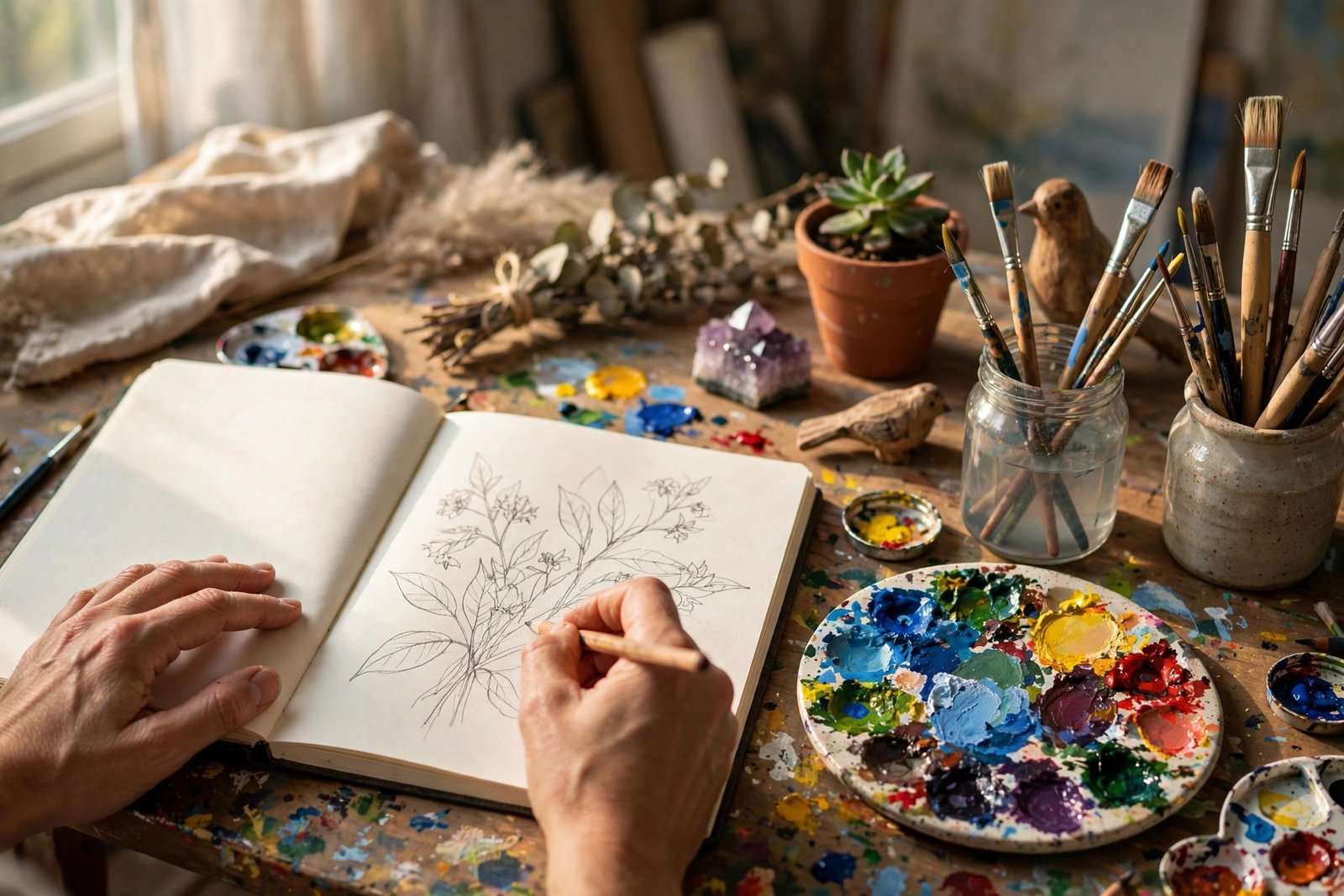
Creativity looks like a gift — some people have it, you do not, end of story. This is the most damaging myth in creative life. Research consistently shows creativity is not a trait but a practice: a set of habits, inputs, and constraints that anyone can install. The people we call “creative” are usually just people with better creative routines, practiced daily until the output looks effortless.
How to become more creative every day? By treating creativity as a system: daily generation habits, a rich input diet, deliberate constraints, cross-pollination between domains, and the patience to let quantity become quality. Here is the practical guide.
Generate Daily: Quantity Begets Quality
The foundation is embarrassingly simple: make something every day. Write 500 words, sketch for 20 minutes, photograph one interesting thing, compose a melody fragment. The output will often be bad — that is the point. Creative research, including the famous work on “creative productivity,” shows that the most creative people simply produce more; their hit rate is not higher, their volume is.
Morning pages — three longhand pages written before the day’s noise — unclog the mental pipes for writers and non-writers alike. A daily sketch or photo trains visual attention. The medium matters less than the streak: daily generation builds the neural pathways of fluency, so ideas arrive faster and stranger. Protect this time fiercely; it is the gym session of the creative life. Even fifteen minutes compounds astonishingly over a year — the same compounding behind any morning routine that actually sticks.
Feed the Machine: Your Input Diet
Creativity is combinatorial — new ideas are old ideas combined in new ways. Which means your creative output is capped by your inputs. A diet of algorithmic feeds and familiar genres produces familiar thoughts. Deliberately diversify: read outside your field (a poet studying architecture, a programmer reading biology), visit museums, watch films with subtitles, listen to music from other centuries and continents.
Keep a capture system — a notebook, a notes app, a voice memo habit — for the fragments inputs spark. Ideas are slippery; the ones you do not capture evaporate. Review the captures weekly; patterns emerge that become projects. And schedule boredom: walks without podcasts, showers without rushing, commutes without scrolling. The brain’s default mode network — active during mind-wandering — is where distant ideas connect. Constant stimulation starves it. Some of the best thinking about creative process, including widely-viewed TED talks on creativity, returns to this paradox: doing less, deliberately, produces more.
Steal Like an Artist (Ethically)
Study masters deeply, not to copy but to understand. Deconstruct what you admire: why does this paragraph work, what makes this design sing, how does this song build tension? Imitation is the apprenticeship phase of every creative field — the key is imitating many sources, not one, so the influences fuse into something yours. Keep a “swipe file” of admired work with notes on what you would steal and transform.
Use Constraints as Fuel
Counterintuitively, limits boost creativity. A blank page paralyzes; a haiku’s 17 syllables liberate. Impose constraints deliberately: write the story in 100 words, design with two colors, compose with three chords, solve the problem assuming the obvious solution is banned. Constraints force the brain off autopilot and into invention.
Time constraints work too: the 25-minute sprint, the one-hour song challenge, the weekend project. Deadlines compress dithering and force decisions — and creative work improves with decidedness. Even arbitrary rules (“no adjectives today”) jolt you out of ruts. When you feel stuck, do not remove limits; add them.
Cross-Pollinate Ruthlessly
Breakthrough ideas usually arrive as imports: a business model borrowed from biology, a narrative structure stolen from music, a design solution from nature. Deliberately collide domains: attend talks outside your field, collaborate with people who think differently, apply one discipline’s tools to another’s problems. Biomimicry, design thinking, and most innovation methodologies are formalized cross-pollination.
Maintain at least one “foreign” interest deeply enough to think in its terms — the gardener-programmer sees systems differently than the pure programmer. Travel, even locally, with curious eyes: new environments force new perceptions. The creative generalist, long dismissed as unfocused, is increasingly recognized as the innovation engine — depth in one field, breadth across many.
Protect the Fragile Early Stage
New ideas are tender and die easily — usually murdered by premature judgment, yours or others’. Separate generation from evaluation: brainstorm without critiquing, draft without editing, explore without deciding. Schedule the critic for later; during creation, the only rule is forward motion.
Choose your first audience carefully. Share early work only with people who understand drafts — fellow creators, trusted friends — not with those who evaluate finished products. And develop a thick skin selectively: seek criticism of the work’s effectiveness, ignore criticism of its right to exist. Every creator you admire survived a phase where their work was bad and their belief was all they had.
The Creative Environment
Your surroundings shape your output more than willpower does. Design a space that invites making: tools visible and ready (friction kills daily practice — the guitar on the stand gets played, the one in the closet does not), inspiration in sight (books, art, objects that spark), and distractions managed (phone in another room during creative time). Many creators swear by a dedicated corner, however small, that signals “this is where making happens.”
Curate your social environment too. Spend time with makers — creativity is contagious, and regular contact with productive creators normalizes the practice. Join a group, class, or online community where sharing work-in-progress is expected; accountability and feedback accelerate growth dramatically. Conversely, limit exposure to voices that treat creative ambition as frivolous. The people around you are either fuel or friction — choose fuel.
Measure Progress Like a Scientist
Creative growth is hard to see day to day, which is why motivation fades. Track it: keep a log of daily sessions, photograph progress weekly, save early drafts to compare against later work. Monthly reviews reveal the compounding that daily perception misses — the sketchbook that looked stagnant shows obvious improvement across twelve weeks.
Set process goals (sessions completed) rather than outcome goals (masterpieces produced); you control the former, not the latter. Celebrate streaks and milestones. The data of your own progress is the most convincing argument against the days when you feel untalented — feelings lie, but the log does not.
Conclusion
Becoming more creative every day means generating daily in volume, feeding on diverse inputs, imposing productive constraints, cross-pollinating between domains, and protecting fragile new ideas from premature judgment. Creativity is not a gift you wait for — it is a practice you install, one daily session at a time.
Further reading: For more on this topic, see getting back into reading and APA research on everyday creativity.
Frequently Asked Questions
Can creativity be learned or is it innate?
It can be learned. Research shows creative output correlates far more with habits — daily generation, diverse inputs, domain knowledge — than with innate traits. Creative people are made through practice, not born.
What is the best daily creativity habit?
Daily generation in your medium: write, sketch, photograph, or compose every day, even briefly. Volume builds fluency, and fluency produces the conditions for original ideas.
How do constraints help creativity?
Constraints eliminate the paralysis of infinite options and force inventive solutions. Limits on form, time, or materials push the brain off autopilot into genuinely new territory.
Why is boredom good for creativity?
Mind-wandering activates the brain’s default mode network, where distant ideas connect. Constant stimulation suppresses this; deliberate unstructured time — walks, showers, idle moments — feeds it.