
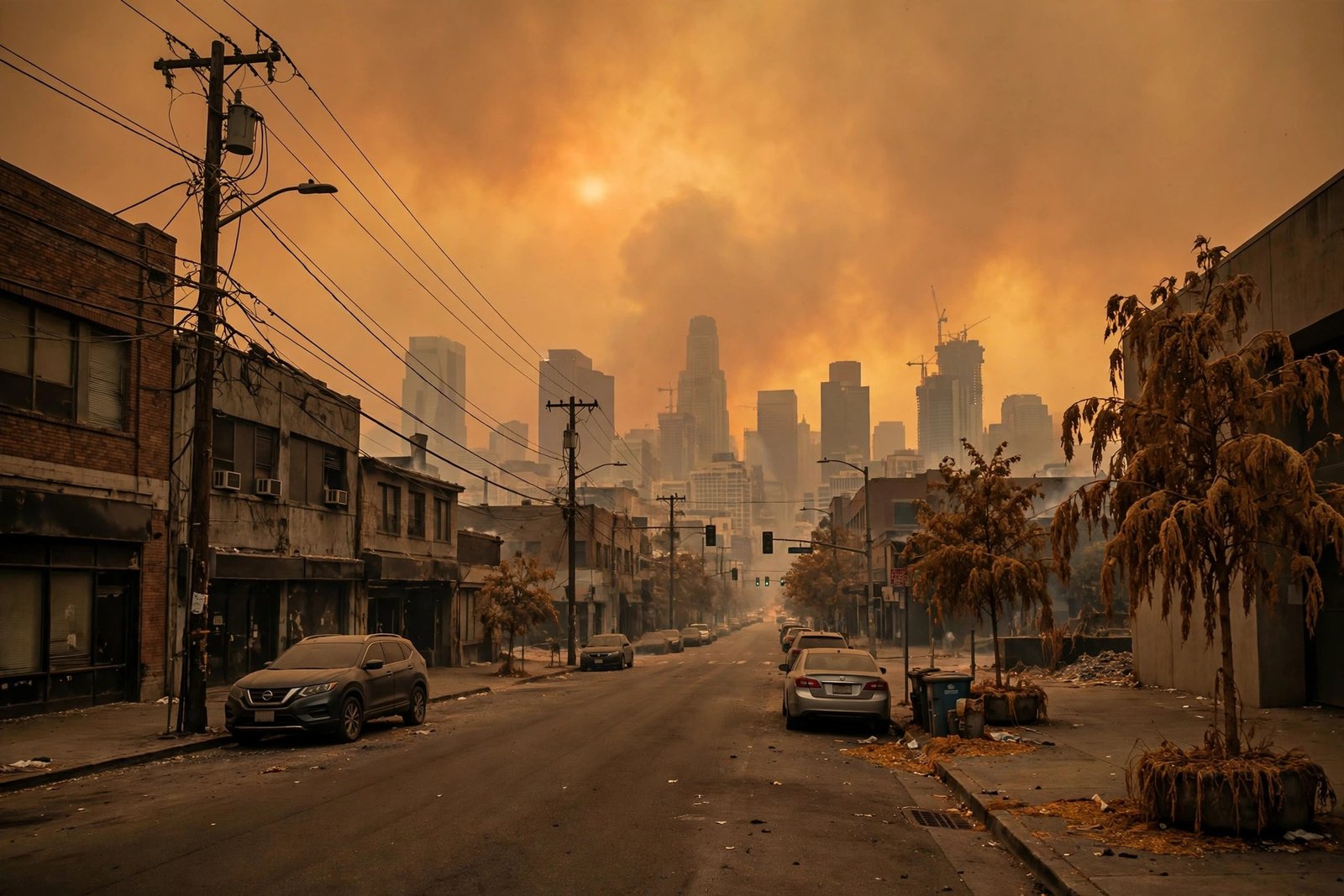
You can smell a wildfire hundreds of miles before you see it — a campfire scent on the wind that means the air itself has turned against you. During severe fire seasons, smoke has blanketed entire regions for weeks: San Francisco’s skies turned apocalyptic orange in 2020, New York choked on Canadian wildfire smoke in 2023, and cities from Sydney to Athens have all had their turn. The eerie light is the least of it. What that haze does inside your lungs is a serious, well-documented health threat — even for healthy people, and far from the flames.
How does wildfire smoke affect your lungs? The answer lies in particles so small they slip past your body’s defenses and into your bloodstream, carrying a cocktail of gases and chemicals. Here is what the science says about the damage, who is most vulnerable, and the practical steps that genuinely protect you when the sky fills with smoke.
The Culprit: PM2.5 and Toxic Gases
Wildfire smoke is a complex mixture, but its most dangerous component is fine particulate matter — PM2.5, particles smaller than 2.5 micrometers, roughly one-thirtieth the width of a human hair. These particles are small enough to bypass the nose and throat’s filtering, travel deep into the lung’s tiny air sacs (alveoli), and in the smallest fractions, cross into the bloodstream.
Alongside the particles come gases: carbon monoxide, formaldehyde, acrolein, benzene, and polycyclic aromatic hydrocarbons. The exact recipe varies with what is burning — a eucalyptus forest, a suburban neighborhood, or a peat bog each produce different chemical signatures, and structure fires add plastics and treated wood to the mix. But PM2.5 is the pollutant health agencies track most closely, because the evidence linking it to harm is overwhelming. The EPA’s wildfire smoke guidance treats PM2.5 as the primary yardstick for danger.
What Happens Inside Your Airways
When PM2.5 reaches your lungs, the immune system treats it as an invader. Airway linings inflame, mucus production surges, and the tiny cilia that sweep debris out of your lungs become impaired. For healthy adults, this typically means coughing, throat irritation, wheezing, chest tightness, and stinging eyes during heavy smoke days — miserable but reversible once the air clears.
For vulnerable lungs, the story darkens. People with asthma face more frequent and severe attacks; studies of major fire seasons show emergency room visits for asthma and COPD spike in direct proportion to smoke density. Those with chronic bronchitis, emphysema, or heart disease face elevated risk of hospitalization and, in severe episodes, premature death. Fine particles do not stay in the lungs either — once in the bloodstream, they promote systemic inflammation linked to heart attacks and strokes. This is why cardiologists, not just pulmonologists, warn their patients about smoke days.
Children, the Elderly, and Pregnancy
Children breathe faster than adults relative to body size, inhaling more pollution per pound, and their lungs are still developing — repeated heavy smoke exposure in childhood is associated with lasting reductions in lung function growth. Older adults often carry the heart and lung conditions that smoke aggravates. Pregnant people face particular concern: research links wildfire smoke exposure to higher risks of preterm birth and low birth weight. If you belong to any of these groups, smoke days deserve the same seriousness as a severe weather warning. Even routine wellness habits matter more under smoke stress, which is why doctors remind patients that foundations like daily moderate exercise for lung and heart health pay off most when air quality is good and recovery is possible.
Reading the Air: AQI and What the Numbers Mean
The Air Quality Index translates PM2.5 concentrations into a 0–500 scale with color-coded categories. Green (0–50) is good; yellow (51–100) moderate; orange (101–150) unhealthy for sensitive groups; red (151–200) unhealthy for everyone; purple (201–300) very unhealthy; maroon (301+) hazardous. During extreme events, monitors have pegged readings above 500 — literally off the chart.
Check your local AQI on AirNow.gov or the EPA’s Fire and Smoke Map before planning outdoor activity. A critical nuance: AQI reflects outdoor air at the monitor’s location, and smoke varies block by block. If you smell smoke or see haze, trust your senses over a distant monitor. And remember that AQI is a 24-hour-oriented scale — exercising hard for an hour in “moderate” air still delivers a meaningful particle dose to deep lung tissue.
How to Actually Protect Your Lungs
Generic advice (“stay inside”) undersells what works. Protection is a layered strategy, and the layers matter.
Make Indoor Air Safe
Your home can be a clean-air refuge if you prepare it. Keep windows and doors closed, and run air conditioning on recirculate. A portable HEPA air cleaner sized for the room genuinely reduces indoor PM2.5 — this is the single most effective household intervention. Upgrading your HVAC filter to MERV-13 or higher helps if your system can handle the airflow resistance. Avoid adding to the indoor burden: no candles, no frying, no vacuuming without a HEPA filter, no smoking. A 20-inch box fan taped to a MERV-13 furnace filter — the famous DIY “Corsi-Rosenthal box” — is a proven budget alternative that researchers have validated.
Mask Up Properly Outdoors
Cloth and surgical masks do almost nothing against PM2.5. What works: N95 or KN95 respirators, fit-tested by pressing the nosepiece and checking for leaks around the edges. A well-sealed N95 filters at least 95 percent of fine particles. Keep a supply before fire season — they sell out when smoke arrives. And reschedule strenuous outdoor exercise when AQI exceeds 100; the harder you breathe, the deeper particles go.
Know When to Leave
For prolonged extreme events, the healthiest option may be temporary relocation — staying with friends or family in cleaner air, especially for children, the elderly, and those with chronic conditions. Public health agencies increasingly frame extended smoke episodes as evacuation-worthy for the most vulnerable, not merely an inconvenience.
The Long-Term Picture
Perhaps the most unsettling research concerns repeated exposure. Firefighters who work seasons of heavy smoke show measurable lung function declines. Communities downwind of annual fires are essentially enrolled in an uncontrolled long-term experiment, and early evidence suggests chronic exposure carries cardiovascular and respiratory costs that accumulate. As climate change lengthens fire seasons and intensifies burns, smoke is shifting from an episodic disaster to a recurring seasonal reality for tens of millions of people — which makes clean indoor air infrastructure a public health priority, not a luxury. Managing overall cardiovascular risk also becomes more important under repeated smoke stress, another reason physicians emphasize basics like keeping blood pressure in a healthy range without medication where possible.
Conclusion
Wildfire smoke harms your lungs through fine PM2.5 particles that penetrate deep into airways and even the bloodstream, triggering inflammation that ranges from a healthy person’s cough to a vulnerable patient’s emergency room visit. The defenses that work are specific: HEPA-filtered indoor air, properly fitted N95 respirators, AQI-guided activity decisions, and relocation during the worst episodes. As fire seasons grow longer, treating smoke days with the seriousness of any other health emergency is simply rational.
Further reading: For more on this topic, see American Lung Association’s wildfire smoke resources.
Frequently Asked Questions
How does wildfire smoke affect healthy lungs?
Short-term exposure typically causes coughing, throat and eye irritation, wheezing, and chest tightness. These symptoms usually resolve when air clears, but repeated or prolonged exposure may carry longer-term respiratory and cardiovascular risks still being studied.
Do cloth masks protect against wildfire smoke?
No. Cloth and surgical masks do not filter the fine PM2.5 particles that make smoke dangerous. Only well-fitted N95 or KN95 respirators provide meaningful protection against wildfire smoke particles.
What AQI level is dangerous during wildfires?
AQI above 100 (orange) is unhealthy for sensitive groups; above 150 (red) is unhealthy for everyone. Above 200, everyone should avoid outdoor exertion. Check AirNow.gov for local readings and trust visible smoke or smell over distant monitors.
How can I keep indoor air clean during wildfire smoke?
Close windows and doors, run AC on recirculate, use a portable HEPA air cleaner sized for the room, upgrade HVAC filters to MERV-13 if compatible, and avoid indoor particle sources like candles, frying, and vacuuming without HEPA filtration.
Who is most vulnerable to wildfire smoke?
Children, older adults, pregnant people, and anyone with asthma, COPD, or heart disease. These groups should take protective action at lower AQI levels and consider temporary relocation during prolonged extreme smoke events.