
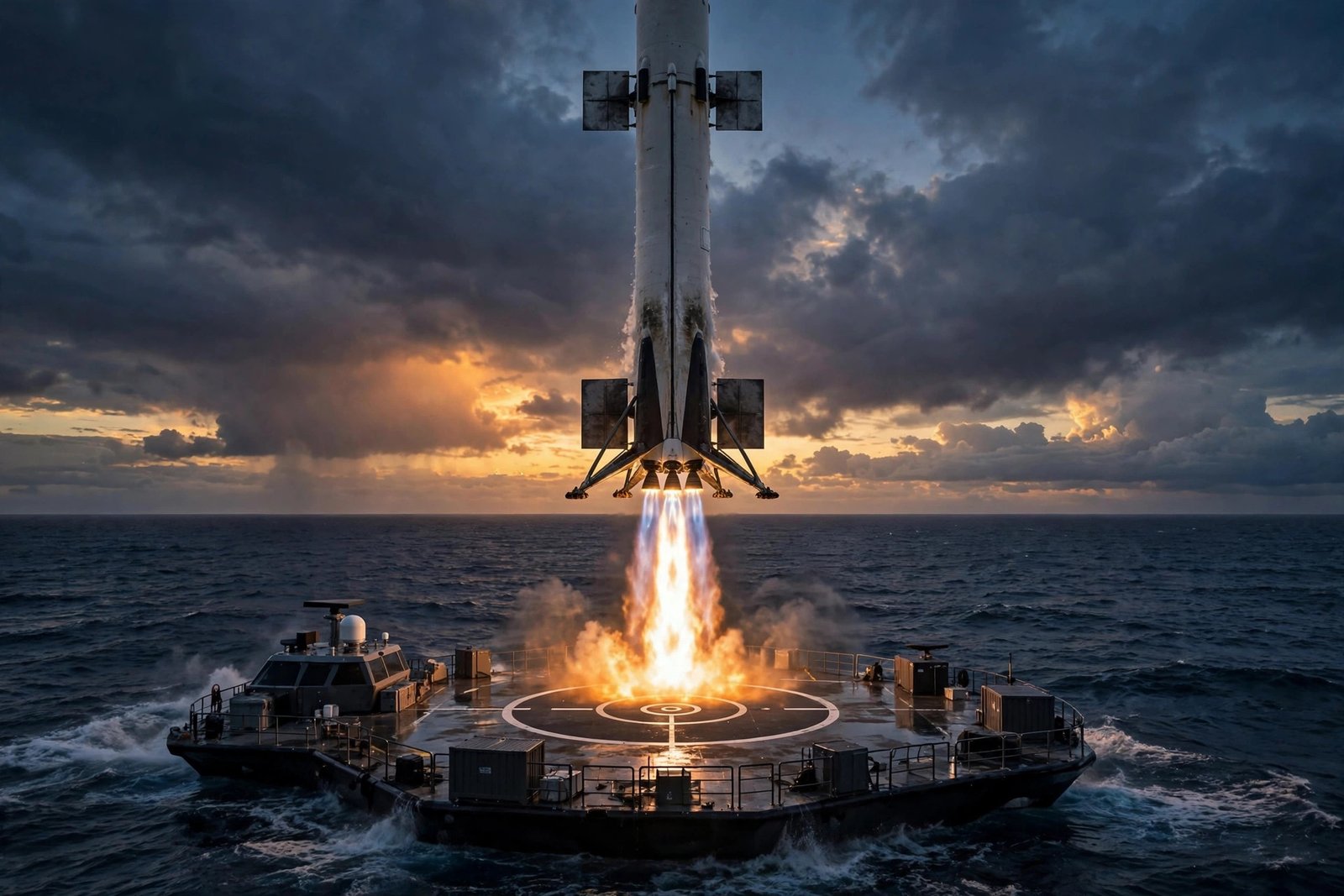
Watching a 14-story rocket fall out of the sky, flip around, and land itself on a robotic ship in the middle of the ocean still feels like science fiction — even though SpaceX has done it more than 400 times. Propulsive landing transformed spaceflight economics: instead of discarding a $60 million booster after one use, SpaceX refuels it and flies it again, sometimes more than 20 times.
Here is the physics and engineering behind the trick — the flip, the burns, the grid fins, and the pinpoint guidance that makes it possible.
The Problem: Why Landing a Rocket Is Absurdly Hard
An orbital rocket’s first stage separates at roughly 60–80 km altitude, traveling around 8,000 km/h (Mach 6+). To land it, you must: kill that velocity, survive reentry heating, steer to a precise target, and touch down at near-zero speed — all with a vehicle designed to go up, not down. The booster is mostly empty fuel tank at this point, making it aerodynamically unstable — like trying to land a falling pencil eraser-first.
Before SpaceX, the industry consensus was that this was impractical. Parachute recovery (the Space Shuttle’s solid boosters) left hardware needing extensive refurbishment; true propulsive landing was considered a stunt. SpaceX’s insight was economic as much as technical: the booster represents the majority of the rocket’s cost, and recovering it intact changes the entire business model.
The Sequence: Four Burns and a Flip
1. Stage separation and the flip
After the second stage ignites and continues to orbit, the booster uses cold-gas thrusters (nitrogen jets) to flip 180 degrees — from engines-forward to engines-backward. This “boostback” orientation points the engines retrograde (against the direction of travel) for the burns to come.
2. The boostback burn
Three of the nine Merlin engines reignite, canceling the booster’s downrange velocity and sending it back toward the landing site — either the launch site (for return-to-launch-site landings) or a droneship positioned downrange. This burn also shapes the trajectory into a ballistic arc aimed at the target.
3. The reentry burn
As the booster plunges back into the atmosphere at hypersonic speed, three engines fire again briefly. This is counterintuitive — firing engines into the airflow — but the exhaust plume acts as a protective shield, pushing the superheated shockwave away from the engine section. Without it, reentry heating would destroy the engines.
4. The landing burn and touchdown
In the final minute, the booster deploys four landing legs and four titanium grid fins (which steer it aerodynamically — more below). A single Merlin engine reignites for the landing burn, and the booster decelerates from supersonic to zero velocity at exactly zero altitude — the famous “hoverslam.” The engine cannot throttle low enough to hover, so the timing must be perfect: too early and it runs out of fuel; too late and it craters. Onboard computers handle this autonomously in real time.
The Key Technologies
- Grid fins: the waffle-iron-like titanium fins that deploy during descent. They provide aerodynamic control authority at supersonic speeds where normal fins would melt or fail — steering the booster with remarkable precision. They are why landings look so stable.
- Autonomous guidance: GPS, inertial measurement, and radar altimetry feed flight computers that continuously recompute the trajectory. The droneship itself is autonomous, holding position against waves. No human flies the landing — it is too fast for human reaction times.
- Deep-throttling Merlin engines: the engines must reignite multiple times after the violence of launch and throttle precisely for the hoverslam. Restartable, throttleable engines were a prerequisite the entire architecture was built around.
- Thermal protection: beyond the reentry burn, the booster’s base heat shield and the interstage protect against the thermal loads of the return trip.
SpaceX documents the program’s evolution openly — their Falcon 9 page details the reusable architecture — and independent analyses like those at NASA’s commercial crew resources explain why reusability became the agency’s expectation for modern launch systems.
Why It Matters: The Economics
A new Falcon 9 launch costs customers around $67 million; SpaceX’s internal cost for a reused booster flight is estimated well under half that. The savings compound: recovered boosters have flown 20+ missions, and the fairing halves (the nose cone) are also recovered and reused. This cost collapse is what made Starlink’s thousands of satellites economically feasible and forced the entire global launch industry to pursue reusability.
The next iteration — Starship’s “chopstick” tower catch, where the booster is caught mid-air by the launch tower — eliminates landing legs entirely, saving mass for payload. Each generation removes more expendability from the equation.
What Could Go Wrong (and Did)
The early landing attempts were spectacular failures — boosters tipping over, running out of hydraulic fluid, landing hard on droneships. Each failure taught a specific lesson: grid fin hydraulic fluid capacity, landing leg deployment dynamics, engine relight reliability. The program’s philosophy — fly, fail, learn, iterate quickly — is why it succeeded where cautious programs stalled. Even now, occasional landings fail; the system is designed so that a lost booster is an acceptable cost, not a catastrophe.
For the curious, space documentaries capture the landing program’s drama better than any article, and long-form science podcasts regularly feature engineers explaining the guidance problem in depth.
Frequently Asked Questions
How many times can a Falcon 9 booster be reused?
The fleet leader boosters have flown 20+ missions. SpaceX originally designed for 10 flights with minimal refurbishment; operational experience pushed well past that. The limit is component fatigue, assessed after each flight.
Why land on a droneship instead of back at the launch site?
Physics: some missions need so much performance that the booster lacks fuel to fly all the way back to land. The droneship positions itself downrange along the flight path, catching boosters that cannot make the return trip. Land landings happen when performance margins allow.
What is the “hoverslam”?
The landing burn maneuver where the booster decelerates to zero velocity at exactly zero altitude. Because the Merlin engine’s minimum thrust exceeds the nearly-empty booster’s weight, it cannot hover — it must time the burn so velocity hits zero precisely at touchdown. Hence “suicide burn,” the engineers’ original nickname.
How accurate are the landings?
Remarkably: boosters routinely land within meters of the droneship’s center. The autonomous guidance system’s precision is what makes the whole architecture work — a landing zone the size of a football field would not suffice for the economics.
Will all rockets land like this eventually?
The industry is converging on reusability as the standard — Blue Origin, Rocket Lab, and Chinese programs are all developing propulsive landing. Expendable rockets are becoming the exception, which is SpaceX’s true legacy: they did not just land rockets, they made throwing them away seem absurd.
The Bottom Line
SpaceX lands rockets by turning the booster into a precisely guided hypersonic glider: flip with thrusters, kill velocity with the boostback burn, shield with the reentry burn, steer with grid fins, and nail the hoverslam with autonomous computers. Each element was a hard engineering problem; together they rewrote the economics of spaceflight. The pencil lands eraser-first, every time — and the industry will never go back to throwing boosters away. That is the real revolution, and it happened in our lifetime.