
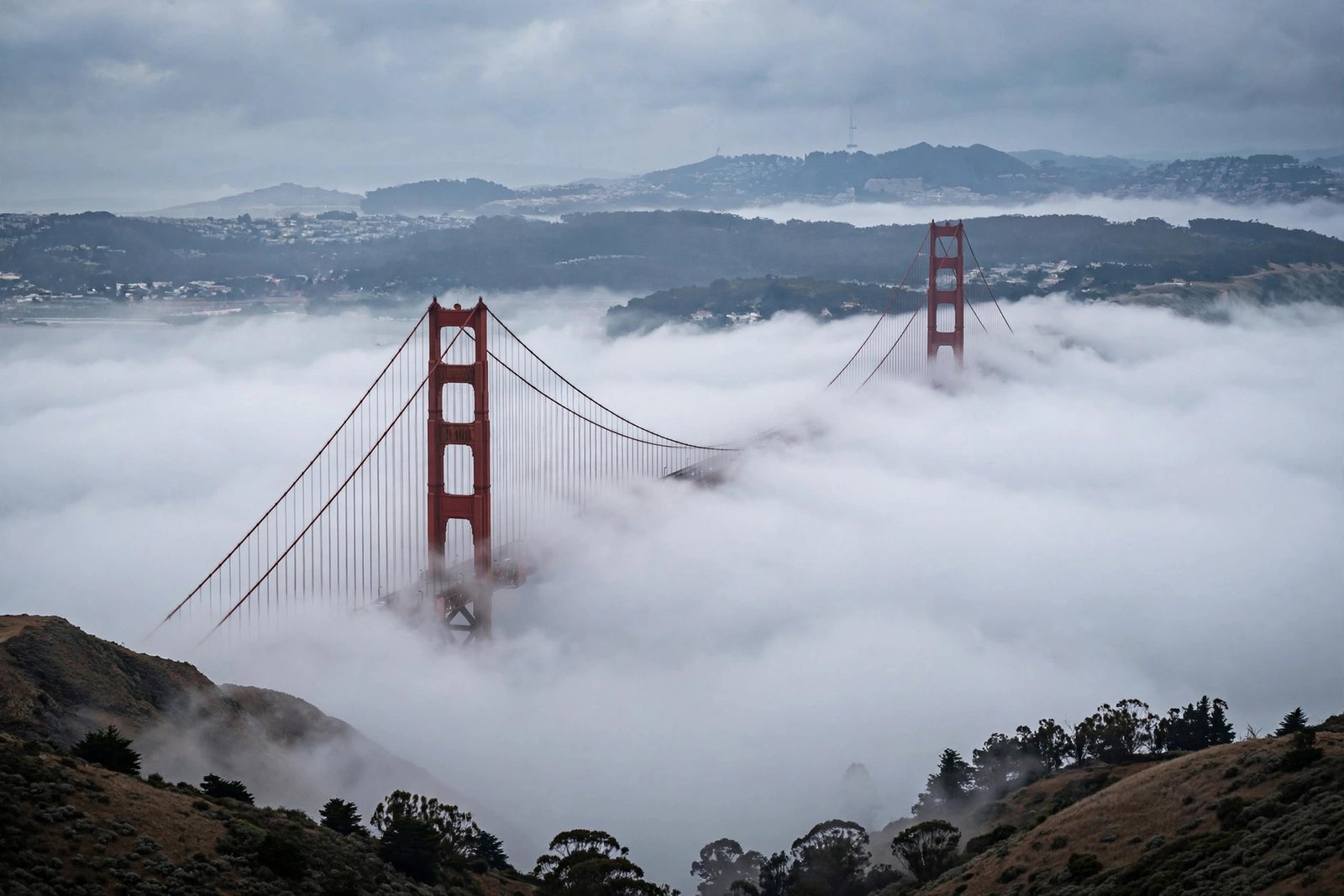
San Francisco’s most famous resident is not a person — it is the fog, affectionately nicknamed Karl, with its own social media following and a starring role in countless photographs of the Golden Gate Bridge dissolving into white. Summer visitors arrive expecting California sunshine and find themselves shivering in 60-degree mist in July. The fog is so reliable, so defining, that it feels like weather with a personality. Underneath the romance, though, is a precise piece of atmospheric physics that plays out almost daily.
How does fog form in San Francisco? The answer involves a frigid ocean current, a stubborn layer of marine air, inland valleys hot enough to bake, and a gap in the coastal hills that funnels it all together. Here is the full mechanism — and why the city’s fog follows a schedule you can nearly set your watch by.
The Cold Ocean Is the Engine
Everything starts with the California Current, a river of cold water flowing south along the coast from the Gulf of Alaska, supercharged by coastal upwelling — deep, frigid water pulled to the surface by winds and Earth’s rotation. Summer ocean temperatures off San Francisco hover in the low 50s Fahrenheit, astonishingly cold for the latitude.
When warm, moist air drifts over this cold water, the air chills from below. Cold air holds less water vapor than warm air, so as the temperature drops to the dew point, the excess vapor condenses into countless microscopic droplets suspended in the air. That is advection fog — fog formed when air moves over a colder surface — and it is San Francisco’s signature type. The National Weather Service Bay Area office watches this setup daily: cold water plus moist air equals fog, with near-mechanical reliability.
The Marine Layer: Fog’s Delivery System
The fog does not just sit on the water; it rides a structure called the marine layer — a cool, moist slab of air near the surface, capped by warmer, drier air above in a temperature inversion. This inversion acts like a lid, trapping the fog beneath it, typically between a few hundred and 1,500 feet thick. The Golden Gate Bridge’s towers, at 746 feet, often poke through the top — the classic photograph of bridge towers rising above a sea of white.
Why Summer Is Fog Season
Counterintuitively, San Francisco’s foggiest months are summer, not winter. The mechanism is a giant thermal seesaw. California’s Central Valley bakes under summer sun, and rising hot air creates low pressure inland. That low pressure acts like a vacuum, sucking the cool marine layer through gaps in the coastal hills — principally the Golden Gate — and deep into the Bay Area. The stronger the inland heat, the harder the fog gets pulled in.
This is why the city’s microclimates are so extreme: while downtown shivers at 62°F in July fog, inland valleys roast at 100°F, and that very heat is dragging the fog across the city. Residents learn to layer for cold weather without looking bulky in August — a skill no other American city demands in midsummer. Mark Twain’s famous line about the coldest winter being a summer in San Francisco endures because the physics behind it never changes.
The Daily Rhythm: In, Then Out
The fog follows a dependable daily cycle. It typically pushes in during the late afternoon and evening as inland areas cool slightly and the sea breeze strengthens, thickens overnight, and lingers through the morning. Then the sun — where it can penetrate — warms the surface, the inversion weakens, and the fog burns off from the top down, usually by midday or early afternoon. Neighborhoods on the ocean side, like the Sunset and Richmond districts, can stay socked in all day while downtown basks in sun — a ten-degree, two-mile microclimate swing that defines local life.
Tule Fog: The Valley’s Different Beast
Inland, winter brings a different phenomenon: tule fog, a dense radiation fog that forms in the Central Valley on cold, still nights when the ground chills the air above it to the dew point. Tule fog can cut visibility to near zero and causes some of California’s worst multi-car pileups. It is a ground-up fog, unlike San Francisco’s ocean-driven marine layer — same word, entirely different physics.
Is the Fog Disappearing?
Here is the bittersweet coda: research suggests coastal fog in California has declined over recent decades. Warming oceans weaken the temperature contrast that drives condensation, and shifting pressure patterns alter the inland-sea breeze engine. The redwoods of the coast — which harvest up to a third of their moisture directly from fog drip — feel the loss first. Karl may not be forever; the fog that defines the city is itself a climate indicator, thinning as the planet warms.
The Fog’s Hidden Ecological Job
San Francisco’s fog is not just atmosphere — it is infrastructure for an entire ecosystem. Coast redwoods, the tallest trees on Earth, harvest enormous quantities of water directly from fog: droplets condense on needles and drip to the forest floor in a process called fog drip. In some groves, fog drip supplies up to a third of the trees’ annual water during the dry summer months, precisely when rain is absent.
The relationship runs deeper. Fog drip wets the soil, sustains understory ferns and salamanders, and even carries dissolved nutrients from the ocean into the forest. Studies using isotope tracing have shown that redwood growth rings correlate with fog frequency — the trees literally record foggy summers in their wood. This is why ecologists watch fog trends with alarm: a decline in summer fog does not just change the city’s postcards, it dries the water budget of an ancient forest. Protecting fog means protecting everything downstream of it, from banana slugs to the salmon streams that fog-fed forests shade and cool.
Conclusion
San Francisco’s fog forms when warm moist air meets the frigid California Current, condenses into advection fog, and gets vacuumed through the Golden Gate by inland summer heat — then burns off on a daily rhythm dictated by the marine layer inversion. It is clockwork physics wearing a romantic disguise. Enjoy it while it lasts; the data suggest the city’s most famous resident is slowly fading.
Further reading: For more on this topic, see dealing with doors that stick in humid weather and FAA guidance on low-visibility flight operations.
Frequently Asked Questions
Why is San Francisco foggy in summer instead of winter?
Summer heat in the Central Valley creates low pressure that pulls the cool marine layer through the Golden Gate. The stronger the inland heat, the more fog gets drawn into the city — making summer, paradoxically, the foggiest season.
What is the marine layer?
A cool, moist slab of air near the ocean surface, capped by warmer air above in a temperature inversion. The inversion traps fog beneath it, typically a few hundred to 1,500 feet thick — which is why the Golden Gate’s towers often rise above it.
Does the fog burn off every day?
Usually by midday or early afternoon, as sunshine weakens the inversion from above. But ocean-side neighborhoods can stay foggy all day while inland areas see full sun — microclimates vary block by block.
Is San Francisco’s fog really decreasing?
Research indicates a decline in coastal California fog over recent decades, likely tied to warming oceans and shifting wind patterns. It is gradual, not a sudden disappearance — but the trend concerns ecologists because coastal redwoods depend on fog moisture.