
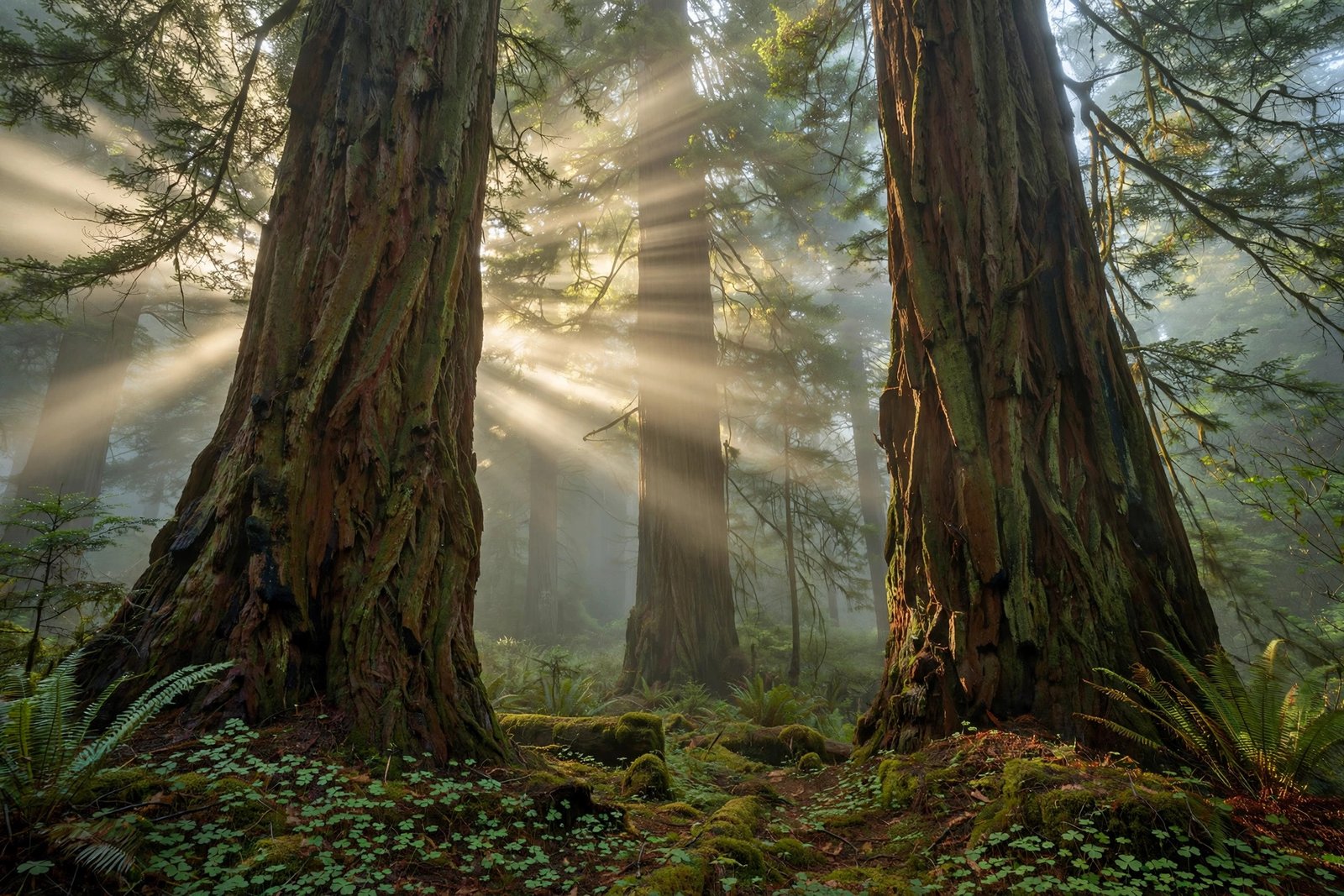
Some coast redwoods were seedlings when Rome was still a republic. They stood through the rise and fall of empires, the entire medieval era, and the industrial revolution — silent witnesses to two millennia of human history. But how do we actually know a tree is 2,000 years old? Nobody was there to plant it, and you cannot ask a redwood for ID. The answer is a forensic science that reads time itself, written in wood.
How do scientists date ancient redwood trees? Through dendrochronology — the study of tree rings — refined with techniques that can pin a tree’s birth year without ever cutting it down, each core a millennium-spanning record. Here is how researchers extract centuries of history from living giants, what the rings reveal beyond age, and why the oldest redwoods are also climate archives of extraordinary value.
Tree Rings: Nature’s Calendar
The foundation is beautifully simple. In temperate climates, a tree grows a new layer of wood each year: fast-growing, light-colored earlywood in spring, then dense, dark latewood in summer. One light-dark pair equals one year. Count the pairs from bark to center, and you have the tree’s age.
Reality is messier than the textbook. Drought years produce razor-thin rings; exceptionally wet years produce wide ones. Some years, stressed trees skip rings entirely or grow partial “false rings.” Fire scars interrupt the pattern. So simple counting is only the start — the real science is in cross-checking, which is where dendrochronology earns its reputation for precision. The National Park Service, which stewards the great redwood parks, relies on these methods to document the ages of the groves visitors walk through.
Core Sampling: Reading a Tree Without Killing It
To count rings in a living redwood, scientists use an increment borer — a hollow, screw-like tool, typically about two feet long, that extracts a pencil-thin core from bark to center. The wound is small relative to the tree’s girth, and redwoods compartmentalize the damage quickly. The extracted core, mounted and sanded to a polish, reveals the ring sequence like a barcode of centuries.
For the largest trees, a single core may not reach the center — old redwoods often have hollow or rotten hearts. Researchers then take multiple cores at different heights and angles, or estimate missing inner rings from growth curves. It is painstaking work: a core from a 2,000-year-old tree contains two thousand rings to measure, each width recorded to a hundredth of a millimeter. Patience is the job description.
Cross-Dating: The Precision Engine
The breakthrough that made tree-ring dating a true science is cross-dating. Because regional climate affects all trees in an area similarly, the pattern of wide and narrow rings forms a fingerprint unique to each period. A drought decade leaves the same thin-ring signature in every old tree in the grove.
Researchers match these fingerprints across samples — living trees, dead snags, fallen logs, even beams in historic buildings — building a continuous master chronology stretching back centuries or millennia. Once the master sequence is anchored to the present (we know what this year’s ring looks like), every matched ring gets an exact calendar year. Cross-dating catches missing and false rings that simple counting would miss, delivering dates accurate to the single year. It is the difference between guessing and knowing.
Radiocarbon: The Independent Check
For the oldest wood — or for verifying ring counts — scientists turn to radiocarbon dating. Cosmic rays constantly create carbon-14 in the atmosphere; living trees absorb it, and when a ring forms, its carbon-14 starts decaying with a 5,730-year half-life. Measuring the remaining carbon-14 dates the ring. Modern calibration curves, built partly from tree rings of known age, correct for historical fluctuations in atmospheric carbon-14. When ring counts and radiocarbon agree, confidence is extremely high. Gardeners who nurture young trees today are tending future chronologies — the same patient care behind starting composting at home feeds the soil that grows tomorrow’s ancient giants.
What the Rings Reveal Beyond Age
Age is just the beginning. Redwood chronologies are among the world’s finest climate archives. Ring widths record precipitation and temperature year by year, extending the instrumental weather record back centuries before thermometers existed. Fire scars — healed wounds where flames killed the cambium — date past wildfires to the exact year, revealing natural fire intervals that guide modern forest management.
The rings have also recorded human impact: suppressed fire regimes, logging-era growth releases when neighboring trees were cut, and the fingerprint of 20th-century climate shifts. Some chronologies capture megadroughts that dwarf anything in the modern record — sobering context for water planning. A single ancient redwood is simultaneously a birth certificate, a weather station, and a fire log — three archives in one towering trunk.
The Oldest Redwoods and Their Rivals
Coast redwoods (Sequoia sempervirens) routinely exceed 1,000 years, with the oldest verified individuals topping 2,000 — each one a living archive that began growing before the fall of Rome. Their inland cousins, the giant sequoias (Sequoiadendron giganteum), push further — the General Sherman tree is estimated at around 2,200 years old. Neither approaches the bristlecone pines of the White Mountains, where individuals exceed 5,000 years, but redwoods combine great age with staggering size: the tallest known living tree, Hyperion, stands 380 feet — taller than the Statue of Liberty.
Dating these giants carries a conservation imperative. Old-growth redwood holds irreplaceable scientific value — each felled ancient tree destroys a climate archive that cannot be regrown on any human timescale, erasing data about droughts, fires, and climate shifts that modern science cannot reconstruct any other way. Organizations like Save the Redwoods League frame protection partly in these terms: the oldest trees are libraries, and we are still learning to read them.
Conclusion
Scientists date ancient redwood trees by extracting thin core samples, counting annual growth rings, and cross-dating ring patterns against master chronologies — with radiocarbon as an independent check. The methods are non-destructive, accurate to the year, and they yield far more than ages: centuries of climate data, fire histories, and ecological records. The next time you stand before a redwood, remember you are looking at two thousand years of weather reports, written in wood.
Further reading: For more on this topic, see keeping houseplants alive while you travel.
Frequently Asked Questions
How old are the oldest redwood trees?
Coast redwoods can exceed 2,000 years, with the oldest verified individuals topping that mark. Giant sequoias live even longer — around 2,200 years for famous specimens. Bristlecone pines, by comparison, exceed 5,000 years.
Does dating a tree require cutting it down?
No. Scientists use an increment borer to extract a pencil-thin core from bark toward the center. The small wound heals, and the tree survives — the method has been used safely on ancient trees for over a century.
What is cross-dating in tree-ring science?
Matching the distinctive pattern of wide and narrow rings across multiple wood samples to build a continuous, calendar-anchored chronology. It corrects for missing or false rings and dates each ring to an exact year.
Can tree rings really record climate history?
Yes. Ring widths reflect growing conditions each year, so long chronologies reconstruct precipitation and temperature centuries before instrumental records, forming the backbone of paleoclimate science. Fire scars in rings also date historical wildfires precisely.