
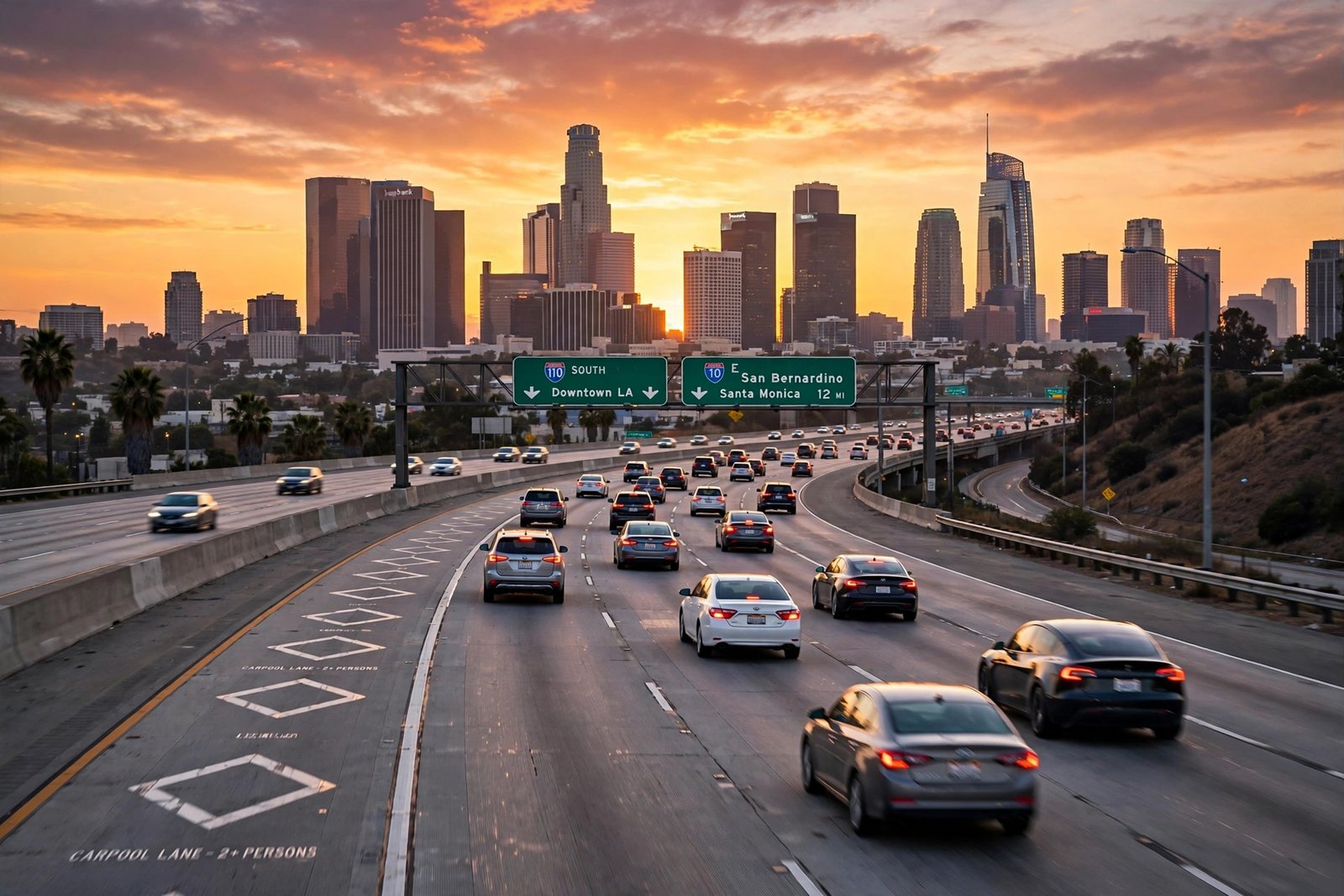
California’s carpool lanes — the diamond-marked lanes that glide past gridlocked traffic — are one of the state’s great commuter advantages and one of its most ticketed mysteries. The rules seem simple (2+ people, right?) until you encounter the variations: 3+ requirements, time restrictions, toll express lanes, motorcycle rules, and the clean-air-vehicle decals that let solo drivers in legally. Get it wrong and you’re looking at a $490+ fine. Get it right and you’ll cut your commute in half.
Here’s the complete 2026 guide to navigating California carpool lane rules: who qualifies, when the rules apply, the express lane twist, and how to avoid the tickets.
The Basics: Who Can Use Carpool Lanes
California carpool (HOV — high-occupancy vehicle) lanes generally require 2 or more occupants, as posted on signs at each lane’s entrance. But “generally” does heavy lifting: some lanes, especially in the Bay Area and on certain LA corridors, require 3+ occupants during peak hours. Always read the sign — the occupancy requirement is posted and enforceable per-lane, and assuming 2+ everywhere is how people get ticketed in 3+ zones.
What counts as an occupant? Any person — adults, children, babies. Pets don’t count (yes, people have tried). The passenger must be in the vehicle, not implied. Motorcycles are allowed in carpool lanes regardless of occupancy — federal law protects motorcycle HOV access, and California honors it. Buses and vanpools, obviously, qualify.
Hours matter enormously: many carpool lanes operate part-time (e.g., 6–10am and 3–7pm weekdays), reverting to general-purpose lanes outside those hours — during off-hours, anyone can use them legally. Others are full-time (24/7). The signs state the hours; “CARPOOL 2+ 6AM–10AM 3PM–7PM MON–FRI” means exactly that. Outside those windows, the diamonds don’t apply. Check Caltrans for corridor-specific lane configurations.
Clean Air Vehicles: The Solo-Driver Exception
California’s Clean Air Vehicle (CAV) decal program allows qualifying low-emission vehicles to use carpool lanes with only the driver. Eligible vehicles include pure EVs, hydrogen fuel cell vehicles, and certain plug-in hybrids meeting emissions standards — the California Air Resources Board maintains the eligibility list. You must apply for and display the physical decals; the car alone doesn’t qualify you.
2026 caveat: the CAV program has faced repeated sunset dates and extensions — verify your decals’ current validity, as expired-decal solo use is ticketed like any other violation. If you’re shopping for an EV partly for HOV access, confirm the program’s horizon matches your ownership plans. This is one of the most tangible daily benefits of electric ownership in California’s traffic.
Express Lanes: Carpool Meets Toll
Many California corridors now feature Express Lanes — carpool lanes converted to HOT (high-occupancy toll) operation. The rules: carpools of the posted occupancy (2+ or 3+) travel free; solo drivers may use them for a toll that varies with congestion. You need a FasTrak transponder — and critically, a FasTrak Flex switchable transponder set to the correct occupancy, so the system knows whether to charge you.
This is the #1 confusion point in 2026. A qualifying carpool with a standard (non-Flex) FasTrak gets tolled as a solo driver. A solo driver without any transponder gets a violation notice. Set the Flex switch before entering: 1 for solo (tolled), 2 or 3+ for carpool (free). Forgetting to switch it back after dropping off your passenger is the classic expensive mistake.
Entering, Exiting, and the Lines That Matter
Carpool lanes are separated by markings with legal meaning: double solid yellow or white lines mean do not cross — enter and exit only where the lines break (dashed) or at designated openings. Crossing double lines to dart into the carpool lane is its own violation, separate from occupancy. Single dashed lines allow weaving in and out. Some newer express lanes use channelizers (plastic posts) — crossing those is both illegal and vehicle-damaging.
Plan your exits: carpool lanes sometimes run for miles without openings, and missing your exit because you couldn’t cross back in time is a rite of passage. Know your corridor’s ingress/egress points before relying on the lane daily. And never stop in the lane — if you have car trouble, hazards on and coast to the nearest opening; the lane has no shoulder by design.
These are driving-rules details worth mastering alongside broader road knowledge — what to know before driving in another country covers how differently lane discipline works elsewhere, and for daily commuters, making long car rides more enjoyable makes the time you do spend in traffic far more pleasant.
Carpool Lane Etiquette: The Unwritten Rules
Beyond the legal rules, carpool lanes have a culture — and violating it earns honks, not tickets. Keep pace: the lane’s social contract is that it moves faster than general traffic; camping in the carpool lane at the speed limit while a line forms behind you is legal but antisocial. Don’t tailgate to pressure slower drivers — the lane has no shoulder and sudden braking cascades dangerously. Merge decisively at openings; hesitating at the dashed line confuses everyone behind you.
Rideshare coordination: if you’re carpooling with coworkers, establish pickup logistics that don’t block traffic — the carpool lane’s time savings evaporate if pickups add 20 minutes. Motorcycle awareness: car drivers should expect lane-splitting motorcycles near carpool lanes (legal in California) and give them space; motorcyclists should remember that carpool-lane drivers aren’t always checking mirrors for bikes. And if you’re the solo CAV-decal driver enjoying the lane alone — a quiet thank-you to the carpoolers around you, whose extra passengers are the reason the lane exists.
Fines and Enforcement
Carpool violations in California start around $490 for a first offense — among the steepest traffic fines in the state, deliberately so. Enforcement is both human (CHP motorcycle officers famously lurk at lane entrances during rush hour) and increasingly automated (cameras on express lanes catch occupancy and transponder violations). Common ticket scenarios: solo driver in 2+ lane, 2 occupants in a 3+ lane, expired CAV decals, wrong FasTrak Flex setting, and crossing double lines.
The violation goes on your driving record and can affect insurance. There’s no “I didn’t know” defense that works — the signs are the law. If ticketed, your options are the standard ones: pay, traffic school (if eligible), or contest. But the best strategy is prevention: know your lane’s occupancy, hours, and entry rules before you depend on it.
Conclusion
Navigating California carpool lane rules in 2026 means: read every sign (occupancy and hours vary by lane), remember motorcycles always qualify and CAV-decals grant solo access, master the FasTrak Flex switch for express lanes, cross only at dashed-line openings, and respect the ~$490 fines. Used correctly, the diamond lane is the closest thing California offers to a time machine — turning a 60-minute crawl into a 25-minute cruise, twice a day, for free.
Frequently Asked Questions
How many people do you need for the carpool lane in California?
Usually 2+, but some lanes require 3+ during peak hours — always read the posted sign for that specific lane, as requirements vary by corridor.
Can motorcycles use carpool lanes in California?
Yes — motorcycles may use HOV lanes regardless of occupancy, protected by federal law and honored statewide.
Do babies count as passengers in carpool lanes?
Yes — any person counts, including infants and children. Pets do not count.
Can I use the carpool lane with a FasTrak?
On express (HOT) lanes you need a FasTrak Flex transponder set to your correct occupancy — carpools travel free, solo drivers pay the toll. Set the switch before entering.
How much is a carpool lane ticket in California?
Around $490+ for a first offense, among the state’s steepest traffic fines. Violations go on your driving record and can affect insurance rates.