
What Are the Best Road Trip Routes Across the American Southwest?
What are the best road trip routes across the American Southwest? It’s road trip country the way nowhere else is — vast desert skies, red rock canyons, weird roadside art, and distances that make the drive itself the destination. But with so many iconic routes, which ones are actually worth your limited vacation days? Here they are, ranked by what they deliver, with practical details for each.
1. The Grand Circle (Utah/Arizona) — The Greatest Hits
Route: Las Vegas → Zion → Bryce Canyon → Capitol Reef → Arches → Canyonlands → Monument Valley → Grand Canyon → back to Vegas. Distance: ~1,400 miles. Time: 7–10 days.
This is the single best road trip in the Southwest — a loop through five national parks plus Monument Valley and the Grand Canyon. Zion’s narrows, Bryce’s hoodoos at sunrise, Arches’ Delicate Arch, the Grand Canyon’s south rim — it’s a highlight reel with no filler. Tips: book park lodging 6+ months ahead (it sells out), start hikes early to beat heat and crowds, and download offline maps — cell service vanishes for long stretches. For Grand Canyon timing specifically, see the best time of year to visit the Grand Canyon.
2. Route 66: Arizona Stretch — The Classic
Route: Kingman → Seligman → Flagstaff → Winslow → Petrified Forest. Distance: ~400 miles of the Mother Road. Time: 2–4 days.
Arizona holds the longest continuous stretch of original Route 66, and it’s gloriously weird: the Snow Cap Drive-In in Seligman, standing on the corner in Winslow (yes, really), Hackberry General Store’s rusted Americana, and the painted desert at Petrified Forest. It’s kitsch, history, and desert beauty in equal measure. Tips: this is a slow-road trip — the point is stopping. Budget twice the driving time for roadside attractions.
3. Santa Fe to Taos via the High Road — Culture + Scenery
Route: Santa Fe → High Road to Taos (through Chimayó, Truchas) → Taos → Enchanted Circle. Distance: ~200 miles. Time: 2–3 days.
New Mexico’s high desert is criminally underrated. Santa Fe’s adobe old town and art scene, the winding High Road through centuries-old villages, Taos Pueblo (a UNESCO site inhabited for 1,000 years), and the Enchanted Circle’s mountain loop. Add green chile everything. Tips: altitude (7,000+ feet) — hydrate and take it easy day one. Fall brings golden aspens; winter brings Taos skiing.
4. Big Bend and West Texas — The Empty Frontier
Route: El Paso → Marfa → Big Bend National Park → back. Distance: ~800 miles. Time: 4–6 days.
Big Bend is the least-visited major national park in the lower 48 — and that’s the appeal. Desert, mountains, and the Rio Grande in one park, plus Marfa’s art-world weirdness (the Prada storefront in the middle of nowhere) and some of America’s darkest skies for stargazing. Tips: fill up whenever you see gas (stations are 100+ miles apart), carry extra water, and book lodging early — options are limited.
5. Sedona to Monument Valley via the Desert — Red Rock Majesty
Route: Phoenix → Sedona → Flagstaff → Monument Valley → Page (Antelope Canyon, Horseshoe Bend). Distance: ~700 miles. Time: 4–5 days.
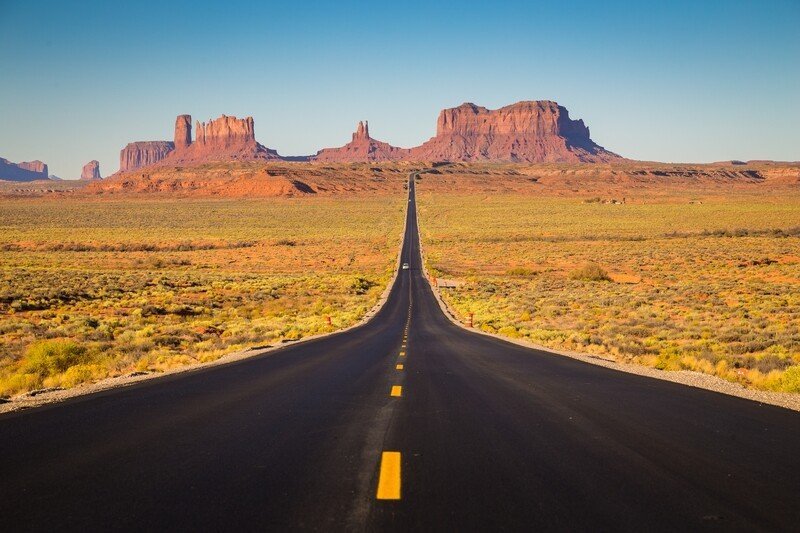
Sedona’s red rocks, Oak Creek Canyon’s winding drive, Monument Valley’s iconic buttes (take the Navajo-guided tour — worth every penny), Antelope Canyon’s light beams (book the midday tour), and Horseshoe Bend at sunset. It’s the most photogenic route on this list. Tips: Antelope Canyon requires advance booking and sells out; Monument Valley’s tribal park has an entry fee separate from national parks passes.
What Are the Best Road Trip Routes Across the American Southwest? Practical Advice for All of Them
- Season matters enormously. Summer in the desert means 100°F+ — spring (March–May) and fall (September–November) are the sweet spots. Winter works for lower elevations.
- Water, always. Carry a gallon per person per day in the car, always. Desert breakdowns without water become emergencies fast.
- Gas up early and often. Stretches of 100+ miles without services are normal. Never pass a station under half a tank in remote areas.
- Get the America the Beautiful pass ($80). Covers all national parks for a year — pays for itself in two parks.
- Download everything offline. Maps, music, podcasts. Assume no signal for hours.
- Respect tribal lands. Much of the most beautiful Southwest is Navajo, Hopi, or other tribal land. Follow posted rules, don’t trespass, and support Native-owned businesses and guides.
For general road trip comfort, our guide on making long car rides more enjoyable covers the in-car experience, and your car emergency kit is non-negotiable for desert driving.
What Are the Best Road Trip Routes Across the American Southwest for First-Timers?
If you’ve never done a Southwest road trip, the options are overwhelming. Here’s the simple decision: do the Grand Circle if you have a week, the Sedona–Monument Valley route if you have 4–5 days, and the Route 66 Arizona stretch if you have a long weekend. But first-timers make predictable mistakes — here’s how to avoid them.
Mistake one: underestimating distances. The Southwest is enormous — the Grand Circle is 1,400 miles, and “just popping over” to the next park is often a 3-hour drive. First-timers consistently plan too much driving per day. The rule: cap driving at 4–5 hours daily, and remember that scenic roads (which is most of them) take 50% longer than the GPS estimate because you’ll stop constantly. Build stop time into the plan, not on top of it.
Mistake two: going in summer without a heat plan. First-timers often default to summer (school schedules), then discover that 110°F desert hiking is dangerous, not adventurous. If summer is your only option: hike only before 10 AM, carry a gallon of water per person per day, and plan midday for driving (air conditioning) or water activities. Better: go in spring or fall. The weather difference isn’t minor — it’s the difference between a great trip and a survival exercise.
Mistake three: skipping reservations. The popular parks and lodges book out months ahead — first-timers assume they can wing it and end up sleeping an hour from the park entrance. Book in-park lodging 6+ months out, reserve timed-entry permits where required (Arches now uses them seasonally), and book Antelope Canyon and similar guided experiences weeks ahead. The spontaneous road trip is a myth in the modern Southwest; the prepared one is better anyway.
Mistake four: ignoring the human history. First-timers see the geology and miss the 1,000+ years of Native American history layered over it. Take the Navajo-guided tour at Monument Valley and Antelope Canyon (required, and worth it), visit Taos Pueblo respectfully, stop at the cultural centers. The landscape is more meaningful when you understand who has called it home — and your tourism dollars support tribal communities directly when you choose Native guides and businesses.
The first-timer’s packing essentials beyond the obvious: a real paper map or fully downloaded offline maps (cell service is a rumor in much of the region), twice the water you think you need, sun protection for the car’s interior (a windshield shade saves the dashboard and your return comfort), and a cooler — because the best roadside picnic spots have no services, and a cold drink at a desert overlook is a top-tier life experience.
The Bottom Line
The Grand Circle is the essential Southwest road trip; Route 66’s Arizona stretch is the most fun; Santa Fe–Taos is the most cultural; Big Bend is the most remote; Sedona–Monument Valley is the most photogenic. Whichever you choose, go in spring or fall, carry water like your life depends on it (it might), and leave room in the itinerary for the weird roadside thing you didn’t plan. That’s where the stories come from.
For park details and reservations, the National Park Service is the authoritative source, and Wikipedia’s Grand Circle overview maps the classic loop.