
Can AI Help Me Plan Weekly Meals on a Tight Budget?
Can AI help me plan weekly meals on a tight budget? Yes — and it is genuinely good at it. Meal planning is a perfect AI task: it involves juggling constraints (budget, nutrition, preferences, time), generating options, and organizing information. Tell a chatbot your budget, dietary needs, and what is in your pantry, and it will produce a full week of meals with a shopping list in seconds. I have watched skeptical friends become converts after one week of AI-planned groceries. Here is how to get results that actually save you money instead of just sounding impressive.
Why AI is surprisingly good at this
Budget meal planning is an optimization puzzle: maximize nutrition and variety while minimizing cost, waste, and cooking time. Humans are bad at this kind of multi-constraint juggling — we default to the same five meals and let produce rot. AI does not get bored, does not forget the lentils in the back of the pantry, and can instantly cross-reference prices, nutrition, and ingredient overlap. It excels at the specific thing that makes budget cooking work: ingredient reuse. A good AI plan cooks a big batch of rice on Monday that becomes fried rice Wednesday and soup Friday; roasts a whole chicken that stretches across three dinners. That overlap is where the savings live.
Can AI help me plan weekly meals on a tight budget? The prompt that makes it work
Generic prompts get generic meal plans. Give the AI everything it needs:
“Create a 7-day dinner meal plan for 2 adults. Budget: $75 for the week. Constraints: one vegetarian, no shellfish, 30 minutes max cooking time on weeknights. Pantry already has: rice, pasta, canned tomatoes, lentils, oats, cooking oil, spices. Prefer minimal food waste — reuse ingredients across meals. Include a shopping list organized by store section with estimated costs, and note which meals produce leftovers for lunch.”
The magic ingredients in that prompt: exact budget, household size, dietary constraints, time limits, existing inventory, and the explicit instruction to minimize waste. The more specific you are, the more usable the plan. Vague in, vague out — this is true of all good AI prompting, but it matters most when money is on the line.
Where AI meal plans go wrong (and how to fix it)
AI is not a perfect budget cook. Common failure modes: fantasy pricing — the AI may estimate costs from outdated or national-average data that does not match your store. Fix: ask for the plan first, then price the shopping list yourself against your store’s app or flyer, and ask the AI to swap anything over budget. Unrealistic recipes — “easy weeknight dinner” that requires 14 ingredients and a food processor. Fix: specify your equipment and a hard ingredient-count limit per meal. Nutrition blind spots — AI can under-plan protein or produce variety. Fix: ask it to include estimated protein per meal, or run the plan past a basic nutrition check. Repetition blindness — it may suggest chicken four nights in a row. Fix: explicitly cap repeats (“no protein more than twice”).
Treat the first plan as a draft, not gospel. One round of “this is over budget, swap the salmon for something under $3/serving” usually produces something genuinely shoppable.
Level up: pantry-first and sales-first planning
Two advanced techniques squeeze out more savings. Pantry-first: photograph or list everything in your fridge, freezer, and pantry, and ask the AI to build meals around what you already own. This kills waste — the average American household throws away over $1,500 in food yearly, and much of it is forgotten inventory. Sales-first: paste your grocery store’s weekly ad into the chat and ask for meals built around the loss leaders. Combining both — “here is my pantry, here are this week’s sales, build me a plan” — is the closest thing to a professional budget-cooking system most people will ever use.
Beyond dinners: the full week
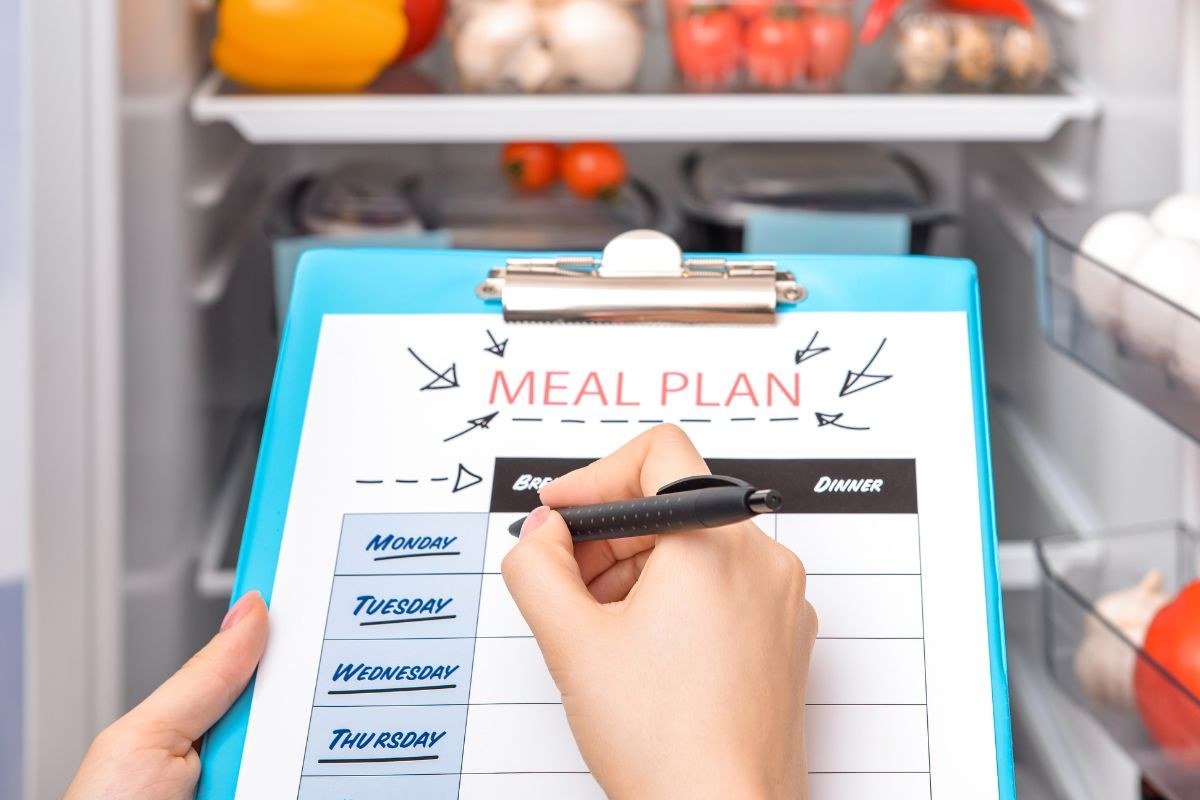
Do not stop at dinner. Ask for: breakfasts (overnight oats variations, egg rotations), packable lunches (designed from dinner leftovers — state this explicitly), and snacks (so you are not buying $6 granola bars). A complete plan also reduces the impulse spending that destroys food budgets — the takeout ordered because “there is nothing to eat” when there is actually a plan you forgot about. Stick the plan on the fridge. The system only works if you can see it.
For broader money management, pair meal planning with AI-assisted budgeting — food is most households’ most flexible expense, so it is the highest-leverage place to start saving.
Batch cooking: where AI planning really pays off
The biggest budget wins come from cooking once and eating three times, and AI is excellent at designing batch-cooking workflows. Ask for a “Sunday prep plan”: two hours of cooking that produces components for the whole week — a big pot of grains, a sheet pan of roasted vegetables, a protein, a sauce. Then ask for the assembly map: which components combine into which weeknight meals in under 15 minutes. This is how busy people actually eat cheaply without spending every evening cooking. One friend of mine cut her family’s grocery bill by nearly a third just by switching from nightly cooking to AI-planned Sunday batch sessions — same food, fraction of the effort.
Feeding picky eaters without breaking the bank
Kids and picky partners complicate budget cooking, but AI handles this better than you might expect. Give it the constraints honestly: “one child who only eats beige food, one adult avoiding dairy.” Ask for deconstructable meals — taco bars, grain bowls, pasta with sauce on the side — where one base serves everyone with small variations. Ask for “gateway” versions of budget staples: lentil bolognese that actually tastes good, bean quesadillas with hidden vegetables. And request the plan to introduce one new food per week rather than overhauling everything at once. Small, sustainable changes beat ambitious plans that last three days.
The bottom line
AI can absolutely plan your weekly meals on a tight budget — better and faster than most humans do it alone. Give it your real constraints, treat the first draft skeptically, verify prices against your store, and iterate once. The result is less waste, lower grocery bills, and the quiet luxury of never wondering “what is for dinner?” For deeper context on the technology, how modern AI systems work explains why constraint-juggling tasks like this play to their strengths.