
Can You Substitute Honey for Sugar in Baking Recipes?
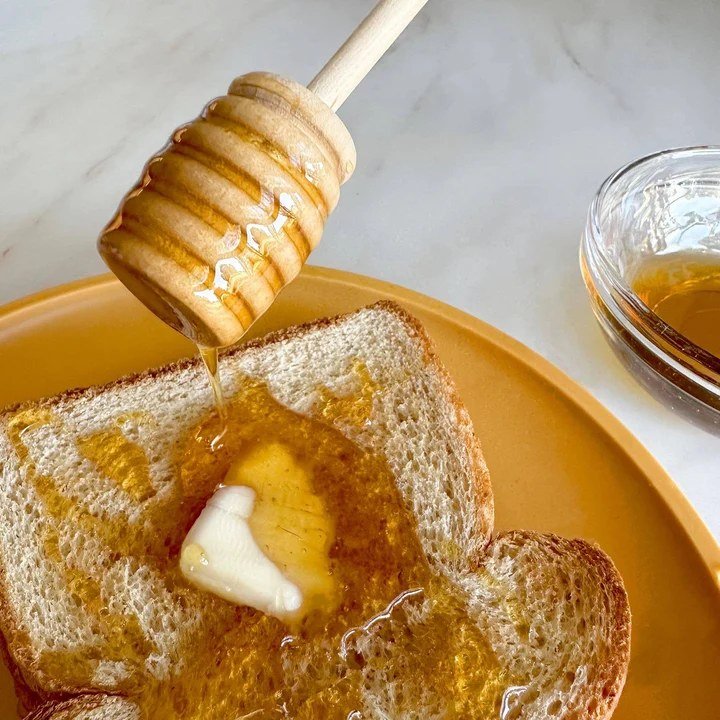
Can I Substitute Honey for Sugar in Baking Recipes?
You’re out of sugar, or you just prefer baking with honey — either way, you’re wondering: can I substitute honey for sugar in baking recipes? I started experimenting with this when I got into keeping bees (a hobby that escalated quickly), and I learned that honey isn’t a simple 1:1 swap. It’s sweeter than sugar, it’s a liquid, it’s acidic, and it browns faster. Ignore those differences and you’ll get dense, over-browned, oddly-textured results. Respect them, and honey makes baked goods that are moister and more flavorful than the original. Here are the rules that make the swap work.
The Four Rules of Honey Substitution
Rule 1: Use less honey than sugar
Honey is about 25–30% sweeter than granulated sugar. Use ½ to ⅔ cup of honey per cup of sugar. For recipes calling for more than a cup of sugar, stick closer to ½; for smaller amounts, ⅔ works. When in doubt, start with less — you can always drizzle more honey on the finished product.
Rule 2: Reduce the other liquids
Honey is about 20% water. For every cup of honey used, reduce another liquid in the recipe by ¼ cup. If there’s no other liquid to reduce, add 2–3 extra tablespoons of flour per cup of honey. Skip this step and your batter will be too wet — the number one cause of honey-swap failures.
Rule 3: Lower the oven temperature
Honey’s natural sugars caramelize faster than refined sugar. Reduce the oven temperature by 25°F to prevent over-browning. Your honey cake will still get that gorgeous golden color — it just won’t cross into burnt before the center sets.
Rule 4: Add baking soda
Honey is acidic, and that acidity needs balancing for proper rise. Add ¼ teaspoon of baking soda per cup of honey (unless the recipe already contains a full teaspoon or more). This neutralizes the acid and ensures your baked goods lift properly instead of baking up dense.
What Bakes Best With Honey
Honey shines in recipes where moisture and deep flavor are assets:
- Quick breads and muffins: banana bread, zucchini bread, bran muffins — honey keeps them moist for days.
- Spice cakes and gingerbread: honey’s floral notes pair beautifully with warm spices.
- Granola and energy bars: honey is the ideal binder and sweetener in one.
- Glazes and baklava: where honey is the star, not a substitute.
Honey is trickier in recipes where precise structure matters: delicate cakes, meringues, and candy-making all depend on sugar’s specific crystallization behavior. And in cookies, honey makes them softer and chewier with more spread — delicious, but a different cookie.
Does the Honey Type Matter?
Yes, more than you’d think. Mild honeys (clover, orange blossom) disappear into baked goods, adding sweetness without distinct flavor — use these when you want a clean swap. Bold honeys (buckwheat, chestnut) bring strong, almost molasses-like notes that can overpower delicate recipes but are magnificent in spice cakes and rye breads. That fancy single-origin honey? Save it for drizzling; baking heat destroys its subtle aromatics. Bake with the affordable stuff.
Honey vs. Sugar: The Health Question
Let’s be honest: honey is still sugar. It has trace minerals and antioxidants that white sugar lacks, and a slightly lower glycemic index, but your body processes them similarly. The real advantage is flavor — honey’s complexity means you can often use less sweetener overall and still feel satisfied. Don’t bake with honey because it’s “healthy”; bake with it because it tastes better. If you’re cutting sugar broadly, our balanced smoothie formula shows how to satisfy sweet cravings with whole foods instead.
The honey article on Wikipedia covers varieties and composition, and King Arthur Baking has tested honey-substitution charts.
Honey in Specific Recipes: What to Expect
Let’s get concrete about common bakes. Banana bread: the ideal honey convert — swap ¾ cup honey for 1 cup sugar, reduce milk by 2 tablespoons, drop temp 25°F. The result is moister with deeper flavor; most tasters prefer it. Muffins: equally straightforward. Honey keeps muffins soft for days (honey is hygroscopic — it attracts moisture), solving the day-two dry muffin problem.
Cakes: work well with the full four-rule adjustment, but expect a denser, moister crumb — closer to a snacking cake than a fluffy layer cake. For layer cakes where structure matters, consider swapping only half the sugar for honey. Yeast breads: honey is fantastic here — yeast loves it, and it adds beautiful browning and subtle flavor. Swap freely in dinner rolls and sandwich loaves.
Where to be cautious: meringues and angel food cake depend on sugar’s crystallization — honey versions collapse. Candy-making (fudge, caramel) requires precise sugar chemistry that honey disrupts. And delicate sugar cookies lose their crisp snap with honey’s moisture. Know the recipe’s structural needs before swapping.
Storing Honey and Honey-Baked Goods
Honey never spoils — archaeologists have tasted 3,000-year-old honey and found it fine. Crystallization is natural, not spoilage: warm the jar gently in hot water to re-liquefy (never microwave — it destroys delicate flavors). Store at room temperature; refrigeration accelerates crystallization.
Honey-baked goods stay fresh longer than sugar versions thanks to honey’s moisture-retaining properties — most keep 3–4 days at room temperature in an airtight container, versus 1–2 for sugar equivalents. They also freeze beautifully for up to 3 months. The extended freshness is one of honey baking’s quiet superpowers, especially for gifting and meal prep.
Can I Substitute Honey for Sugar in Baking Recipes? Quick Answer
Yes, with four adjustments: use ½ to ⅔ cup honey per cup of sugar, reduce other liquids by ¼ cup per cup of honey, lower the oven by 25°F, and add ¼ teaspoon baking soda per cup of honey. Honey shines in quick breads, muffins, and spice cakes; avoid it in meringues and candy where sugar’s crystallization matters.
The Takeaway
Less honey than sugar (½–⅔ cup per cup), reduce liquids by ¼ cup, drop the oven 25°F, add ¼ teaspoon baking soda. Four rules, and honey becomes one of your best baking ingredients — especially in quick breads, muffins, and spice cakes where its moisture and flavor shine.