
Is It Cheaper to Meal Prep or Eat Out Every Day?
Is it cheaper to meal prep or eat out every day? This sounds like a trick question — of course cooking at home is cheaper. But once you count groceries, waste, time, and the sad desk salad you throw away uneaten, the answer has more nuance than the personal finance gurus admit. Let’s run the real numbers.
The Raw Numbers
Eating out every day: A modest lunch out runs $12–$16; dinner $15–$25. Even sticking to cheaper options, daily eating out lands around $25–$40/day — that’s $750–$1,200/month on food. Fast food “value” menus still run $8–$12 per meal.
Meal prep: Home-cooked meals average $2–$5 per serving depending on ingredients. Three meals a day at $3.50 average = ~$315/month. Even generous meal prep with quality ingredients rarely tops $450–$500/month.
The gap: $300–$700/month. Over a year, that’s $3,600–$8,400. It’s not close. But the raw numbers hide important caveats.
Is It Cheaper to Meal Prep or Eat Out Every Day? The Honest Caveats
- Food waste is the silent killer. If you buy $120 in groceries and throw away $40 uneaten, your real cost jumps. Meal prep only wins if you actually eat what you prep. Start with 3–4 days of prep, not 7.
- Your time has value. Two hours of Sunday prep is real time. But compare honestly: 2 hours prepping vs. 30+ minutes daily deciding, ordering, waiting, and picking up food. Meal prep usually wins on time too.
- The variety problem. Eating the same chicken-and-rice five days straight leads to rebellion takeout — the most expensive outcome. Prep components (proteins, grains, roasted veg, sauces) instead of finished meals, then mix and match.
- Startup costs. Containers, spices, and staples cost upfront. Amortized over months, it’s trivial — but the first grocery trip stings.
The Meal Prep System That Actually Sticks
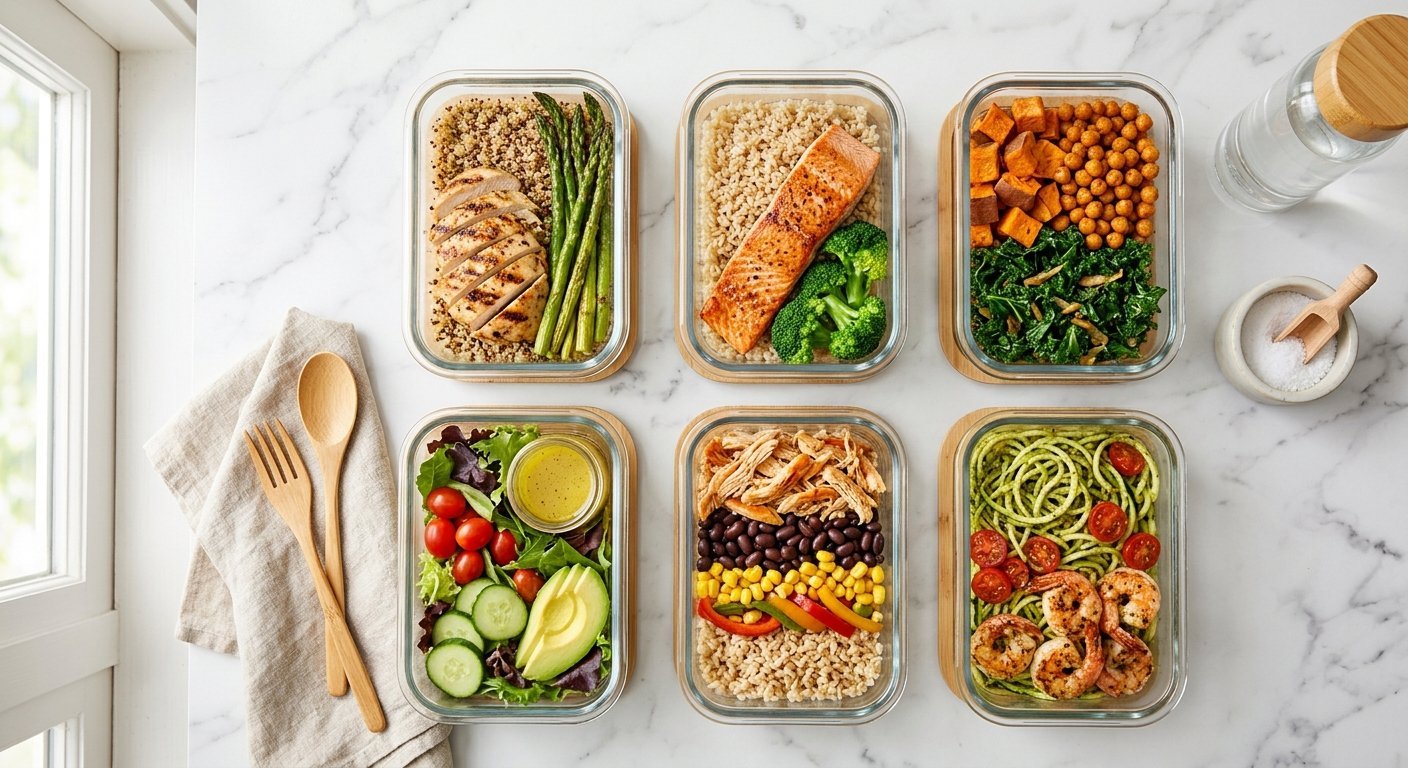
- Pick 2 proteins, 2 grains, 3 vegetables, 2 sauces. That’s 24+ combinations. Cook them simply on Sunday.
- Breakfast: automate it. Overnight oats, egg muffins, or Greek yogurt — same thing daily. Decision-free mornings.
- Lunch: the workhorse. Grain bowls and salads in jars. Prep 4, buy Friday’s lunch out as a treat.
- Dinner: semi-prep. Prepped components + 15-minute assembly beats full meal prep for dinners. Marinated proteins ready to cook, chopped veg, cooked grains.
- Embrace the freezer. Soups, stews, burritos, and pasta bakes freeze beautifully. A freezer stash is insurance against “I’m too tired” takeout.
Pair this with saving money on groceries without couponing and your per-meal cost drops even further.
The Hybrid Approach (What Most People Should Do)
Here’s my actual recommendation: meal prep 80%, eat out 20%. Prep breakfasts and lunches (the boring, expensive-if-bought meals), cook simple dinners most nights, and eat out 2–3 times a week guilt-free. You get 80% of the savings with 0% of the deprivation. Total food budget: $400–$550/month with a real social life intact.
The all-or-nothing mindset is what fails. “I meal prepped perfectly for two weeks then ordered $60 of sushi” isn’t a meal prep failure — it’s a sustainability failure. Build the system you’d actually follow in your worst week, not your best.
If cooking feels like the barrier, check out whether you can learn to cook from YouTube — the 20-minute meals there are perfect prep material.
Is It Cheaper to Meal Prep or Eat Out Every Day for One Person?
Cooking for one is where meal prep economics get tricky. The standard advice assumes a family splitting bulk ingredients — but solo cooks face the “recipe serves four” problem: you buy a full bunch of cilantro, use a quarter, and watch the rest liquefy. Done wrong, solo meal prep wastes so much that eating out starts looking rational. Done right, it’s still far cheaper. Here’s the solo playbook.
Shrink the prep, not the principle. Instead of prepping five full meals, prep components in small batches: one grain, one protein, two vegetables, one sauce — enough for 3–4 meals. Cook Sunday and Wednesday (two mini-preps beat one big one for freshness). The twice-weekly rhythm prevents the Thursday “I’m sick of this” rebellion that sends solo preppers to the takeout app.
Master the “cook once, eat twice (differently)” method. The boredom problem is real when it’s just you eating the same thing. Solution: transform, don’t repeat. Sunday’s roast chicken becomes Monday’s chicken tacos becomes Tuesday’s chicken soup. Same base protein, three different meals. Your palate gets variety; your wallet gets efficiency. This is the single skill that makes solo meal prep sustainable.
Buy for one strategically. The bulk traps that waste solo money: giant produce bags, family-size meat packs, the warehouse club temptation. Instead: frozen vegetables (zero waste, perfect portions), the salad bar for small amounts of prepped ingredients, meat counters that sell single portions, and eggs (nature’s perfect solo protein — cheap, versatile, no waste). Shop the store’s perimeter in small quantities rather than the center aisles in bulk.
Do the honest solo math. Solo meal prep: ~$60–$80/week in groceries ($240–$320/month) with minimal waste using the methods above. Solo eating out: even modest ($12 lunch + $15 dinner + occasional breakfast) runs $700–$900/month. The gap is $400–$600/month — smaller than the family gap in absolute terms, but enormous relative to a single person’s budget. That’s a vacation fund, an emergency fund, or serious debt payoff, created by cooking.
The real solo enemy isn’t cost — it’s motivation. Cooking for one can feel pointless, which is why the system matters more than the recipes. Keep it dead simple, keep it tasty, and keep one “emergency” meal in the freezer for the nights you’d otherwise order in. Solo meal prep done simply beats solo takeout on every metric that matters: money, health, and the quiet satisfaction of feeding yourself well.
The Bottom Line
Meal prep beats eating out by $300–$700/month — it’s not a contest. But it only works if you prep food you’ll actually eat, in quantities you’ll actually finish. Start with lunches, prep components not meals, keep 2–3 eat-out meals a week, and watch the savings stack up. Your wallet (and probably your energy levels) will thank you.
For official food cost data, the USDA tracks food-away-from-home spending, and the Bureau of Labor Statistics CPI reports show how restaurant prices keep outpacing groceries.