
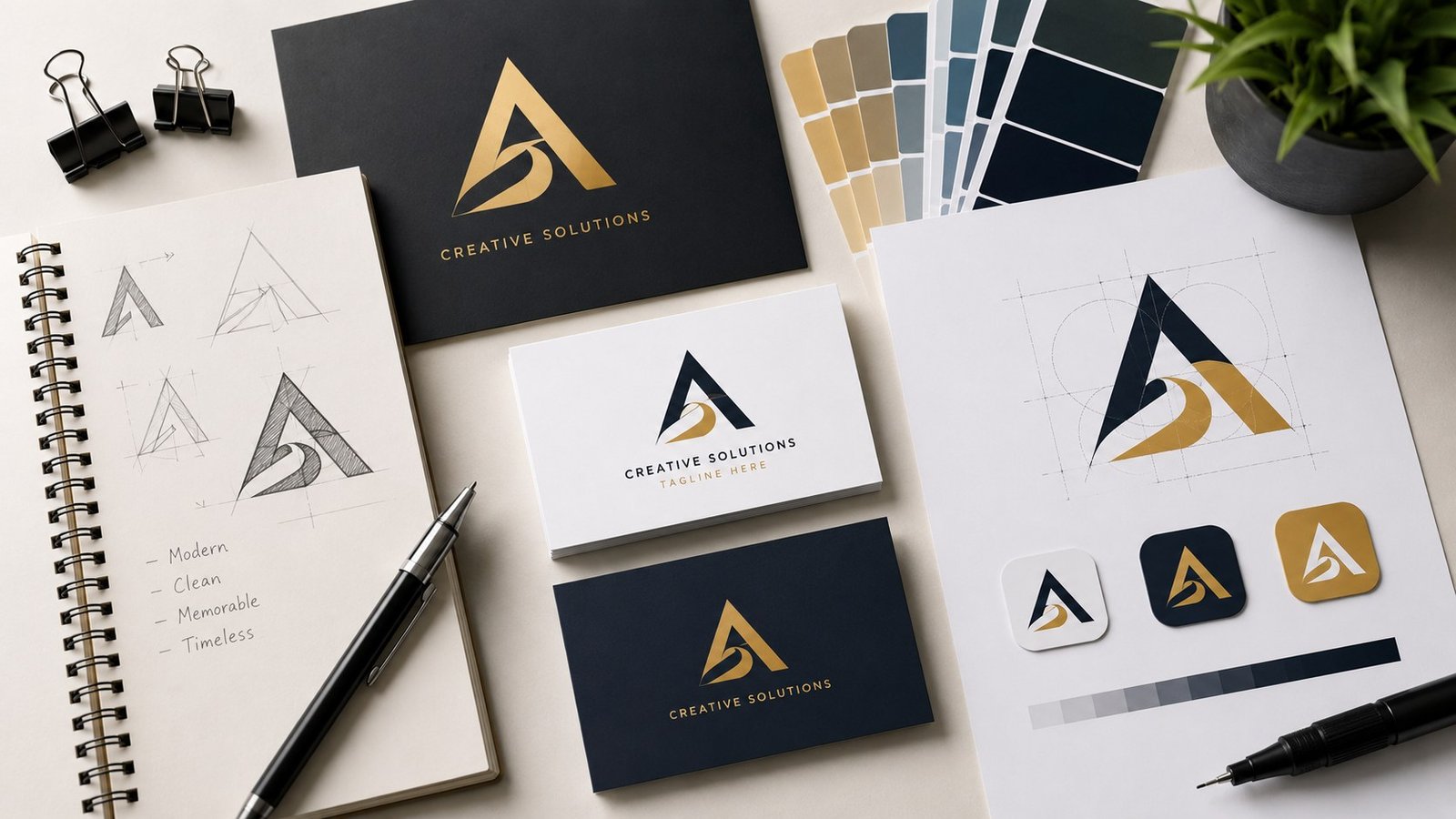
Is It Legal to Use AI-Generated Images for My Business Logo?
Is it legal to use AI-generated images for my business logo? It is a question more business owners are asking as AI image generators make “free professional logos” tantalizingly easy. The answer is: probably legal, but riskier than you think — and for a logo specifically, the risks cut deeper than for other AI imagery. A logo is not just a picture; it is a trademark, a brand asset, and the visual identity your business builds equity in for years. Getting this wrong can cost you far more than a designer’s fee. Here is the full picture.
The copyright problem: you may not own your logo
The core issue: under current U.S. Copyright Office guidance, purely AI-generated images — created from a text prompt with no meaningful human authorship — cannot be copyrighted. Copyright requires human authorship, and typing “modern minimalist coffee logo” does not clear that bar. What does this mean practically? You can use the image, but you cannot own it exclusively. Competitors could use the same or similar AI-generated imagery, and your legal options to stop them would be limited. For a logo — the asset whose entire value is exclusivity — that is a serious problem.
The nuance: works with substantial human creative input can qualify. If you generate a base image and then meaningfully transform it — significant manual editing, compositing with original elements, creative arrangement — the human-authored portions may be protectable. But “I wrote a detailed prompt” alone almost certainly does not count, and the boundary is untested in court. Do not build your brand’s legal foundation on an untested boundary.
The trademark problem: registration and distinctiveness
Copyright is about ownership; trademark is about brand protection — and logos live in trademark world. To trademark a logo with the USPTO, it must be distinctive and used in commerce. AI-generated logos face two hurdles: distinctiveness — AI models trained on millions of existing logos tend to produce generic, derivative-looking marks that may lack the distinctiveness trademarks require; and prior art collisions — your AI logo might closely resemble an existing registered trademark (the model learned from real logos, after all), exposing you to infringement claims. Before adopting any AI logo, run a trademark search — the USPTO’s free search system plus a professional clearance search for anything you will invest in. Discovering a conflict after printing signage, packaging, and a website is a five-figure mistake.
The training-data problem: hidden infringement risk
There is a subtler risk: AI models trained on copyrighted works can produce outputs substantially similar to existing copyrighted logos or artworks. If your “original” AI logo turns out to closely resemble a designer’s copyrighted work, you could face an infringement claim — and “the AI made it” is not a defense. This risk is low for any single generation but non-zero, and it scales with how much you invest in the brand. The evolving copyright law around AI training may eventually clarify liability, but today the risk sits with you, the user.
What the AI companies’ terms say
Read the fine print of your generator: terms vary enormously. Some grant broad commercial rights to outputs; others restrict commercial use on free tiers; some claim no ownership but also offer no indemnification if the output infringes someone else’s rights. Paid tiers sometimes include IP indemnification (the company defends you against claims) — a meaningful protection worth having for business use. The terms also change frequently. Whatever the terms say today, screenshot and save the version in effect when you generate your logo.
Is it legal to use AI-generated images for my business logo? The practical playbook
- Use AI for concepts, humans for final. The safest high-value workflow: generate dozens of AI concepts, pick a direction, then have a human designer refine and finalize it. The designer’s creative contribution also strengthens your copyright claim.
- Transform substantially. Do not use raw output. Edit, combine, redraw — make it unmistakably yours through human craft.
- Trademark search before investing. USPTO search plus professional clearance for serious brands.
- Check the generator’s commercial terms and keep records of which tool, tier, and terms produced your logo.
- Consider the long game. A logo you will use for a decade deserves a few hundred dollars of professional design. AI is excellent for the $0 prototype; the real brand asset deserves real craft.
This connects to the broader question of whether AI art is truly original — and to how creators protect work from AI training, the mirror image of this issue.
When AI logos make sense (and when they do not)
Reasonable: side projects, MVPs, internal tools, temporary branding, brainstorming directions to show a designer. Risky: your primary business identity, any brand you will invest heavily in, industries where brand distinctiveness is the moat (fashion, food, consumer goods). The irony: the more successful your business becomes, the more the logo’s legal fragility matters. Plan for success — build the brand on solid ground from the start.
The international dimension
AI copyright rules vary dramatically by country, which matters for online businesses serving global markets. United States: human authorship required; pure AI output uncopyrightable (current guidance). United Kingdom: uniquely grants copyright to computer-generated works with no human author — to the person who made the arrangements — though the protection is thinner and shorter. European Union: generally follows the human-authorship requirement, with ongoing legislative debate. China: courts have issued mixed rulings, some recognizing AI-assisted works. If your business operates internationally, the logo’s legal status may differ by jurisdiction — yet another reason to involve a human designer and secure proper rights. Trademark protection, unlike copyright, is available for AI-assisted logos in most jurisdictions provided the mark is distinctive and used in commerce — which is why the trademark search matters even more than the copyright question.
The bottom line
Using AI-generated images for your business logo is probably legal to use but problematic to own: you likely cannot copyright pure AI output, trademark distinctiveness is harder to establish, hidden infringement risks exist, and the legal landscape is still shifting. The smart play is hybrid — AI for rapid concepting, human designers for the final mark, trademark clearance before you commit. Your logo is the face of your business for years; it deserves better than a legal gray area. Spend the design money once, and own your brand with confidence.