
Which Is Better for a Small Business: A Website or Just Social Media?

Which is better for a small business, a website or just social media? I hear this from new owners constantly, usually hoping I’ll say social media is enough — because it’s free and they’re already on Instagram. Here’s my honest answer: social media is rented land, and you need to own at least a small plot.
I’ve watched businesses lose everything when an account got hacked, banned, or algorithmically buried. The website-versus-social debate has a clear winner, and it’s not either/or.
Which Is Better: A Website or Just Social Media? What Each Actually Does
Social media is discovery and conversation: it’s where new customers find you, see your personality, and engage daily. It’s fast, free, and where attention already lives. A website is credibility and conversion: it’s where customers verify you’re legitimate, find your hours/location/pricing without DMing you, and buy or book without friction.
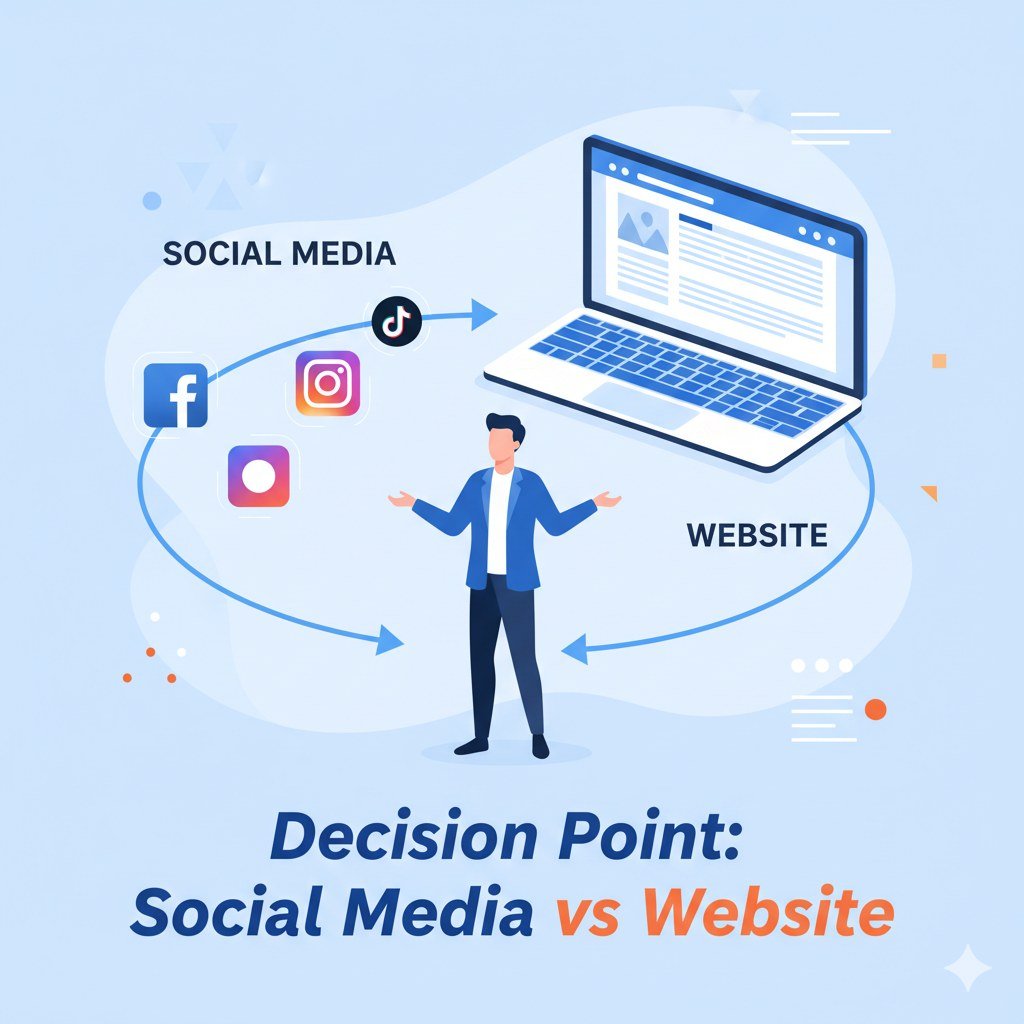
Notice they’re different jobs. Social brings people in; the website closes them. A business with only social media is a store with no address — findable but not quite trustworthy, and one algorithm change from invisible. A business with only a website is a store with no foot traffic. You need the discovery engine and the home base. The SBA’s online-business guidance at the U.S. Small Business Administration frames it the same way.
The Rented-Land Problem
This is the core argument: you don’t own your social media presence. The platform can suspend your account (it happens to legitimate businesses weekly), throttle your reach to force ad spending (organic reach on major platforms is a fraction of what it was), or simply decline in relevance — remember when businesses bet everything on Facebook pages? On MySpace?
Your website and email list are assets you control. An email subscriber is worth roughly 10–40x a social follower in revenue terms because you can reach them directly, anytime, without paying the platform. Social media should be a funnel into owned channels — every post should nudge followers toward your site and email list. Build the audience on rented land; move the valuable ones home. For driving that discovery traffic affordably, see What is the cheapest way to market a local business online.
The small-business web presence playbook:
- You need both: social for discovery, website + email for ownership and conversion.
- Minimum website: one page with what, where, how to buy, hours, contact — on your own domain.
- Minimum social: ONE platform, 3–5 posts/week, every post funneling to your site/email list.
- Never build solely on rented land — accounts get banned, algorithms change.
- Email list from day one: it’s your only algorithm-proof audience.
The Minimum Viable Version of Each
Website minimum (do this in a weekend): your business name, what you do, where/how to buy or book, hours and location, contact info, and 3–5 photos. That’s it — one page can suffice. Register your own domain (see How do I register a domain name for my business website — $12–$15/year, non-negotiable for credibility), use a simple builder (Squarespace, Wix, WordPress), and make sure it loads fast on phones. Cost: $150–$300/year all-in.
Social minimum: pick ONE platform where your customers actually are (not three — depth beats breadth), post 3–5x weekly with a mix of product, process, and personality, and put your website link everywhere. Ignore the rest until the first one works. Total minimum investment: a weekend for the site, 30 minutes a day for social. That’s the whole digital presence a small business needs to start.
When Social-First Actually Works (Temporarily)
Fair exceptions: if you’re pre-launch validating an idea, social-only is fine — don’t build a website for a business that might pivot next month. Certain businesses (personal brands, some food vendors, freelance creatives) can run on social + DMs for a long time. And if 100% of your customers come from one platform’s marketplace (Etsy, for example), the website is less urgent.
But treat social-first as a stage, not a strategy. The moment revenue is real, build the site and start the email list. I’ve never met a business owner who regretted owning their web presence; I’ve met dozens who regretted not building it sooner — usually right after an account suspension or an algorithm change cut their reach in half overnight.
The Bottom Line
Which Is Better for a Small Business a Website or Just Social Media? What Most People Get Wrong
What most owners get wrong: treating social media followers as an asset they own. They’re not — they’re the platform’s asset, lent to you under revocable terms. Algorithm changes have repeatedly cut businesses’ reach by 80%+ overnight; account suspensions (often automated and erroneous) have killed businesses in a day. Every hour invested purely in rented platforms is equity built on someone else’s land. The email list is the only audience you truly own — build it from day one, relentlessly.
Second mistake: the ‘I’ll build the website later’ trap. Later never comes until the crisis — the banned account, the algorithm shift, the platform decline — and then you’re building under duress. A basic one-page site takes a weekend and $150/year; there’s no business so early that it can’t afford that, and no business so small that it doesn’t need it. The website isn’t a luxury for established businesses; it’s the foundation that lets you become established without platform risk.
Start collecting emails before the website is even finished — a simple landing page with an email signup (‘we’re opening soon, get 10% off’) builds your launch list while you build the site. On launch day, that list is your first customers, first reviewers, and first word-of-mouth engine, all reachable without paying a platform. The businesses that launch to crickets are the ones that built in silence; the ones that launch to a waiting list built the audience first. Audience before assets, always.
A website beats social-only because you own it — but the real answer is both, each doing its job: social media for discovery, your website and email list for credibility and conversion. Build the minimum viable version of each in a weekend, funnel social followers into owned channels, and never let a platform’s algorithm be your business’s single point of failure.
Own your home base, rent your discovery channels, and move followers to email with every post. The website-plus-email-list combo is the only algorithm-proof marketing asset in existence, and it costs less than one month of the ads you’d otherwise need. Build it before you need it — because when you need it, it’s urgent.