
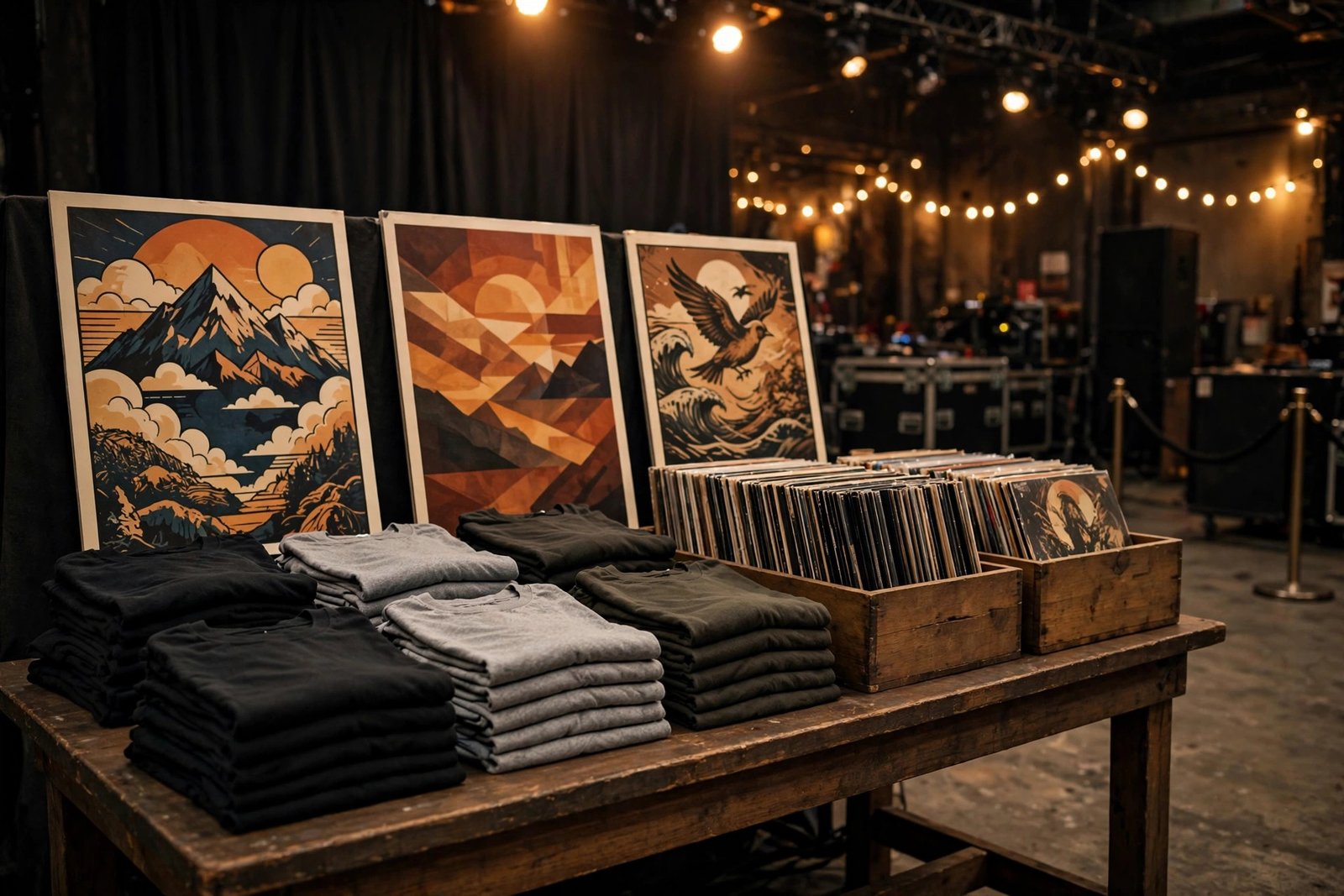
For many touring artists, the merch table earns more than the performance fee. A packed club pays the band $1,500; the line at the merch booth afterward can clear $3,000 in an hour. Yet most musicians price their merch by gut feeling — copying whatever the last band charged, or worse, pricing so low they lose money on every shirt. Merch pricing is a business discipline, and the math is simpler than most artists fear.
How to price your merch for tours? By knowing your true costs, targeting healthy margins, designing for perceived value, and using bundles and tiering to lift average order value. Here is the complete pricing playbook for the road.
Know Your True Costs First
You cannot price profitably without knowing what each item costs you, all-in. The shirt blank, the print job, the hang tags, the bags — plus shipping the inventory to the venue, the percentage the venue takes (merch cuts of 10–25 percent are common and must be negotiated in advance), and payment processing fees. A $6 blank with a $4 print is not a $10 shirt once freight, venue cut, and card fees pile on; your landed cost per unit is the real number, and most artists underestimate it by 30 percent or more.
Calculate per-item: (blank + print + packaging + freight per unit) ÷ (1 − venue cut − processing fees). That denominator matters — a 20 percent venue cut means you keep 80 cents of every dollar before costs. Price from this fully-loaded cost, not the invoice from your printer. Artists who skip this step discover at tour’s end that their “profitable” merch run broke even, a painful lesson in Shopify’s merchandising guides warn against explicitly.
The Margin Targets That Work
The industry rule of thumb: price at 3–4x your landed unit cost. A shirt costing you $10 all-in sells for $30–$40; a hoodie costing $22 sells for $60–$75. This is not greed — it is the margin structure that absorbs venue cuts, unsold inventory, damaged goods, and the reality that you will discount or comp some items. Typical street prices in 2026: tees $25–$40, long-sleeves $35–$50, hoodies $50–$80, hats $25–$35, vinyl $25–$40, posters $15–$25.
Resist the urge to undercut. Fans at shows are in a buying mood — the emotional peak after a great set is when perceived value is highest, and pricing too low leaves money that would happily have been spent. Conversely, absurd pricing breeds resentment and kills volume. The sweet spot feels slightly premium but fair: fans should feel they got something special, not that they were fleeced.
Design for Perceived Value
Price is set by perception as much as math. Tour-exclusive designs (“only available on this tour”) command premiums and create urgency. Limited colorways, numbered prints, and date/venue-specific posters turn commodities into collectibles. Quality blanks matter enormously — a soft, well-fitting shirt at $40 outsells a scratchy $25 one because fans wear it for years, advertising you with every wear. Invest in design: great artwork sells itself, while clip-art merch discounts your brand. The same fans who support local artists deliberately will pay premium prices for merch that feels genuinely special.
Bundles and Tiering: Lift the Average Order
The merch table’s secret weapon is the bundle. “Tee + vinyl + poster for $70 (save $15)” moves three items where one might have sold, raising average order value dramatically. Design bundles at natural price points ($50, $75, $100) with genuine savings, and display them prominently — most fans will not assemble bundles themselves, but they will buy pre-built ones.
Tier your offerings: an entry item under $20 (stickers, pins, koozies) captures broke fans and kids; core apparel at $30–$60 serves the majority; a premium tier ($100+ box sets, signed bundles) serves superfans who want to spend more. Every tier should exist for a real buyer. And always have card/mobile payment ready — cash-only tables lose a third of potential sales to fans who simply do not carry cash anymore.
Inventory Math: How Much to Bring
Over-ordering ties up cash in boxes that follow you home; under-ordering leaves money on the table nightly. Start from venue capacity and your draw: a rough rule is merch-buying rates of 10–20 percent of attendance for openers, 20–35 percent for headliners with engaged fans. Size curves matter — order the full range, weighted to mediums and larges, and track nightly sales to reorder mid-tour if your printer can turn quickly.
Tour-exclusive items should be genuinely limited — scarcity only works if it is real. For online follow-up, keep a small reserve to sell after the tour; “leftover tour stock” drops create second revenue waves. And reconcile nightly: count cash, match card payouts, log inventory. The unglamorous spreadsheet is what turns a merch table from a hobby into a profit center.
Print-on-Demand vs. Bulk: The Strategic Choice
Bulk screen printing gives the best per-unit costs and quality control but requires upfront cash and inventory risk. Print-on-demand services eliminate inventory entirely — designs sell online with zero stock — but per-unit costs are higher and you cannot sell POD at the merch table the same night. The smart hybrid: bulk-print your core tour designs for the road, run POD for deep-catalog designs and online-only variants. Each channel plays to its strength, and you never face a table with empty sizes.
Pricing Psychology at the Table
How you present prices matters as much as the numbers. Charm pricing ($29 instead of $30) works on merch tables just as in retail — the left-digit effect is real even among music fans. Price anchoring helps too: place the premium $75 hoodie bundle where eyes land first, and the $35 tee beside it suddenly feels reasonable. Round numbers ($40, $60) signal quality and simplify cash transactions; precise numbers ($37) signal calculation.
Display prices clearly on every item — unmarked merch creates friction, and friction kills impulse buys. A clean price board or individual tags, readable in dim venue lighting, outsells a table where fans must ask. And train whoever works the table: a friendly “we’ve got the new tour-exclusive colorway” doubles as salesmanship and fan service. The table is a retail environment; run it like one, and the numbers follow.
Conclusion
Pricing tour merch means calculating fully-loaded costs, targeting 3–4x margins, designing for perceived value with tour exclusives, building bundles that lift order value, and ordering inventory from real attendance math. The merch table is often the most profitable hour of a tour date — price it like the business it is, and it will fund the next tour.
Further reading: For more on this topic, see finding local live music events near you and SBA pricing-strategy guides for small businesses.
Frequently Asked Questions
How much should I charge for band t-shirts on tour?
Typically $25–$40, priced at 3–4x your fully-loaded unit cost (including blank, print, freight, venue cut, and fees). Quality blanks and tour-exclusive designs support the higher end.
What is a typical venue merch cut?
Merch cuts of 10–25 percent are common, varying by venue and deal. Negotiate the rate in advance as part of your booking contract — it directly affects your pricing math.
Should I use print-on-demand or bulk printing for tour merch?
Bulk printing for core tour designs (better margins, table-ready inventory) and print-on-demand for deep-catalog and online-only items. The hybrid approach minimizes risk while maximizing per-unit profit where it counts.
How do bundles increase merch revenue?
Bundles raise average order value by packaging multiple items at a slight discount. Fans who would buy one $35 shirt will often buy a $70 bundle — moving three items where one would have sold.