
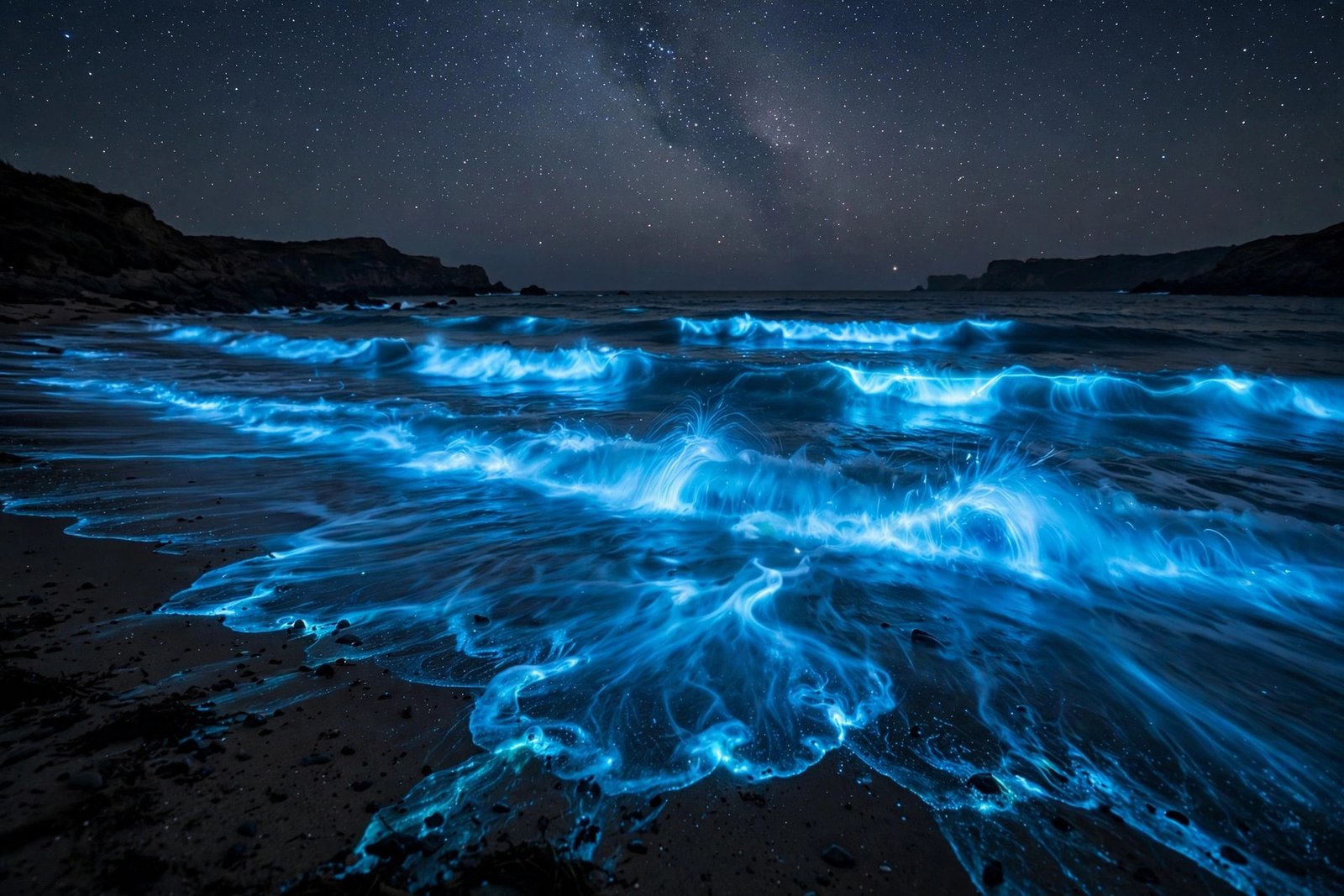
Every so often, the night ocean catches fire. Waves rolling onto the beach ignite in electric blue, surfers carve glowing trails through black water, and every footstep on wet sand leaves a fading neon print. It looks like special effects, but it is biology — millions of microscopic organisms flashing in unison. This is bioluminescence in ocean waves: living light, triggered by motion, and one of the most magical sights in nature.
The phenomenon has stopped traffic in San Diego, drawn midnight crowds to beaches from Puerto Rico to Tasmania, and puzzled sailors for centuries. Here is what causes it, the chemistry behind the glow, why these tiny organisms flash at all — and how to witness it yourself.
The Organisms Behind the Glow
In most glowing-wave events, the stars are dinoflagellates — single-celled plankton, often the species Lingulodinium polyedra along the California coast. These microscopic algae drift in surface waters by day (sometimes visible as reddish “red tide” discoloration) and transform at night. When disturbed by a breaking wave, a swimming fish, or a surfer’s board, they emit a brief flash of blue-green light lasting about a tenth of a second. Multiply by millions of organisms in a single wave, and the whole surf zone ignites.
Dinoflagellates are not the only light-makers. Krill, certain jellyfish, squid, and deep-sea fish all produce bioluminescence, and the famous bays of Puerto Rico host the dinoflagellate Pyrodinium bahamense. But the crashing-wave displays that go viral are overwhelmingly dinoflagellate blooms — dense concentrations of plankton primed to flash.
The Chemistry of Living Light
The glow comes from a chemical reaction between a light-emitting molecule called luciferin and an enzyme called luciferase, powered by oxygen. When the organism is mechanically disturbed, a cascade opens proton channels that activate the luciferase, and the reaction releases energy as photons rather than heat — “cold light” at nearly 100 percent efficiency, far better than any human lightbulb.
The blue-green color is no accident. Blue light travels farthest through seawater, so marine bioluminescence evolved in the wavelength most visible underwater. Researchers at institutions like the Smithsonian Ocean Portal note that this chemistry evolved independently dozens of times across marine life — a sign of how powerfully useful living light can be.
Why Do They Flash? Three Theories
Scientists debate the purpose, but three explanations dominate. The startle hypothesis says the flash surprises predators, buying the plankton a split second to escape. The burglar alarm hypothesis proposes the flash attracts bigger predators to eat whatever is attacking the dinoflagellates — a microscopic call for backup. The third idea is simpler: the flash may just be a byproduct of the organism’s daily chemistry, with no purpose at all. Most researchers favor a mix of the first two, since flashing clearly correlates with predation pressure.
Red Tides and Glowing Surf: The Connection
The same blooms that light up the night can discolor water by day. When dinoflagellate concentrations explode — fueled by warm water and nutrient runoff — the daytime sea turns rust-red or brown, the famous red tide. Some red tides produce toxins harmful to marine life and humans, which is why health officials monitor them closely. The glow itself is harmless, but a glowing beach by night plus red water by day means checking local advisories before swimming is wise — the same caution you would apply to planning any beach trip around water conditions.
Where and When to See It
Bioluminescent waves appear worldwide but cluster in warm coastal waters with nutrient-rich upwelling. Legendary spots include Mosquito Bay on Vieques, Puerto Rico — often called the brightest bioluminescent bay on Earth — along with bays in Jamaica, the Maldives, Tasmania, and Southern California during bloom years. Timing matters enormously: go on moonless nights, away from city lights, ideally two to three hours after sunset. Summer and early fall bring the densest blooms in most regions. Local surf reports and social media often flag active events, since blooms can appear and vanish within days.
Photographing the Glow
Your eyes will see it easily; your phone may struggle. Use a tripod or prop the camera steady, switch to manual mode, open the aperture wide, and expose for 10 to 30 seconds at high ISO. The results — long neon ribbons of surf — are worth the fiddling. And resist the urge to use flash: it kills your night vision and everyone else’s.
The Deep Sea: Bioluminescence’s True Kingdom
Glowing surf is just the shallow preview. In the deep ocean — below 1,000 meters, where sunlight never reaches — bioluminescence is not a curiosity but the dominant form of communication. Scientists estimate that three-quarters of deep-sea animals can produce light. Down there, in permanent darkness, living light is how creatures hunt, hide, mate, and avoid being eaten.
The strategies are astonishing. The stoplight loosejaw fish produces red light — nearly invisible to most deep-sea animals, which cannot see red — giving it a private headlamp for hunting. Hatchetfish use counterillumination: light organs on their bellies match the faint downwelling light from above, erasing their silhouette from predators lurking below. Vampire squid eject glowing mucus instead of ink, a luminous decoy. And the anglerfish’s famous glowing lure, studded with symbiotic bioluminescent bacteria, is perhaps nature’s most iconic fishing rod. Every submersible dive reveals new variations, reminding us that the ocean’s light show runs 24 hours a day — we just rarely get to see the main stage.
Can You Swim in Glowing Water?
Yes — and it is unforgettable. Swimmers describe every stroke igniting swirls of blue light, like moving through liquid stars. Night kayaking tours in bioluminescent bays rank among the most memorable wildlife experiences available anywhere. Just check local advisories first during red-tide events, avoid wearing chemical sunscreens that harm plankton, and never collect the water in jars — the organisms die quickly out of the ocean, and the magic belongs in the waves.
Conclusion
Bioluminescence in ocean waves is chemistry made visible: dinoflagellate plankton converting disturbance into cold blue light through the luciferin-luciferase reaction, probably to startle predators or summon bigger ones. It is harmless, hauntingly beautiful, and wonderfully democratic — no ticket required, just a dark beach, a moonless night, and a bloom. When the surf starts glowing, go. These displays never last long.
Further reading: For more on this topic, see whether you need a passport for a Bahamas cruise and Monterey Bay Aquarium Research Institute findings.
Frequently Asked Questions
What causes waves to glow blue at night?
Microscopic plankton called dinoflagellates. When waves disturb them, a chemical reaction between luciferin and luciferase produces flashes of blue-green light. Millions of organisms flashing together make entire waves glow.
Is bioluminescence in the ocean dangerous?
The glow itself is harmless. However, the plankton blooms behind it can coincide with red tides, some of which produce toxins. Check local water-quality advisories before swimming during a bloom event.
When is the best time to see bioluminescent waves?
On dark, moonless nights, away from city lights, typically two to three hours after sunset during warm months when plankton blooms peak. Blooms are unpredictable and can last days or weeks.
Where are the best places to see bioluminescence?
Mosquito Bay in Vieques, Puerto Rico is the most famous, along with spots in Jamaica, the Maldives, Tasmania, and Southern California during bloom years. Any warm, nutrient-rich coast can produce displays when conditions align.