
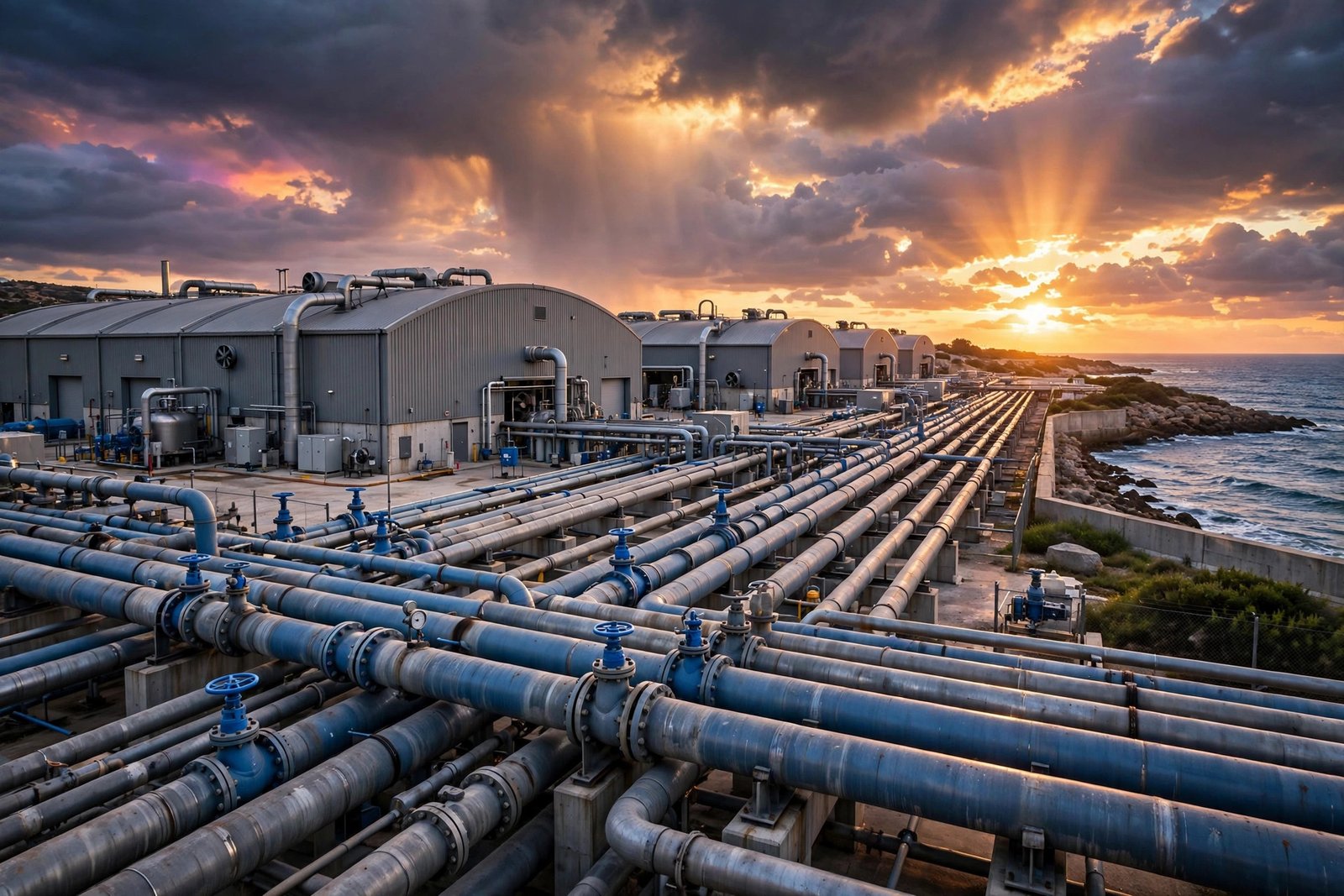
The ocean holds 96 percent of Earth’s water, and almost none of it is drinkable. A liter of seawater contains about 35 grams of dissolved salts — drink it, and your kidneys work harder to expel the salt than the water is worth, accelerating dehydration. Yet from Saudi Arabia to San Diego, massive industrial plants now convert that undrinkable ocean into tap water for millions of people. The transformation looks like alchemy. It is actually physics, pushed through membranes at extraordinary pressure.
Desalination supplies drinking water to more than 300 million people worldwide, and capacity keeps climbing as droughts deepen and aquifers deplete. Here is how these plants turn seawater drinkable — the dominant technology, the energy math, the brine problem nobody talks about enough, and where the industry is headed.
The Dominant Technology: Reverse Osmosis
Most new desalination plants use reverse osmosis (RO), which forces seawater through semipermeable membranes at pressures of 60 to 80 bar — roughly 60 to 80 times atmospheric pressure. The membranes’ pores are so fine that water molecules pass through while dissolved salts, minerals, and most contaminants are rejected. It is filtration at the molecular scale.
The process runs in stages. Seawater first passes through intake screens and pretreatment — filtration and chemical conditioning that remove algae, particles, and organisms that would foul the membranes. Then high-pressure pumps drive it across spiral-wound membrane elements arranged in pressure vessels. Roughly 40 to 50 percent emerges as fresh permeate; the rest becomes concentrated brine. Finally, the product water gets post-treatment: minerals like calcium are added back for taste and pipe health, pH is adjusted, and disinfectant is applied. What reaches taps meets the same EPA drinking-water standards as any municipal supply.
The Older Method: Thermal Desalination
Before membranes dominated, the Middle East built its water security on heat. Thermal methods like multi-stage flash distillation boil seawater in successive chambers at progressively lower pressures, collecting the condensed vapor as pure water. The approach is robust and produces exceptionally pure water, but it is energy-hungry — which is why it persists mainly where fuel is cheap and abundant, particularly in the Gulf states. New construction has overwhelmingly shifted to reverse osmosis, which uses a fraction of the energy per liter.
The Energy Equation
Energy is desalination’s defining cost. Modern seawater reverse osmosis needs roughly 3 to 4 kilowatt-hours per cubic meter of product water — dramatically better than the 10-plus of early plants, thanks to energy-recovery devices that capture pressure from the brine stream. Still, desalinated water costs on the order of $0.50 to $1.00 per cubic meter to produce, several times the cost of conventional freshwater treatment.
That premium is why desalination is a drought and coastal strategy, not a universal fix. Israel now gets more than half its domestic water from desalination, with the Sorek plant among the world’s largest. The Carlsbad plant in San Diego County — the biggest in the United States at about 50 million gallons per day — supplies roughly 10 percent of the region’s water. For households watching every drop, pairing supply-side solutions with demand-side habits like tracking how much water you actually need daily keeps the whole system sustainable. Energy-recovery devices have been the quiet revolution behind falling costs: by harvesting pressure from the outgoing brine stream and feeding it back into the incoming feed, modern plants recycle energy that early designs simply threw away — without that innovation, today’s production costs would run nearly double.
The Brine Problem
Every liter of fresh water leaves behind concentrated brine — roughly twice as salty as seawater, laced with pretreatment chemicals. Dumping it carelessly creates dead zones on the seafloor. Modern plants mitigate this with diffusers that dilute the discharge across a wide area, and researchers are developing ways to mine brine for magnesium, lithium, and other minerals — turning waste into resource. Brine management, more than energy, is now the industry’s central environmental challenge, and regulators increasingly demand rigorous outfall monitoring — with some jurisdictions requiring real-time salinity sensors and adaptive discharge controls.
The Future: Cheaper, Smarter, Smaller
Three trends are reshaping desalination. First, renewable pairing: solar-powered RO plants in the Middle East and North Africa are decoupling water production from fossil fuels. Second, better membranes — including graphene and biomimetic designs in the lab — promise lower pressures and higher recovery, with some new facilities designed to run primarily on dedicated solar farms. Third, modular small-scale plants are bringing desalination to island communities and disaster zones that could never finance a mega-plant. None of this makes ocean water free, but the trajectory is unmistakable: the cost curve bends down while thirst rises.
How Desalination Compares to Other New Water Sources
Desalination is not the only way to manufacture water security, and honest planning compares it against the alternatives. Wastewater recycling — treating sewage to drinking-water standards — typically costs less per cubic meter than seawater desalination and uses less energy, which is why cities like San Diego and Los Angeles are investing heavily in potable reuse alongside their desalination plants. Orange County’s Groundwater Replenishment System, the world’s largest water purification project for indirect potable reuse, produces water at a fraction of desalination’s energy cost.
Stormwater capture is cheaper still where rainfall allows, and agricultural efficiency — drip irrigation, soil moisture sensing — stretches existing supplies dramatically. But each alternative has limits: recycling needs wastewater to recycle, stormwater needs storms, and efficiency eventually plateaus. The realistic future for water-stressed coastal regions is a portfolio: conservation first, recycling second, desalination as the drought-proof backbone. No single technology wins; the combination does. What desalination uniquely offers is reliability — the ocean does not have dry years.
Conclusion
Desalination plants turn seawater drinkable by forcing it through molecular-scale membranes at immense pressure, then polishing the result to drinking-water standards. The physics is proven at staggering scale — hundreds of millions of people already depend on it daily — and the remaining battles are economic and environmental: energy costs and brine disposal. As climate pressure grows, expect these plants to shift from last resort to standard infrastructure along the world’s dry coasts.
Further reading: For more on this topic, see whether tap water is safe when you travel and WHO drinking-water quality guidelines.
Frequently Asked Questions
Is desalinated water safe to drink?
Yes. Product water is remineralized, pH-adjusted, and disinfected to meet the same drinking-water standards as conventional municipal supplies, with continuous monitoring at the plant. It is routinely tested and, mineral-balanced, tastes like ordinary tap water.
Why is desalination so expensive?
Energy dominates the cost — pushing seawater through membranes at 60-plus bar takes roughly 3 to 4 kWh per cubic meter. Capital costs for intakes, membranes, and brine outfalls add more. It typically costs several times conventional freshwater treatment.
What happens to the leftover salt?
The concentrated brine is usually discharged back to the ocean through diffusers that dilute it, under environmental monitoring. Researchers are developing mineral extraction from brine, but large-scale brine mining is not yet economical.
Can desalination solve water shortages everywhere?
No — it is best suited to coastal regions with energy access and funding, where plants can be built at meaningful scale. Inland areas face the added cost of pumping water uphill and disposing of brine far from the sea. Conservation, recycling, and better groundwater management remain absolutely essential everywhere.