
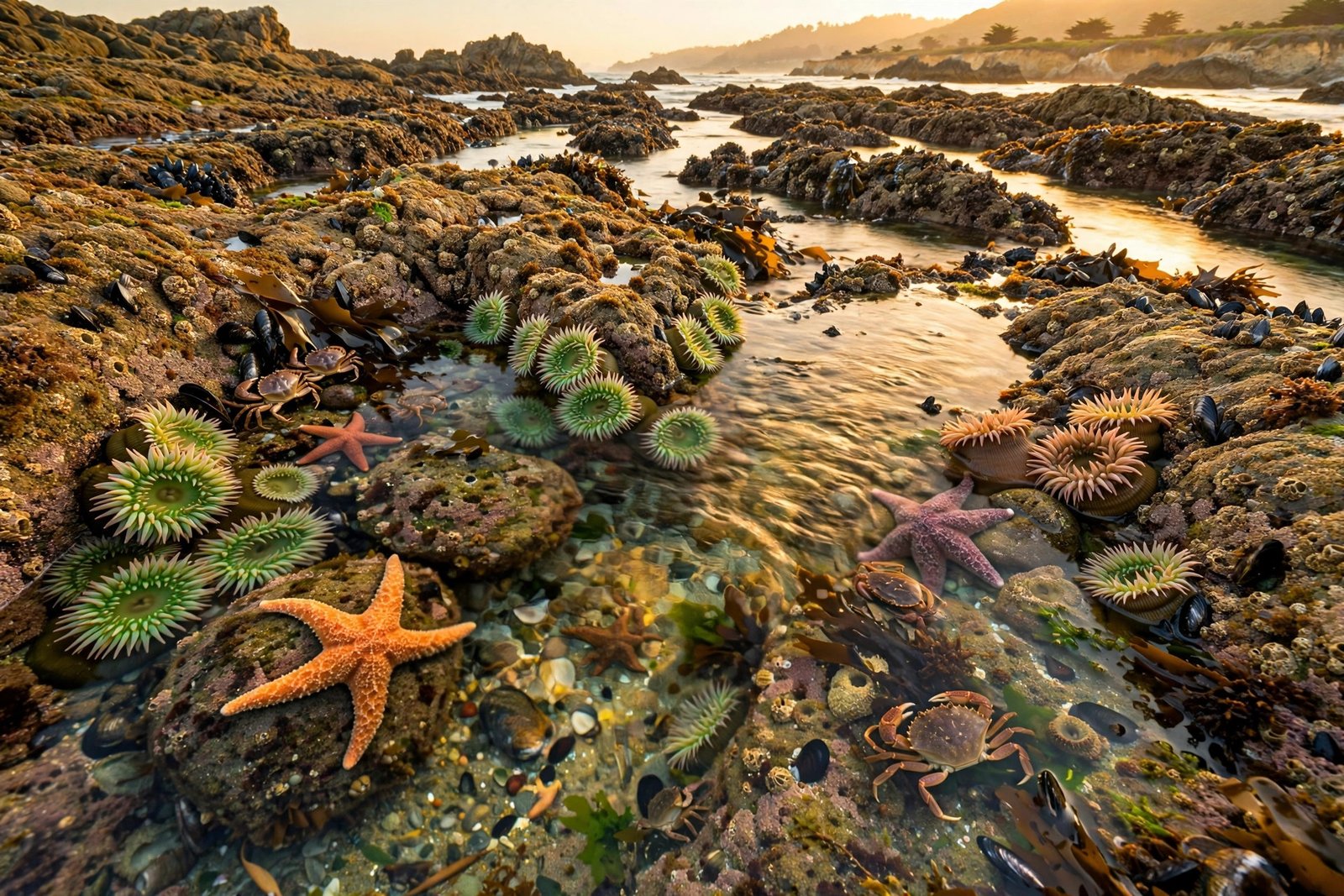
At low tide along the California coast, the receding ocean leaves behind rock basins teeming with impossible density of life: purple sea urchins packed shoulder to shoulder, ochre sea stars draped over mussel beds, anemones blooming like flowers, tiny crabs and sculpins darting through miniature kelp forests. A single tide pool can hold dozens of species in a few square feet — biodiversity rivaling a coral reef, compressed into a rock basin.
How does so much life thrive in what looks like a puddle? The answer is a perfect storm of nutrients, structure, and ecological relationships — and understanding it reveals why tide pools are among the most productive habitats on Earth.
The Nutrient Engine: Upwelling on Tap
The foundation of tide pool abundance is the ocean feeding it. The California coast’s upwelling system pumps cold, nutrient-rich deep water to the surface, fueling massive phytoplankton blooms — the base of the marine food web. Every incoming tide delivers a fresh shipment of plankton, larvae, and dissolved nutrients into the pools. The pools are not closed systems; they are refreshed twice daily with the ocean’s richest water.
This constant resupply is the key difference from a literal puddle. A tide pool is more like a restaurant with twice-daily deliveries than a pantry — the high turnover supports far more life than the pool’s volume alone could sustain.
Structure Creates Neighborhoods: The Intertidal Zones
Tide pools are not uniform — they are layered into distinct zones, each with its own community adapted to specific exposure:
- The splash zone (upper): rarely submerged; dominated by hardy periwinkles, lichens, and barnacles that tolerate hours of air exposure and temperature swings.
- The middle intertidal: submerged half the time; mussel beds, gooseneck barnacles, and sea stars. Competition for space is fierce — rock surface is the limiting resource, and organisms literally grow over each other.
- The lower intertidal: exposed only at the lowest tides; the richest zone — sea urchins, anemones, nudibranchs, kelp holdfasts, and the greatest species diversity. These pools stay submerged longest and most stably.
This zonation means a single rocky shore stacks multiple ecosystems vertically in a few yards — each zone’s specialists thriving where others cannot survive the exposure regime.
Adaptations: Life Engineered for Extremes
Tide pool residents endure conditions that would kill most marine life: hours exposed to air, temperature swings of 30°F+, salinity spikes as pools evaporate, pounding surf, and hungry predators at every tide change. Their adaptations are extraordinary:
- Closing up shop: mussels clamp shut, anemones retract into jelly-like blobs, barnacles seal their plates — each riding out low tide in a self-contained moisture vault.
- Grip strength: sea stars’ tube feet, urchins’ spines wedged into crevices, limpets’ suction — all evolved to resist waves that hit with tons of force.
- Timing reproduction to tides: many species spawn on specific tidal cycles, releasing larvae into the outgoing tide for dispersal and catching the incoming tide to settle.
- Rapid feeding: predators like sea stars feed intensely during high tide submersion, then digest through the low tide — the intertidal’s feast-and-famine rhythm.
The Keystone Story: Why Sea Stars Matter So Much
Tide pools taught ecology one of its foundational lessons. In the 1960s, Robert Paine’s experiments at Makah Bay showed that removing ochre sea stars — the top predator — caused mussel beds to take over, collapsing species diversity from 15+ species to 8. The sea star was a keystone species: disproportionately important relative to its abundance, holding the entire community’s diversity in place through predation.
This discovery, made in tide pools, reshaped conservation biology worldwide. And it is playing out in real time: sea star wasting disease has devastated ochre star populations along the West Coast since 2013, with cascading effects on mussel dominance being monitored by researchers at institutions like the Monterey Bay Aquarium Research programs and California Academy of Sciences intertidal surveys.
Visiting Responsibly: The Ethics of Tide Pooling
Tide pools’ accessibility is their vulnerability. A single careless visitor can destroy decades of growth — anemones torn from rocks, urchins crushed underfoot. The rules:
- Never remove animals or shells — empty shells are hermit crab homes; every removal cascades.
- Step on bare rock only, never on mussel beds or algae — what looks like rock may be living community.
- Do not poke or prod — anemones close defensively, expending energy they need for feeding. Observe, do not handle.
- Return overturned rocks exactly as found — the underside community depends on its orientation.
- Check tide tables and visit at low tide; never turn your back on the ocean — sneaker waves kill tide poolers every year.
Responsible tide pooling pairs beautifully with a well-planned coastal trip — see our guide to packing for a beach vacation — and with outdoor activities for groups, since tide pooling is best shared (more eyes spotting, more care taken).
The Best Tide Pool Spots on the West Coast
For first-time tide poolers, a few standout locations: Fitzgerald Marine Reserve (Moss Beach, CA) — the Bay Area’s richest and most accessible pools; Cabrillo National Monument (San Diego) — excellent lower-intertidal zones; Haystack Rock (Cannon Beach, OR) — seabird-nesting sea stack with vibrant pools; and Olympic National Park’s Rialto Beach (WA) — wilder, more remote, spectacularly diverse. All require checking tide tables and arriving at negative low tides; all reward the early riser with the ocean’s best free show.
Frequently Asked Questions
What is the best time to visit tide pools?
During the lowest tides — typically early morning in winter months on the West Coast (negative tides expose the richest lower zones). Check local tide tables and aim for tides below 0 feet. Winter offers the best lows but rougher surf; always prioritize safety over optimal viewing.
Are tide pools safe for kids?
Yes, with supervision — they are among the best nature experiences for children. Rules: hold hands on slippery rocks, never turn backs to the ocean, no touching without guidance, and reef-safe sunscreen (chemical sunscreens damage intertidal life; mineral options are safer).
Why are California tide pools so colorful?
The color is the community: purple urchins, orange sea stars, green anemones, pink coralline algae. The nutrient-rich upwelling system supports this density and diversity — tropical reefs get color from coral symbiosis; temperate tide pools get it from sheer species packing.
Can I take shells or rocks from tide pools?
In most California marine protected areas, no — collection is prohibited, and ethically it is harmful everywhere. Empty shells house hermit crabs; rocks host encrusting communities. Take photos, leave everything.
What happens to tide pools during high tide?
They vanish into the ocean — becoming indistinguishable from the surrounding sea, with their residents feeding, spawning, and interacting freely. The “pool” exists only at low tide; the community exists continuously, cycling between exposed and submerged states twice daily.
The Bottom Line
Tide pools support extraordinary marine life because they are not isolated puddles but twice-daily resupplied extensions of one of Earth’s most productive ocean systems — structured into zones, populated by extreme-adaptation specialists, and held in balance by keystone predators. They are also fragile, accessible, and best experienced with care. Visit at low tide, step lightly, touch nothing, and you will witness one of nature’s densest showcases of life thriving at the edge of two worlds.