
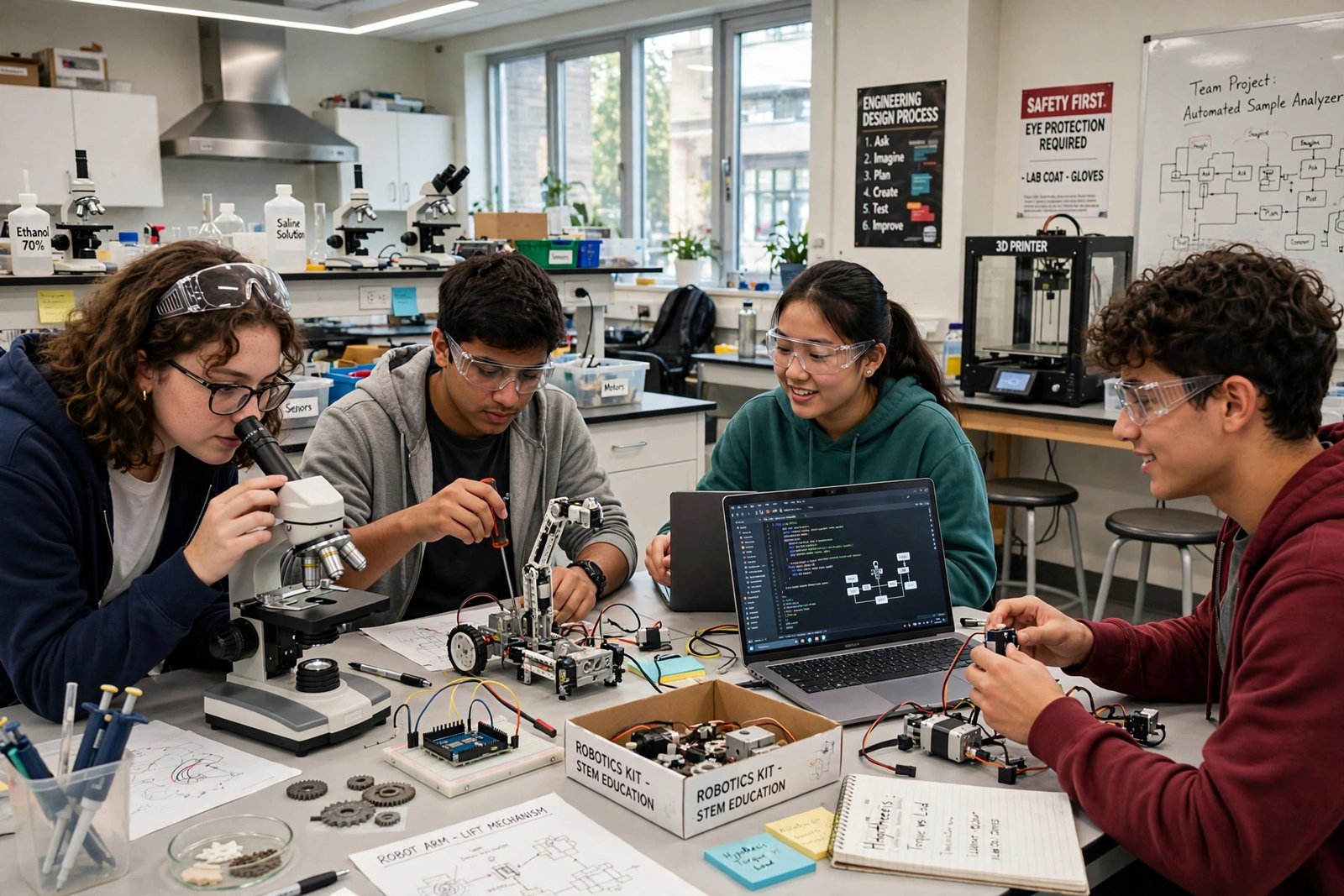
The Bay Area's STEM high school landscape is uniquely intense: public magnets with national reputations, comprehensive high schools with powerhouse STEM tracks, and private schools feeding directly into top engineering programs. For parents navigating it, the signal-to-noise ratio is terrible — rankings disagree, forums contradict each other, and every school claims excellence.
Here's a clear-eyed guide to the Bay Area's genuinely strong STEM high schools, what 'best' actually means, and how admissions really work.
The Public Standouts
Lowell High School (San Francisco) remains the Bay Area's most famous academic public school — historically merit-admissions-based (policies have shifted in recent years, so verify current admissions rules), with deep AP offerings and strong math/science culture. Mission San Jose High (Fremont) posts some of California's highest test scores with a STEM-heavy student body. Lynbrook, Monta Vista, and Palo Alto High anchor Silicon Valley's public excellence, each sending large cohorts to top UC engineering programs.
The honest caveat about elite publics: much of their 'STEM excellence' reflects selective enrollment and affluent, education-focused families as much as school quality. A motivated student at a solid comprehensive high school with strong AP science offerings often outperforms a middling student at a pressure-cooker magnet. Look past rankings at specific indicators: number of AP STEM sections offered (not just listed), science lab quality, math team/robotics participation, and where graduates actually enroll for engineering.
Magnets, Charters, and Alternatives
For families open to alternatives: Basis Independent Silicon Valley (San Jose) runs a famously rigorous STEM curriculum with exceptional AP outcomes — at private-school prices. The Nueva School and Harker School serve the gifted-education niche with deep STEM resources. On the public charter side, schools like Summit and KIPP offer solid STEM pathways with lottery admissions.
Don't overlook community college dual enrollment — Bay Area high schoolers can take actual college STEM courses (multivariable calculus, organic chemistry, programming) through Foothill, De Anza, and other community colleges, often free. A student at an 'average' high school stacking dual-enrollment credits can build a stronger STEM transcript than a magnet student coasting on the school's reputation. Admissions officers notice genuine intellectual initiative more than brand names.
Learn more from US Department of Education.
What Actually Predicts STEM Success
Research consistently shows the strongest predictors of college STEM success aren't school prestige but: completing calculus (ideally BC) and physics in high school, sustained participation in STEM extracurriculars (robotics, math olympiads, science fair, coding projects), and — underrated — writing ability, since STEM careers run on communication. A school that delivers these three things is a good STEM school regardless of ranking.
Equally important: fit and mental health. The Bay Area's elite STEM environments can be genuinely damaging for students who internalize the hyper-competitive culture — anxiety, burnout, and impostor syndrome are well-documented at pressure-cooker schools. The 'best' STEM school is the most rigorous one where your specific kid will thrive, not merely survive. Visit, talk to current students (not just tour guides), and trust your read on the culture.
Admissions Strategy
For application-based schools, prepare early: 8th-grade math placement often determines high school STEM trajectory (the calculus-by-senior-year pipeline starts with middle school algebra). Keep grades pristine in math and science specifically — STEM programs weight these heaviest. Build a coherent STEM narrative: two years of robotics beats six disconnected clubs.
For neighborhood-assignment publics, your leverage is course selection and extracurriculars, not admissions — max out the AP STEM sequence, add dual enrollment, and compete in olympiads or build independent projects. Independent STEM projects (a GitHub portfolio, a published app, original research with a local professor) differentiate applicants more than any school name. In the end, colleges admit students, not schools — the institution is the stage, but your kid is the performance.
For the authoritative take, visit California Department of Education.
Supporting Your STEM Student Without Burning Them Out
The Bay Area's achievement culture can turn supportive parenting into pressure without anyone noticing. The research-backed approach: praise process and strategy ('your approach to that physics problem was creative') over talent ('you're so smart') — growth-mindset feedback builds resilience while talent-praise builds fragility. Protect sleep ruthlessly: the all-night study session is neurologically counterproductive, and chronically sleep-deprived teens learn less while feeling worse.
Watch for the warning signs that rigor has become harm: dread about school, loss of interest in everything, physical symptoms before tests, or identity collapse around grades. The most successful STEM students long-term aren't the ones who maximized APs at maximum stress — they're the ones who stayed curious and healthy enough to sustain effort through college and beyond. Your job isn't to optimize their transcript; it's to protect the kid the transcript belongs to. A burned-out 16-year-old with a perfect GPA has lost the actual game.
The extracurricular trap deserves specific attention: Bay Area STEM culture pushes students toward resume-stacking — six clubs, three competitions, zero depth. Colleges and employers see through it instantly. Two deep commitments (a robotics team where they lead, a research project they own) outperform six superficial ones on every measure that matters, including the student's own development and sanity.
Siblings add another dimension: when one child is the 'STEM star,' others can feel invisible by comparison. Celebrate each kid's distinct strengths explicitly, avoid comparison language entirely, and remember that the non-STEM sibling's path is equally valid. The family's job is raising healthy humans with options, not producing a matched set of engineering admits. Keep that hierarchy clear and the STEM pressure stays in its healthy lane.
Related reading you might enjoy: learning a new skill as a busy adult and AI tools for students studying for exams.
The Bay Area's best STEM high schools — Lowell, Mission San Jose, the Silicon Valley publics, Basis, Harker — offer genuine advantages, but the school matters less than the student's trajectory through it: calculus and physics completed, deep extracurricular engagement, and mental health intact. Choose the most rigorous environment your kid will thrive in, supplement with dual enrollment and independent projects, and remember that colleges admit students, not brand names.
Frequently Asked Questions
What is the best public STEM high school in the Bay Area?
Lowell (SF), Mission San Jose (Fremont), and the top Silicon Valley publics (Lynbrook, Monta Vista, Palo Alto High) lead on outcomes. Verify Lowell's current admissions policy, as it has changed in recent years.
Do you need to attend an elite high school for top engineering colleges?
No. Colleges evaluate what you did with your opportunities. A standout student at a comprehensive high school with maxed-out AP STEM and independent projects beats a mediocre student at a famous magnet.
When should STEM preparation start?
The math pipeline starts early — 8th-grade algebra placement largely determines whether calculus by senior year is feasible. But genuine STEM passion can ignite at any age; it's the trajectory that matters.
Are private STEM schools worth the cost?
Sometimes, for the right student — smaller classes, deeper resources, stronger advising. But a motivated public-school student with dual enrollment can match the academic outcomes at a fraction of the cost.