
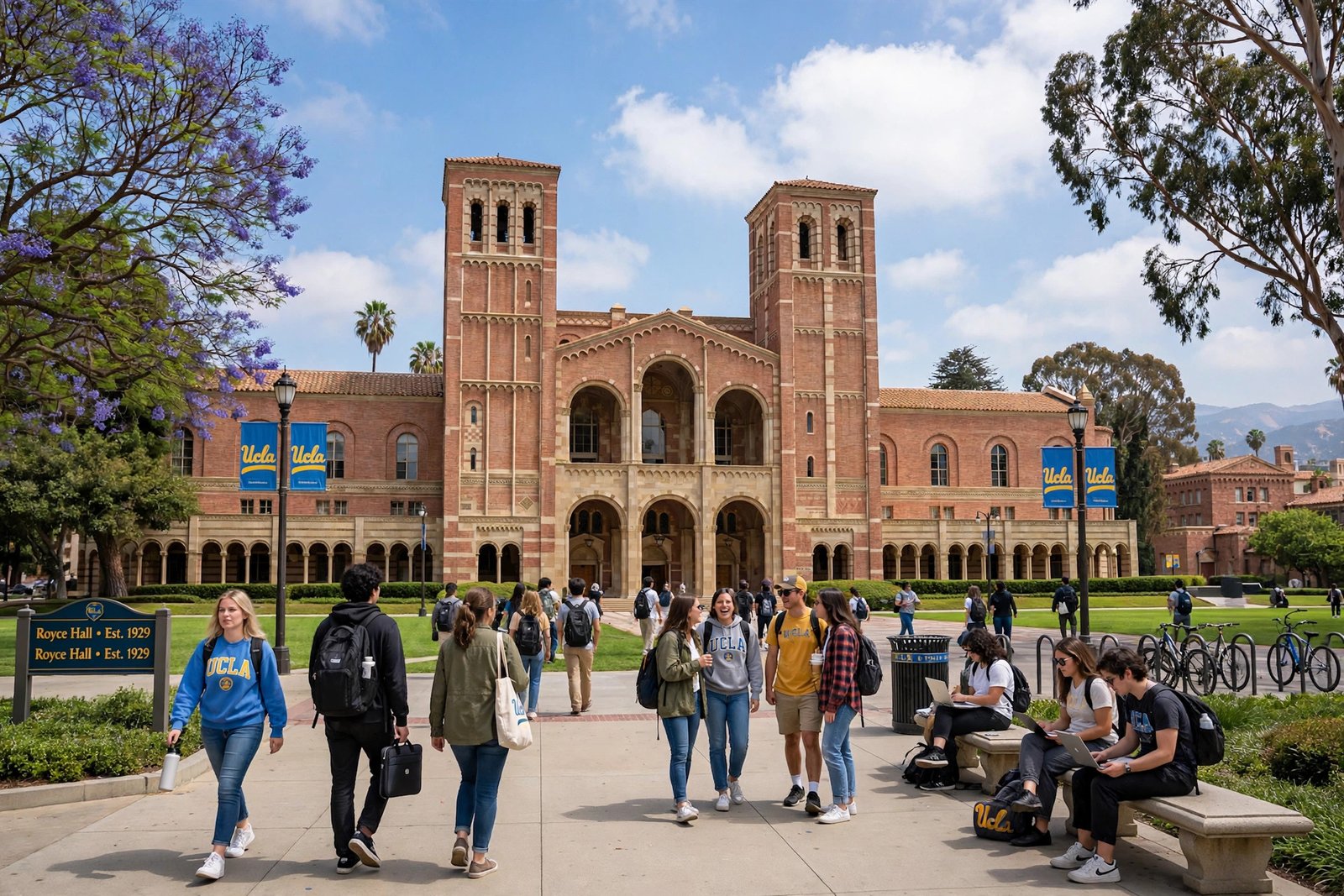
UCLA is the most-applied-to university in America — over 145,000 applications in recent cycles — and out-of-state applicants face a distinct admissions landscape: higher academic bars, no admissions preference, and a $35,000+/year nonresident tuition supplement. But thousands of non-Californians enroll every year.
Here's what out-of-state applicants actually need: the numbers, the strategy, and the honest differences from in-state admissions.
The Numbers: What You're Up Against
UCLA's overall acceptance rate hovers around 9%, but that blends very different pools. California residents are admitted at meaningfully higher rates than out-of-state applicants, and international applicants face the steepest odds. For nonresidents, the academic profile of admitted students skews high: weighted GPAs typically 4.3+, with most admits showing nearly straight A's in the most rigorous curriculum available.
The UC system is test-blind — SAT/ACT scores are not considered at all — so your transcript, course rigor, and Personal Insight Questions carry the entire academic evaluation. UC also caps out-of-state enrollment: nonresidents are limited to 18% of enrollment systemwide, which structurally tightens your odds. The takeaway isn't despair — it's precision: every element of your application must be excellent, because the margin for error is thinner than for Californians.
Academics: The Non-Negotiable Foundation
UC admissions evaluates your GPA in UC-approved honors/AP/IB courses with extra weighting, but only for courses taken in 10th and 11th grade (plus 12th-grade rigor, which they see). For out-of-state applicants, the course-rigor bar is effectively 'the hardest schedule your school offers, aced.' A 4.0 in standard courses loses to a 4.3 in a brutal AP load.
One strategic note: UC calculates its own GPA, and out-of-state honors courses only earn extra weight if they're UC-approved — many aren't. Check the UC course list database for your school; if your honors courses don't count, AP and IB are the safer rigor signal. Senior-year course selection matters too — admissions officers check for senioritis in course choices, and admitted students' offers can be rescinded for dramatic grade drops.
You can verify the details at UCLA official site.
The Personal Insight Questions: Your Differentiator
With no test scores and no interviews, UCLA's four Personal Insight Questions (350 words each) are where out-of-state applicants win or lose. The prompts ask about leadership, creativity, challenges, academics, and community — and the winning approach is specific, reflective, and forward-looking. Vague essays about 'loving diversity' or generic leadership stories drown in the pile.
The out-of-state angle is an asset if used well: what perspective does your background bring to UCLA specifically? Connect your story to actual UCLA programs, professors, or opportunities — named specifics signal genuine interest, which matters when yield (accepted students who enroll) affects rankings. Avoid the two classic failures: the resume in prose form (they have your activities list already) and the trauma essay without reflection (adversity matters only through what it reveals about your thinking). Have a teacher who knows you review for authenticity — admissions readers detect manufactured essays instantly.
Money: The $35,000/Year Reality
Nonresident tuition adds roughly $35,000+ per year on top of base UC tuition — pushing total cost of attendance toward $70,000+/year. UC need-based aid prioritizes California residents; out-of-state students should expect to pay close to full price unless they win merit scholarships (UCLA's are limited and highly competitive).
Run the net-price calculator before falling in love with the campus. Compare honestly against your in-state flagship's honors program — the education gap is often smaller than the price gap suggests. That said, for students targeting film, entertainment, tech, or specific UCLA research strengths, the LA ecosystem access can justify the premium as a career investment. Just make it a calculated decision with real numbers, not a vibes-based one. And note: establishing California residency for tuition purposes as a student is deliberately difficult — don't count on it.
The full background is available at UC admissions official portal.
Campus Life: What Out-of-State Students Should Know
The social transition is the underrated challenge. Roughly 75%+ of UCLA students are Californians, and friend groups form fast in freshman fall — out-of-state students should arrive early, attend every orientation event, and join 2–3 clubs in the first month (the involvement fair is your highest-ROI afternoon of the year). Homesickness peaks around week 6; it's universal, not a sign you chose wrong.
Practical notes: LA's cost of living shocks even prepared students — budget realistically for food, transport, and the social spending that college involves. A car helps enormously in LA but parking is expensive and scarce; many students manage with the bus, bikes, and rideshares. Build your California network deliberately — internships, alumni connections, and friendships here compound into the LA career ecosystem that partly justifies the out-of-state premium. You're not just buying an education; you're buying four years of Los Angeles. Use them.
Academically, the quarter system is UCLA's defining rhythm — 10-week quarters move fast, midterms arrive by week 4, and falling behind is brutally hard to reverse. Out-of-state students used to semesters should front-load organization: syllabi mapped in week one, office hours visited early, study groups formed before midterms. The pace is the steepest adjustment, steeper than the academics themselves.
Financially, build a four-year cost model, not a one-year budget — the nonresident supplement rises most years, LA living costs compound, and study abroad or summer sessions add up. Apply for departmental scholarships annually (many go unclaimed for lack of applicants), work part-time if it doesn't hurt grades (campus jobs are plentiful and flexible), and revisit the value equation each year with real numbers. An honest annual review beats a vague four-year hope.
Want to go deeper? Check out whether AI makes college degrees less valuable and buying a refurbished laptop for college next.
Getting into UCLA as an out-of-state applicant demands near-perfect academics in maximum rigor, standout Personal Insight Questions with UCLA-specific connections, and clear-eyed financial planning for the nonresident premium. The odds are steep but the path is legible: be excellent, be specific, be genuine — and apply with your eyes open about cost. Thousands of non-Californians do it every year; there's no structural reason you can't be one.
Frequently Asked Questions
What GPA do out-of-state applicants need for UCLA?
Admitted nonresidents typically show weighted GPAs of 4.3+ with nearly straight A's in the most rigorous available curriculum. The bar is higher than for California residents.
Does UCLA consider SAT/ACT for out-of-state applicants?
No — the entire UC system is test-blind. Scores are not considered for any applicant, in-state or out-of-state.
How much more does UCLA cost for out-of-state students?
Nonresident supplemental tuition adds roughly $35,000+/year, bringing total cost of attendance to about $70,000+/year. Need-based aid prioritizes Californians.
Can out-of-state students get California residency for tuition?
It's deliberately difficult for students who moved to California for education — you must demonstrate financial independence and intent to remain permanently. Don't count on it in your planning.