
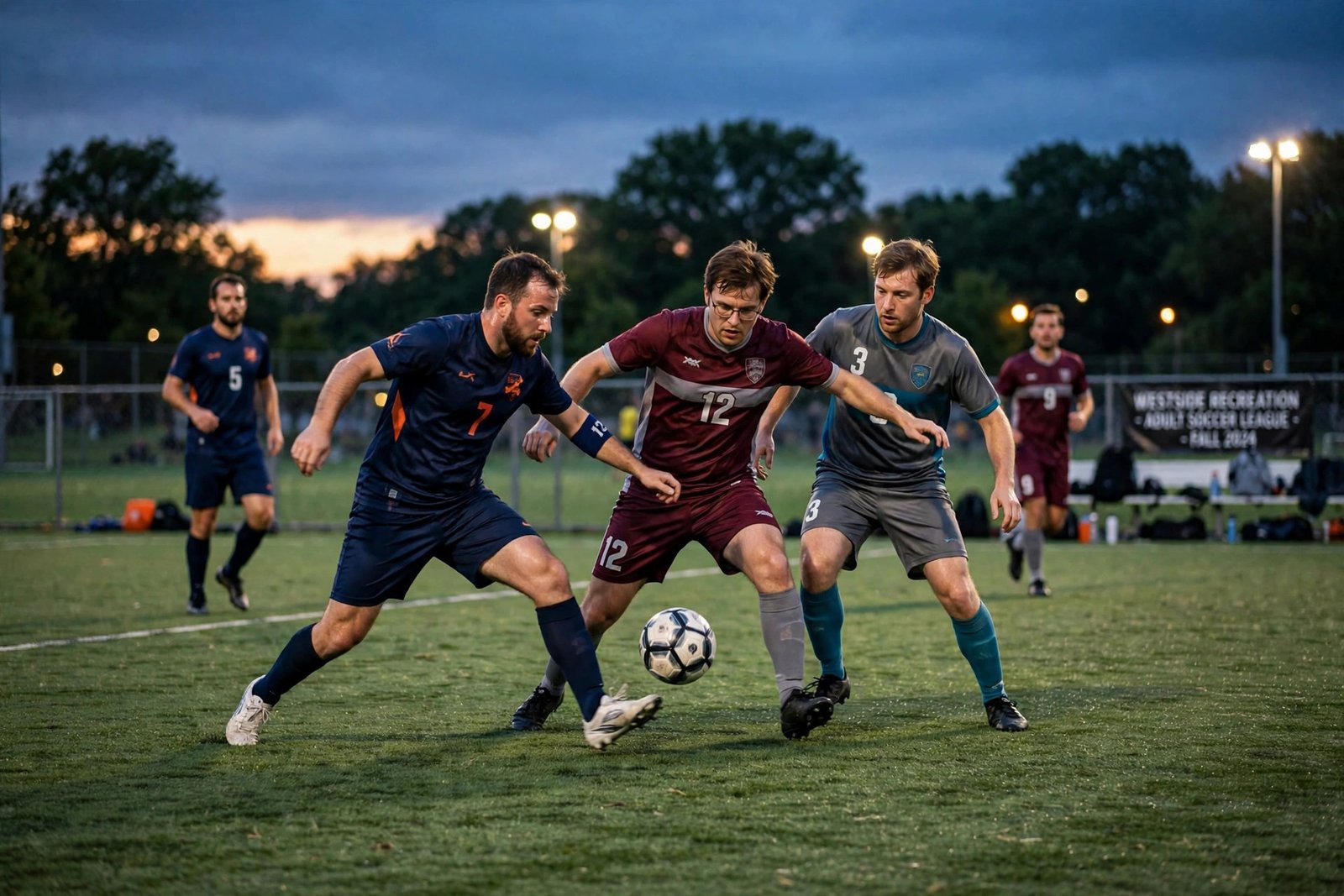
Portland is a soccer city — Timbers Army culture, year-round playable weather (with the right turf), and one of the deepest adult league scenes on the West Coast. Whether you played competitively growing up or haven't touched a ball since middle school, there's a division with your name on it.
Here's how to find it: the leagues, the divisions, the costs, and the free-agent path that gets solo players onto teams.
The League Landscape
Portland's adult soccer runs through several organizations. The Greater Portland Soccer District (GPSD) operates the region's largest outdoor 11v11 leagues with deep divisional structure — from highly competitive Premier down through multiple recreational tiers. Portland Parks & Recreation runs affordable coed and men's/women's leagues at city fields. For indoor and small-sided year-round play, facilities like Portland Indoor Soccer and Rose City Futsal offer 5v5/7v7 leagues that run through the rainy winter.
Oregon Adult Soccer Association affiliates cover the suburbs (Beaverton, Hillsboro, Gresham), often with lower fees and easier parking. The right league depends on format preference: 11v11 outdoor is the 'real' soccer experience but demands 90-minute Sunday commitments; 5v5 indoor is faster, cheaper, weatherproof, and easier to fit into a busy schedule. Most newcomers should start small-sided — more touches, more fitness, less intimidation.
Finding Your Division (Be Honest)
Every league offers tiered divisions, and honest self-placement is the difference between a great season and a miserable one. Haven't played in 10+ years? Start in the lowest recreational division regardless of your high school glory days — fitness and touch fade faster than memory suggests. You can always move up; getting demoted mid-season is awkward for everyone.
Coed leagues are generally more social and slightly less intense; men's/women's divisions skew more competitive. Over-30 and over-40 divisions exist in most organizations and are a gift — the soccer stays good while the reckless tackling (mostly) disappears. If you're between levels, ask league organizers; they've placed thousands of players and will steer you right. And give it 3–4 games before judging: early-season rust lies about your true level.
Learn more from US Soccer official site.
The Free-Agent Playbook
Don't have a team? Every major league runs free-agent lists — sign up, list your experience honestly, and teams short on players will contact you. This is the single most reliable path for solo players; most teams carry thin rosters and welcome committed free agents warmly. Pickup games are the backup plan: Portland has long-running weekly pickups (check Meetup, local soccer shops' boards, and Reddit's r/Portland) where you can play immediately and network onto league teams.
Make yourself signable: show up early, bring both shirt colors, play hard but clean, and be the person who volunteers for the unglamorous positions. Captains remember reliable, positive players and recruit them. Within one season of consistent pickup play, most committed newcomers land on a league team. The soccer community is welcoming but it rewards showing up — literally.
Costs, Gear, and Season Logistics
Budget per season: league fees run $80–$150 per player for outdoor (covering fields, refs, administration) and $100–$200 for indoor (facility costs). Gear is minimal: cleats ($50–$120), shin guards ($15–$30), and socks — most teams provide jerseys or use pennies. That's the entire equipment list, making soccer one of the cheapest organized sports available.
Seasons run roughly: spring (March–June) and fall (September–November) outdoors, with winter indoor leagues filling the gap. Games are typically weeknights or Sundays; expect some travel to suburban fields. Register early — popular divisions fill weeks before deadlines. And get a basic fitness base before day one: two weeks of jogging and the ability to run continuously for 20 minutes prevents the first-game humiliation that ends adult soccer careers before they start.
For the authoritative take, visit Portland Parks & Recreation.
Staying Injury-Free in Adult Soccer
Adult soccer injuries follow patterns — and patterns can be prevented. The big three: ankle sprains (uneven turf, tired legs), hamstring strains (sprinting cold), and knee issues (cutting under fatigue). The prevention protocol is unglamorous but effective: a real 10-minute warmup (FIFA 11+ program — free online, evidence-backed, cuts injuries significantly), strength work twice weekly (single-leg exercises, Nordic hamstring curls, calf raises), and honest rest (playing 3 games a weekend at 35 is how Achilles tendons retire you).
Gear matters at the margins: well-fitted cleats (not the flashy ones — the ones that fit), quality shin guards, and ankle braces if you've sprained before. Hydrate before, during, after — cramps in the 70th minute are usually a hydration failure from Thursday. And learn the difference between soreness (train through) and pain (stop immediately) — adult leagues have no athletic trainers, so your judgment is the medical staff. The best ability in recreational soccer is availability; protect it like the asset it is.
The post-game routine matters as much as the pre-game: cool down with 5 minutes of easy movement (not straight to the car), rehydrate with water and electrolytes, eat protein and carbs within an hour, and do 10 minutes of mobility work that evening — hips, hamstrings, calves, ankles. The players who recover well play well next week; the ones who don't accumulate the chronic tightness that becomes next month's injury.
Build your soccer medical kit: a basic first-aid kit in your bag (ice packs, compression bandage, athletic tape), the number of an urgent-care clinic near your home field, and knowledge of your league's injury protocols. Know the concussion signs — head injuries in soccer are underappreciated, and 'playing through' a head knock is never the right call. Adult soccer should be the healthiest thing in your week, not the thing that sidelines you from everything else. Train smart, recover deliberately, and you'll still be playing at 50.
Related reading you might enjoy: walking for health benefits and knee-strengthening exercises.
Joining an adult soccer league in Portland is straightforward: pick your format (small-sided indoor for beginners, 11v11 outdoor for the full experience), place yourself honestly in a recreational division, sign up as a free agent, and show up consistently. The fees are modest, the community is welcoming, and within a season you'll wonder why you waited. Lace up.
Frequently Asked Questions
How much does adult soccer cost in Portland?
$80–$150 per player per outdoor season, $100–$200 for indoor. Gear is minimal: cleats, shin guards, and socks — teams usually provide jerseys.
I'm a beginner — can I join an adult soccer league?
Yes. Every major league has recreational divisions for beginners, and small-sided indoor leagues are the gentlest entry point. Start low; you can move up as you improve.
How do I find a team as a free agent?
Sign up on league free-agent lists, play weekly pickup games (Meetup, Reddit r/Portland), and be reliable and positive — captains recruit consistent players quickly.
When is soccer season in Portland?
Outdoor: spring (March–June) and fall (September–November). Indoor/futsal leagues run year-round, especially through the rainy winter.