
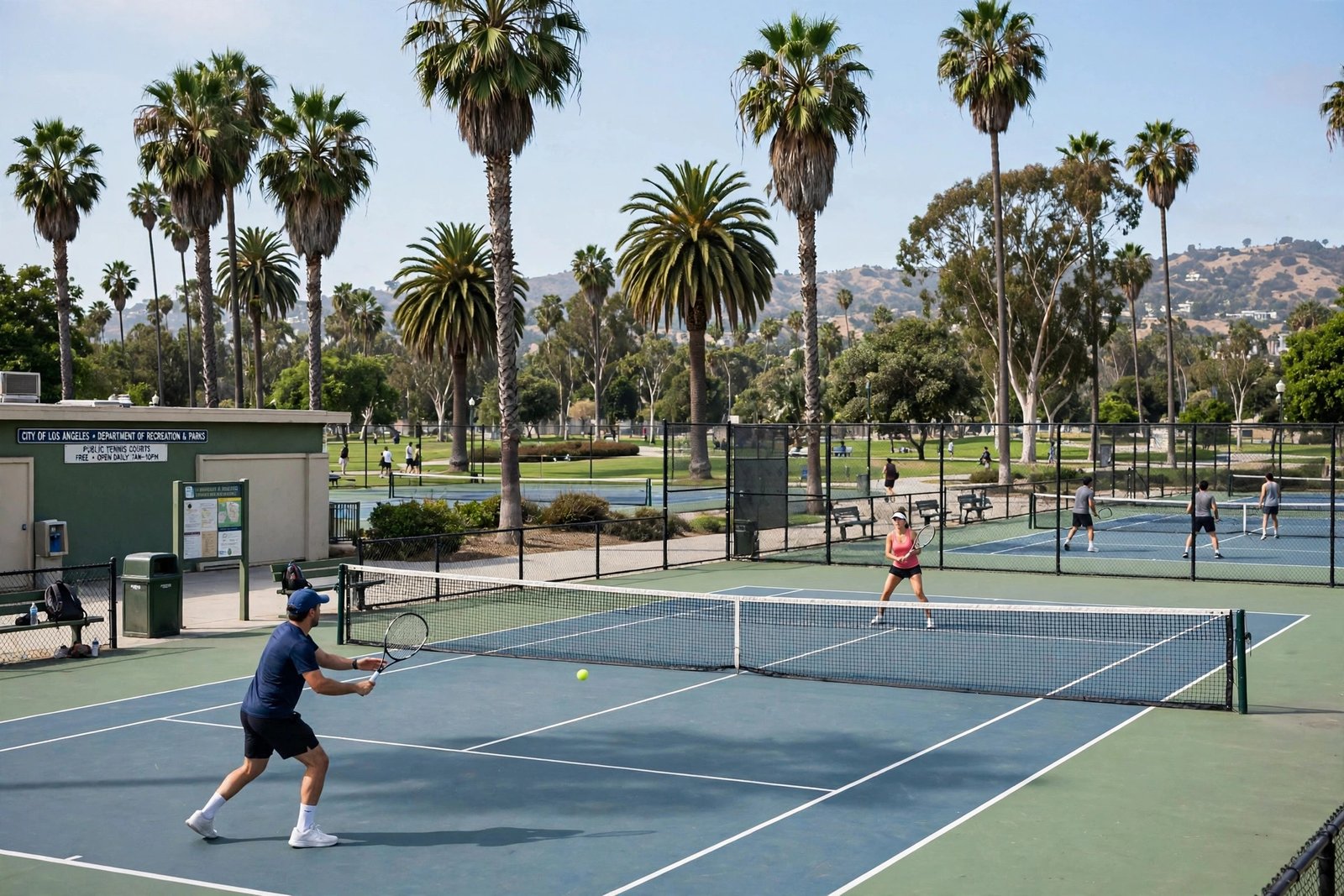
Los Angeles has one of America's great public tennis systems — hundreds of free courts scattered from the Valley to the beach, playable year-round in weather the rest of the country envies. But 'free' comes with its own rules: first-come dynamics, unwritten etiquette, and peak-hour competition for court time.
Here's how to navigate LA's public courts like a local: finding them, securing time, and playing without committing the faux pas that mark you as a newcomer.
Finding Courts: The Best Free Options
LA's Department of Recreation and Parks operates 100+ tennis facilities, many completely free. Standouts include the historic courts at Griffith Park (Riverside Drive), Pan Pacific Park in Fairfax, Stoner Park in West LA, and the beach-adjacent courts at Venice and Santa Monica. The city's tennis court map on laparks.org lists locations, court counts, and lighting — filter for lighted courts if you play after work.
Beyond city courts, LA County parks add more options, and many high schools open courts to the public outside school hours (check posted signs — policies vary by school). For a step up, pay-per-play facilities like the iTennis centers offer reservations and ball machines at reasonable rates. Proximity beats prestige: the best court is the one you'll actually use three times a week, so start with whatever's within 15 minutes.
The Unwritten Rules (and the Written Ones)
Public court etiquette is the real curriculum. Singles get one hour, doubles get 90 minutes to two hours when others wait — post your start time visibly if the facility uses a wait board. Never walk across someone's court mid-point; wait for a break and go around. Keep your voice down on adjacent courts, and never practice serves into an occupied neighboring court.
Ball management: call out 'ball on!' when yours rolls onto another court, and return stray balls promptly. Lessons for pay on free public courts are technically restricted at many facilities — check local rules before hiring a coach to meet you there. And the golden rule of LA public tennis: during peak hours (weekday evenings, weekend mornings), have your group assembled and ready — courts go to whoever's physically present, and hovering without players doesn't hold a court.
For official guidance, see USTA official site.
When to Play: Beating the Crowds
Peak demand hits weekday evenings (5–8 PM) and weekend mornings (8 AM–noon) — expect waits at popular facilities. The sweet spots: weekday mornings (retirees play but turnover is quick), weekday lunch hours, and weekend afternoons after 2 PM. Summer evenings stay playable until 8:30 thanks to daylight; lighted courts extend winter play.
Some facilities take reservations (often a small fee or free with registration) — learn which of your nearby courts do, because a $5 reservation beats a 45-minute wait. Off-peak also means better practice conditions: empty adjacent courts for serve practice, no pressure to rush. If your schedule only allows peak hours, develop a rotation of 2–3 facilities so a full house at one doesn't end your session.
Gear, Partners, and Leveling Up
You need less gear than you think: a decent beginner racquet ($50–$100), proper court shoes (running shoes wreck both ankles and courts), and balls. Don't overthink string tension yet. As you improve, demo racquets from local shops before buying — the right frame matters more than the expensive one.
Finding hitting partners is LA's easiest tennis problem to solve: USTA leagues (search by NTRP rating), Meetup tennis groups with hundreds of members, and park bulletin boards. Start one level below your ego's estimate — nothing kills tennis motivation like getting crushed weekly. And consider group clinics at public facilities ($15–$25/session): the cheapest coaching in the sport, and the fastest way to fix the technique flaws that solo hitting ingrains.
Learn more from LA Parks tennis court info.
Drills for Public-Court Players Who Want to Improve
Court time is precious, so practice with structure. The three highest-ROI drills for intermediate public-court players: the crosscourt rally drill (both players hit crosscourt only — builds consistency and topspin under control), the serve-plus-one (serve, then play out the point with a specific target — the most match-realistic practice in tennis), and approach-volley patterns (one player feeds, the other approaches and volleys — fixes the net game most rec players neglect).
Twenty minutes of wall practice (find a backboard at larger facilities) does more for stroke mechanics than an hour of casual rallying — the wall never misses, so your flaws surface fast. Film yourself monthly with a phone on the fence; the gap between what you feel and what you do is where improvement lives. And play practice sets with scoring consequences (loser buys the post-match tacos) — rec players who never practice under pressure wonder why their strokes vanish in league matches. Pressure is a skill; train it deliberately.
The mental game separates improving players from permanent intermediates. Public-court tennis has no coaches watching, no teammates depending on you — which means your competitive growth depends entirely on self-imposed structure. Play practice sets weekly with something at stake, enter USTA flex leagues or tournaments twice a year (the rating system gives your improvement an objective measure), and review your match patterns honestly: where do points actually end? Most rec players lose on unforced errors, not winners — the fix is shot tolerance, not shot-making.
Protect your body as volume increases: tennis elbow comes from technique flaws plus overuse (get the technique checked before buying the expensive brace), knees and ankles need proper court shoes replaced every 6–9 months of regular play, and a real warmup — 5 minutes of movement plus mini-tennis — prevents the pulled muscles that sideline weekend warriors. LA's year-round season is a gift, but year-round play without rest weeks invites overuse injuries. Schedule deload weeks; your 40-year-old self will thank you.
If this was helpful, keep reading: our guide to staying motivated to exercise and learning a new skill as a busy adult.
Playing tennis on LA's public courts is one of the city's great bargains — free year-round tennis if you learn the system. Find your nearby courts, respect the etiquette (time limits, wait boards, ball courtesy), play off-peak when you can, and plug into USTA leagues or Meetups for partners. The courts are waiting; the only thing missing is you.
Frequently Asked Questions
Are public tennis courts in LA free?
Most city-operated courts are completely free. Some facilities charge small reservation fees, and pay-per-play centers offer guaranteed court time at reasonable rates.
Do I need a reservation for LA public tennis courts?
It depends on the facility — many are first-come, first-served with wait boards during peak times. Check laparks.org for your specific courts' reservation policies.
What are the busiest times at LA tennis courts?
Weekday evenings 5–8 PM and weekend mornings 8 AM–noon. Play weekday mornings, lunch hours, or weekend afternoons for the shortest waits.
Can I bring a private coach to a public court in LA?
Many facilities restrict paid lessons on free courts — check posted rules at your specific location before arranging coaching there.