
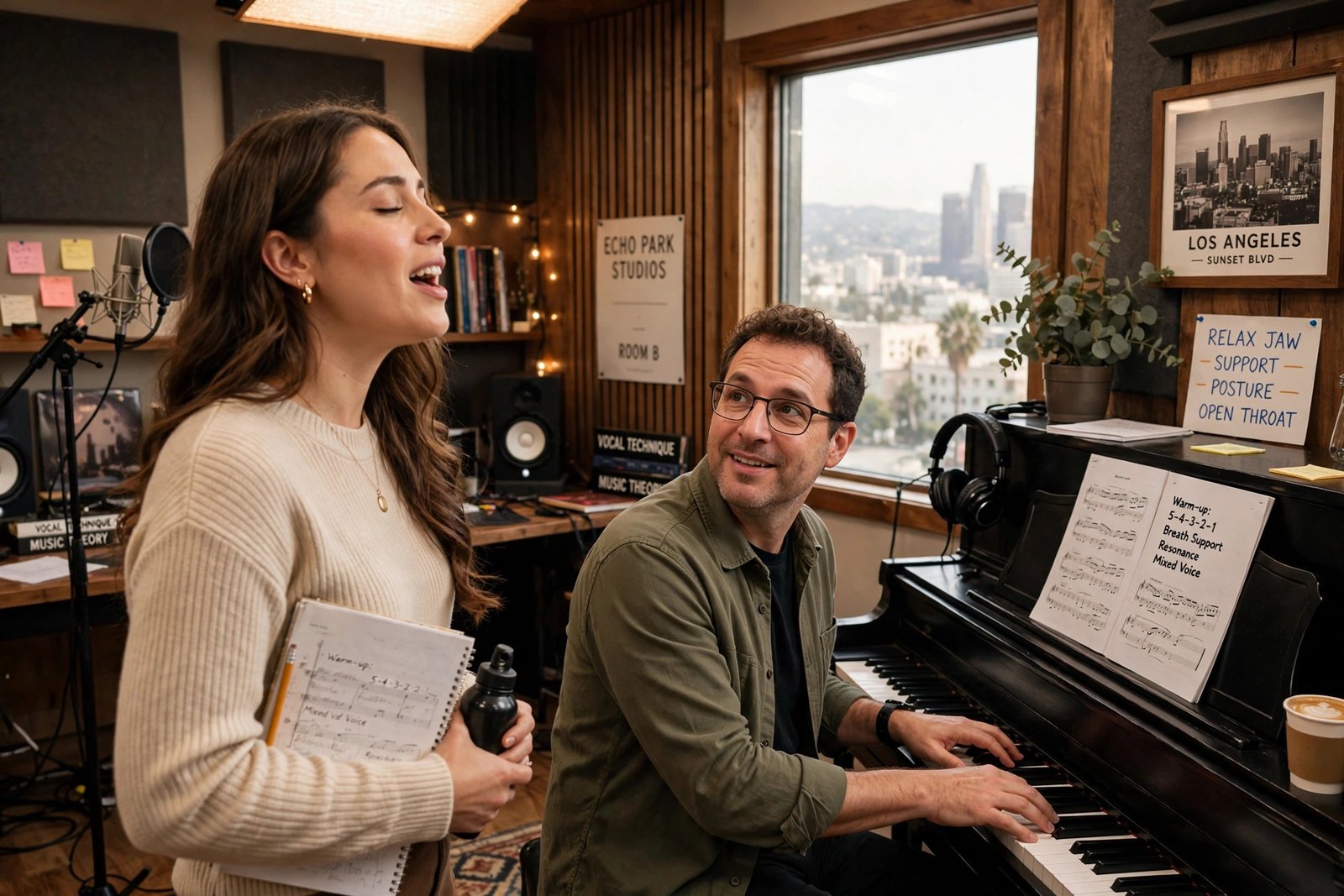
Los Angeles has more vocal coaches per square mile than anywhere on Earth — which is both the opportunity and the problem. Behind every great LA singer is a coach, but the market is flooded with Instagram-famous “coaches” whose credentials are follower counts, alongside genuine world-class pedagogues who’ve trained Grammy winners. Choosing wrong wastes money at best and damages your voice at worst. Here’s how to find a vocal coach in Los Angeles who will actually make you better.
What a Good Vocal Coach Actually Does
First, calibrate expectations. A great coach doesn’t “give” you a voice — they diagnose your instrument’s mechanics (breath support, resonance placement, registration/vocal breaks, tension patterns) and give you targeted exercises that rebuild your technique systematically. Progress looks like: expanded range without strain, consistent tone across registers, stamina for long sets, and style-specific skills (belting, riffing, classical placement). If a coach can’t explain why an exercise works in physiological terms, that’s a red flag.
Coach vs. teacher vs. mentor: the terms blur, but roughly — voice teachers build foundational technique (often classical), vocal coaches prepare specific performances (auditions, tours, recordings — the music-industry term), and mentors guide careers. In LA’s commercial music scene, you most likely want a coach fluent in contemporary styles (pop, R&B, rock, musical theater) who understands both technique and the industry’s demands.
Where to Look in LA
The established studios
LA’s renowned vocal studios (in areas like Burbank, North Hollywood, Santa Monica, and the Valley) employ coaches with verifiable track records — ask who they’ve trained, and verify it. The best studios offer trial lessons; any coach confident in their teaching welcomes evaluation. Expect $100–$300/hour at top studios, $60–$120 at solid independents.
Referrals from the industry
The most reliable path: ask working singers, music directors, and producers who they use. LA’s music community is tight — a recommendation from someone whose voice you admire outweighs any advertisement. Local live music events are where these conversations happen naturally; the green room and the bar after the set are LA’s real talent marketplaces.
Online platforms (with vetting)
Platforms like TakeLessons and Thumbtack list LA vocal coaches with reviews — useful for discovery, but vet ruthlessly: check credentials, request trial lessons, and beware review inflation. Backstage (the industry’s casting and services bible) also lists coaches with entertainment-industry context you won’t find on generic platforms.
Music schools and universities
USC Thornton, UCLA Herb Alpert, CalArts, and LA College of Music employ world-class voice faculty — many teach privately or can refer you to trusted colleagues. University-affiliated coaches bring pedagogical rigor that’s often missing in the influencer-coach market.
How to Vet a Coach (The Trial Lesson Test)
Book trial lessons with 2–3 coaches before committing — this is standard practice, not rudeness. During the trial, evaluate: Do they listen first? (a good coach assesses your voice before prescribing — beware instant diagnosis). Can they explain the physiology? (“engage your diaphragm” is vague; specific muscular guidance is real teaching). Do the exercises make immediate sense? (you should feel something working correctly, even in lesson one). Do they push without straining you? (any pain, hoarseness, or discomfort after a lesson is a hard stop — vocal damage is real and sometimes permanent).
Red flags: guarantees of stardom or rapid transformation, no interest in your goals or genre, one-size-fits-all exercises regardless of your voice, discouraging medical evaluation of vocal issues (see an ENT/laryngologist for persistent hoarseness — coaches aren’t doctors), and pressure to buy large lesson packages before you’ve had three sessions. Green flags: they ask about your goals and history, they explain the why behind exercises, they give you recorded practice routines, and they’re honest about timelines (real technique change takes months, not weeks).
What It Costs and How Often to Go
Pricing: $60–$120/hour for solid independent coaches, $150–$300+ for elite studio coaches and celebrity trainers. Frequency: weekly 60-minute lessons are the standard for serious progress; biweekly works for maintenance. Packages: monthly packages (4 lessons) typically save 10–15% — buy them only after 3+ successful individual sessions. Budget reality: $240–$480/month for weekly lessons is typical for committed students — factor it like any serious training investment.
Maximizing value: practice daily between lessons (30 minutes of focused exercises beats 3 hours weekly — the lesson guides, the practice builds), record every lesson (most coaches allow it; review the exercises during the week), and come with questions (the prepared student gets 2x the value). A coach who assigns structured homework and checks it is worth more than a famous name who wings it.
And keep developing as a complete musician alongside the technique — discovering new music beyond algorithms expands the stylistic vocabulary your coach can help you master.
Online vs. In-Person in 2026
Post-pandemic, elite coaching is genuinely available over video — many top LA coaches now teach hybrid schedules, and for technique work (as opposed to performance coaching), video lessons work well: the coach hears and sees enough to diagnose, and you save LA commute time. In-person wins for: initial assessment (subtle physical cues matter), performance/audition coaching (room presence doesn’t translate fully on video), and recording-session preparation. Video wins for: ongoing technique maintenance, scheduling flexibility, and accessing coaches outside your neighborhood. Many students do both — in-person monthly, video weekly.
Warning Signs of Vocal Damage (See a Doctor, Not a Coach)
Coaches build technique; doctors diagnose injury — know the boundary. See an ENT/laryngologist promptly for: hoarseness lasting more than two weeks, pain when singing or speaking, sudden loss of range, a breathy or rough voice that doesn’t resolve with rest, or any vocal change after illness or trauma. LA has world-class laryngologists who work with professional singers; a stroboscopy exam visualizes the vocal folds directly and is the gold standard for diagnosis.
Common singer injuries: vocal nodules (calluses from misuse — usually reversible with therapy and technique correction), polyps (often requiring surgical removal), hemorrhage (a burst blood vessel — absolute voice rest, then medical evaluation), and muscle tension dysphonia (functional, treatable with specialized speech therapy). The rule: a good coach refers out at the first sign of medical issues rather than coaching through them — any coach who tells you to push through pain is dangerous. Your voice is a physical instrument with limits; respecting them is what allows a 40-year career instead of a 4-year one.
Conclusion
Finding a vocal coach in Los Angeles means: knowing you want technique-building (not just cheerleading), sourcing through industry referrals and vetted platforms, trial-testing 2–3 coaches on their diagnostic skill and physiological explanations, watching for red flags (guarantees, pain, package pressure), and committing to weekly lessons with daily practice. In the world’s most competitive singing market, the right coach isn’t a luxury — it’s the difference between potential and profession. Choose with the seriousness your voice deserves.
Frequently Asked Questions
How much do vocal coaches cost in Los Angeles?
$60–$120/hour for solid independents, $150–$300+ for elite studio coaches. Weekly lessons typically run $240–$480/month; packages save 10–15% after you’ve vetted the coach.
How do I know if a vocal coach is good?
They listen before diagnosing, explain exercises physiologically, produce noticeable (if small) improvement in the trial lesson, never cause pain or hoarseness, and are honest about timelines. Trial 2–3 coaches before committing.
How often should I take voice lessons?
Weekly 60-minute lessons for serious progress, biweekly for maintenance. Daily 30-minute practice between lessons matters more than lesson frequency alone.
Can I learn singing from online vocal coaches?
Yes for ongoing technique work — many elite LA coaches teach hybrid schedules. In-person is better for initial assessment and performance/audition coaching. Many students combine both.
What’s the difference between a vocal coach and a voice teacher?
Roughly: voice teachers build foundational technique (often classical), vocal coaches prepare specific performances and work in commercial styles. In LA’s music scene, you typically want a coach fluent in contemporary genres.